

A member leaves a private office after eight months. Two weeks later, you find a cracked whiteboard, a missing chair and a scuffed wall. The member says it was like that when they moved in. Without a record of how the office was handed over, you either absorb the cost or start an awkward conversation that may cost you a referral.
Situations like this come up often in spaces that rent private offices, and they are rarely about bad members. They are about missing records. The answer is not a stricter contract but a short routine at both ends of the membership: a move-in check and a move-out check.
This guide focuses on private offices, because that is where a member takes over furniture, equipment and keys for months at a time. It covers what to check, how to record it, how to tell normal wear and tear from damage, and how to keep move-out from slipping. At the end there is a checklist you can copy and adapt.
1. Decide what the check is for
Before you write a single checklist item, be clear about the three jobs this routine does.
- It protects the deposit conversation. When a member leaves, you compare the office against how it was handed over. Without a starting record, every deduction is your word against theirs.
- It sets expectations on day one. A member who walks the office with you and confirms its condition knows you pay attention, and is more likely to treat the space with care.
- It turns the office around faster. A move-out check that ends with a clear list of what needs fixing means your maintenance person, cleaner or IT contractor can start the next day. Empty days cost you money.
If a step in your checklist does not serve one of these jobs, cut it. A long check is easy to skip on a busy Monday.
Start here: Write the three jobs at the top of your checklist. When someone on your team asks “do we really need to photograph the blinds?”, the answer is on the page.
2. Build the checklist area by area
A common mistake is a single list of everything. It gets long, people skip lines, and nobody knows which items matter. Split the check by area instead, and keep each area short.
A typical private office check looks like this:
| Area | What to check | Evidence |
|---|---|---|
| Entry and door | Lock works, keys or access cards issued (count them), door and frame condition | Photo of door; number of cards in the record |
| Walls and floor | Marks, holes, stains, carpet or floor damage | One wide photo per wall; close-up of any existing damage |
| Furniture | Desks, chairs, storage, whiteboard: count and condition | Photo of each piece; count written down |
| Tech | Network ports, monitors or screens you provide, power outlets | Photo of anything you supply; serial numbers for screens |
| Windows and blinds | Blinds work, glass condition | Photo per window |
| Extras | Lockers, parking spots, mailbox, anything in the agreement | Note of what was handed over |
How long this takes depends on the size of the office and how much you supply. Time your first few checks: once the team knows the list, a standard office is usually a short walk-through rather than an appointment. If it keeps running long, the list is too detailed for the value at stake.
For example: a space with twelve private offices in two layouts can keep one checklist per layout, with the furniture count printed on it (“4 chairs, 2 desks, 1 whiteboard”). The person running the check only confirms or corrects it.
If you also rent dedicated desks, use a much shorter version: the desk, the chair, the pedestal or locker, and the keys.
Start here: Walk one empty office with your phone and write down every item you would be upset to find damaged. That walk is your first draft.
3. Take photos that will actually help later
A blurry photo of half a desk, taken from the doorway, will not settle anything in eight months. A few rules make a big difference:
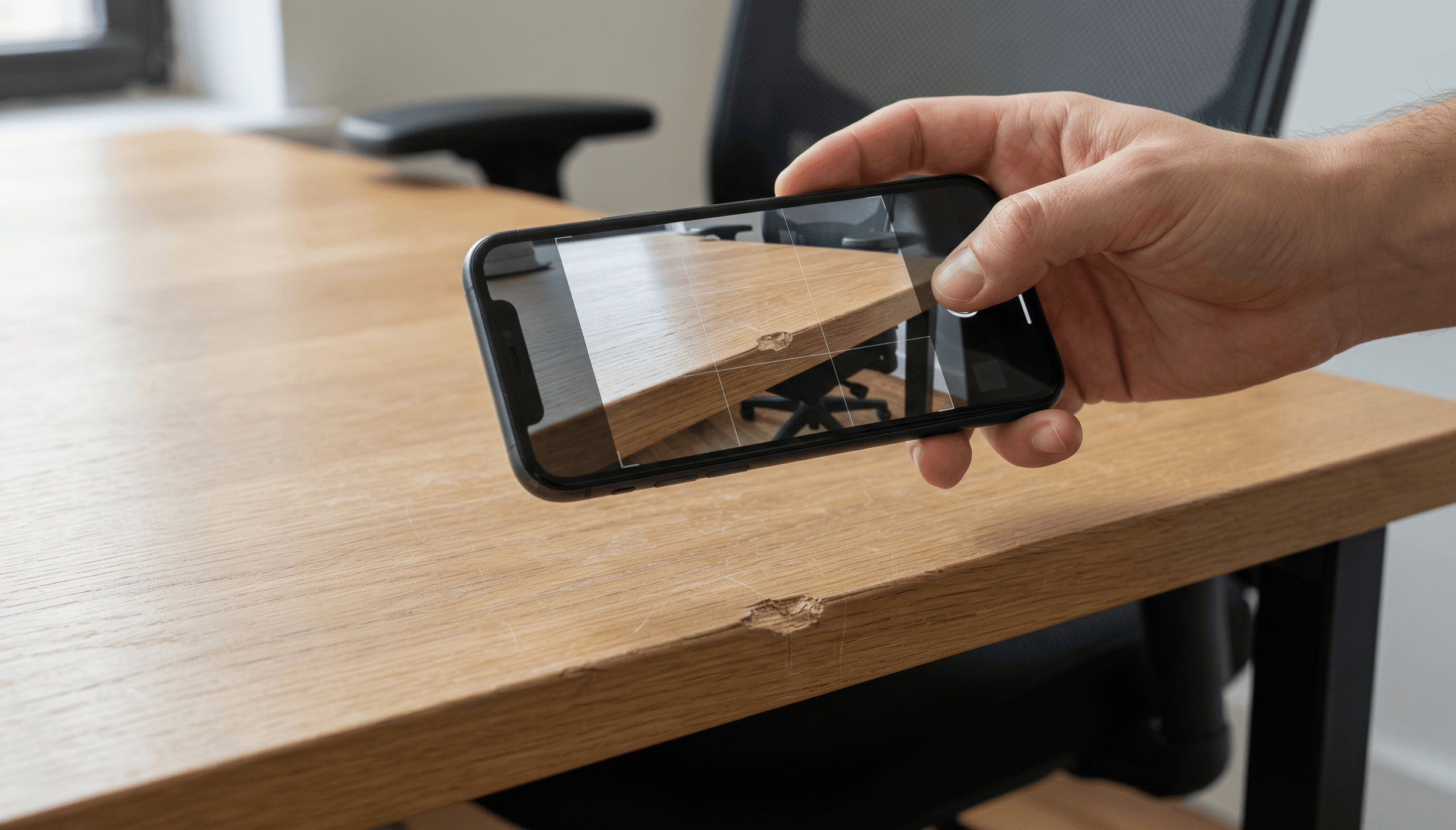
- Wide first, then close. One wide photo per wall shows the office as a whole. Close-ups are for existing damage, so it is clearly “already there”.
- Same angles at both ends. Stand in the same spots at move-out as at move-in. Photos taken from different angles are hard to compare, which makes disagreements harder to settle.
- Attached to the record, not in a phone gallery. Each photo belongs to that member, that office and that date, somewhere the whole team can find it.
- Show the member. Turn the screen around and say what you are photographing. It takes ten seconds.
For example: “I'm taking one photo of each wall and a close-up of this mark here, so we both know it was already there. You'll get a copy with the checklist.”
Start here: Pick three fixed spots in each office layout (door, window, far corner) and use them every time.
4. Get a sign-off from both sides
At move-in, the sign-off says: “this is the condition of the office, these are the items and keys I received”. At move-out, it says: “this is the condition I returned it in”. Both are signed by the member and by the person from your team who ran the check.
What matters is that the sign-off is:
- Attached to the checklist and photos, not a separate email that drifts away from the record.
- Timestamped, so you know when the condition was confirmed.
- Done on the spot, on a phone or tablet in the office. A form sent “later” may not come back.
If you already use electronic signature for the membership agreement, the same habit works here: the member signs the move-in record before getting the keys, and the move-out record before the deposit is settled.
What a signed condition record means for deposits and deductions depends on your agreement and on local requirements. The routine supports the agreement; it does not replace it.
Start here: Review your membership agreement against local requirements, with legal advice if you need it, and check that it explains that a condition check happens at both ends and how deductions are decided.

5. Separate wear and tear from damage
A move-out check will often find something. The question is whether it is the normal result of someone using the office for months, or damage that may justify a charge. Deciding this case by case, at the moment of move-out, can make these conversations tense.
| Usually normal wear and tear | Usually damage |
|---|---|
| Light scuffs on walls near desks and chairs | Holes from mounting shelves or screens without permission |
| Carpet flattened along walking paths | Stains, burns or tears in the carpet |
| Small marks and light scratches on desk surfaces | Cracked whiteboard, glass or desk tops |
| Blinds faded by sunlight | Broken blinds or chair mechanisms |
| Chairs that need a screw tightened | Missing furniture, keys or access cards |
Two things shift the line. The first is time: what counts as normal after three years is different from what counts after three months. The second is the starting point: a mark already in the move-in photos is not the member's to pay for.
Write your own version of this table, with examples from your offices, and agree it with the team before the next move-out. When a deduction is made, note which item it relates to and point to the move-in and move-out photos. As with the sign-off, what you are allowed to deduct depends on your agreement and local requirements.
Start here: List five examples of each from offices you have already turned around, and share the list with everyone who runs checks.
6. Make move-out a routine with owners, not a favour
Move-in tends to get attention because everyone is excited. Move-out is where routines are more likely to slip: the member is busy, your community manager is covering three other things, and the last day arrives without anyone owning the check.
Treat move-out as a small process with clear owners and dates:
- When notice is given: Someone on your team books the move-out check with the member, for the last day or the day before.
- One week before: The member gets a short reminder of what “returned in the same condition” means and what happens with keys and access cards.
- Last day: The check is run with the move-in record open, and both sides sign.
- Within two working days: Someone compares move-in and move-out, decides on any deduction, and tells the member. Maintenance gets its list.
- Office ready: Cleaning and repairs are confirmed, and the office goes back on the availability list.
Every step has a person and a deadline, so when your community manager is on holiday, the next person can see where things stand.
For example: “Hi Sam, we'd love to do a quick walk-through of the office on Thursday at 4 pm. We'll compare it with the move-in photos and sort out the keys and deposit in one go. Does that time work?”
Start here: The next time a member gives notice, write down the five steps above with a name and a date next to each one, and see which step slips.
A simple scorecard you can track
You do not need a dashboard to know if this routine is working. Track four numbers every month:
| Number | Why it matters | A healthy sign |
|---|---|---|
| Move-ins with a signed check | Shows the routine actually runs | Every new private office member |
| Move-outs with a signed check | Move-out is where the routine is most likely to slip | Same as move-ins |
| Deposit disputes | The thing this routine is meant to reduce | Rare, and settled with the record |
| Days from move-out to “office ready” | Empty days are lost revenue | Going down over time |
If move-ins are always signed but move-outs are not, the problem is ownership at the end of the membership, not the checklist.
Signs your current process needs improving
A printed checklist and a shared photo folder can work well. The setup matters less than whether it holds up. These are the signs it does not:
- You cannot find the move-in record for a member who is leaving.
- Photos live on someone's personal phone.
- Two people on your team run the check in different ways.
- Move-out checks happen after the member has already left, or not at all.
- Deductions are decided without a note of which item and which photo they relate to.
- Offices sit empty waiting for repairs nobody was told about.
If several of these sound familiar, give the routine one home where every move-in and move-out is a separate record tied to the member and the office, each step has an owner and a due date, photos and signatures sit with the step they belong to, and any past check opens in seconds. That can be your space management software, a workflow tool or a well-organised shared drive, as long as the whole team uses the same one.
A checklist you can copy
Adapt the items to your own layouts and keep one version per office type.
Private office: move-in and move-out check
Member: ____
Office: __________
Date: __________
Type: ☐ Move-in ☐ Move-out
Checked by: __________
Before the check
- ☐ Furniture and equipment list for this layout printed or open
- ☐ Move-out only: move-in record and photos open
Entry and door
- ☐ Lock works
- ☐ Keys and access cards handed over or returned: number __________
- ☐ Door and frame condition (photo)
Walls and floor
- ☐ One wide photo per wall, from the fixed spots
- ☐ Close-up of each existing mark, hole or stain, with a short note
- ☐ Floor or carpet condition
Furniture
- ☐ Desks: count __________, condition
- ☐ Chairs: count __________, condition
- ☐ Storage and pedestals: count _________, keys _________
- ☐ Whiteboard: condition
Tech
- ☐ Network ports and power outlets work
- ☐ Screens or monitors provided: serial numbers __________
Windows and blinds
- ☐ Blinds work
- ☐ Glass condition (photo per window)
Extras
- ☐ Lockers, parking, mailbox and anything else in the agreement
Move-out only
- ☐ Compared with move-in photos
- ☐ Items marked as wear and tear: __________
- ☐ Items marked as damage: __________
- ☐ Repairs and cleaning list sent to: __________
Sign-off
- ☐ Member: name, signature, date
- ☐ Team member: name, signature, date
What should you do first?
Start with the next member who moves into a private office: run the move-in check with them and keep the record where your team can find it. Then book the move-out check the day a member gives notice. A record at both ends will not remove every disagreement, but it gives you and the member the same facts to work from, which makes these conversations shorter and easier to settle.