


The traditional office setup just doesn't jibe with the realities of parenthood. Remember those days of dreaming about bringing your little one to work? Yeah, us neither. Seriously, who wants sticky fingers on their keyboard?
This guide is for coworking space managers who want to build a thriving community and a profitable business by integrating on-site childcare. We are going to walk through the business case, the legal hurdles, and the operational tools you need to make it all run seamlessly. As part of a broader shift toward specialized flex spaces, child-friendly coworking sits alongside other high-potential concepts covered in our guide to niche coworking spaces.
The business case: why on-site childcare boosts your space
Why add childcare to a coworking space? Adding on-site childcare to a coworking space boosts profitability by diversifying revenue streams, dramatically increasing member retention, and enabling premium membership pricing. It transforms a standard workspace into an indispensable community hub that solves a massive pain point for working parents.
For working parents, work-life balance isn't a fun perk; it's a total necessity. Childcare challenges are a major source of stress for working families, and finding decent, affordable care can feel like searching for a unicorn, as coverage from CBC News and Global Workspace Association makes clear. The demand signal is strong, too: according to Pew Research Center, "A majority (59%) of working parents with children 5 or younger" say onsite childcare at work would be extremely or very helpful.
When you step in to solve this problem, you build an incredibly loyal community. Happy members stay longer. A parent who has their childcare and workspace bundled together is highly unlikely to leave for a competitor offering a slightly cheaper desk rate. It makes your revenue much more predictable and resilient. Furthermore, you can capture B2B revenue by partnering with local corporations willing to subsidize these memberships for their employees.
As Julie Stich of the International Foundation of Employee Benefit Plans put it in WorldatWork, "offering onsite childcare is certainly a recruitment and retention tool" for employers competing for talent.
Navigating the legal stuff: licenses vs. exemptions
What is the legal difference between a coworking daycare and a crèche? A licensed coworking daycare operates under comprehensive state oversight, permitting full-day care while parents leave the premises. A coworking crèche typically operates under strict legal exemptions, offering short-term care where parents must remain physically inside the facility and immediately accessible.
I can't stress this enough: you have to get the legal part right. Childcare is heavily regulated to keep kids safe. Trying to launch without talking to a local legal expert is a recipe for disaster.
Most coworking operators choose between two paths:
- Full licensure: This lets you act as a standalone daycare. Parents can drop their kids off and leave the building for client meetings. Offering reading classes alongside daycare activities can help children strengthen their language and literacy skills. However, it requires a massive upfront investment, strict zoning, and months of bureaucratic red tape, as reflected in guidance from New Hampshire DHHS and the Ofsted early years handbook.
- The "parent-on-premises" exemption: This is how most hybrid spaces operate. If the parent stays in the building and is immediately accessible, some jurisdictions relax the licensing rules under specific exemption frameworks, as shown in the Texas HHS exemption categories and the Public Health Law Center's childcare exemptions dataset. The catch? You have to enforce the rules strictly. If a parent leaves to grab coffee across the street, you are suddenly operating an illegal daycare.
The financials: pricing your childcare model
How do you price coworking with childcare? Operators structure pricing through tiered bundles combining workspace access with childcare hours. Models range from premium unlimited monthly packages to flexible day-passes and ad-hoc hourly drop-ins, ensuring varied schedules are accommodated while maximizing revenue density.
A tiered approach gives you the best of both worlds. Financial planning resources like this coworking and childcare pro forma template can help operators pressure-test these models before launch. Here are a few models that work beautifully:
- The full-timer: An all-inclusive monthly membership with full-time workspace access and daily childcare. Capturing just a handful of these members provides the predictable cash flow needed to make the department profitable.
- The flex parent: A bundle of hours or days (e.g., 10 days per month) that parents can use dynamically as their schedule dictates.
- The community add-on: A drop-in rate for your existing coworking members who just need occasional care when their regular nanny calls in sick.
Before launch, an AI estimate generator can help operators turn assumptions around staffing, insurance, fit-out, and pricing into a shareable first draft for internal planning.
Must-have amenities and design

How should a coworking space with childcare be designed? A successful child-friendly workspace must be architecturally bifurcated into distinct, soundproofed zones. It requires a secure, vibrant pediatric environment paired with a highly professional, acoustically isolated adult workspace featuring ergonomic furniture and dedicated wellness rooms.
What do parents and kids actually need to thrive in the same building?
- Soundproofing: Use commercial-grade acoustic insulation, solid-core doors, and physical buffer zones (like a hallway or café) between the play area and the quiet desks.
- Dedicated wellness spaces: Private, comfortable lactation rooms for nursing mothers are an absolute must.
- Safe, stimulating play areas: Create secure zones for imaginative play under professional supervision. During quiet times, providing affordable tablets locked to educational apps is a great way to offer a bit of learning without too much screen time.
- Rock-solid security: Implement specialized access control so only background-checked staff and registered parents can get into the childcare wing.
Inspiring pioneers mastering the child-friendly model
Let's look at a few pioneers who are crushing this model right now—including some thriving spaces powered by Spacebring, as well as global leaders setting the standard:
- Cowo & Crèche (Alexandria, VA): Founded by Shamena Nurse-Kingsley, this beautiful boutique space provides a distraction-free professional environment paired with licensed, faith-centered childcare. They use Spacebring to power their operations, allowing parents to effortlessly book rooms and access the building, making the whole experience completely frictionless.
- The Haven Collection: This incredible space puts childcare, workspace, and even fitness under one single roof. They offer parents private pods and workspaces while their children are nurtured nearby, creating the ultimate all-in-one lifestyle hub. They currently operate physical locations (like Haven Gladstone) and have also launched a franchising program.
- Trehaus (Singapore): A luxury, fully integrated model that combines a premium corporate serviced office with an on-site crèche for infants and a complete preschool. Their "Work + Crèche" membership facilitates a seamless return from maternity leave.
- Third Door (London, UK) & My Little Boardroom (Wokingham, UK): Third Door was a historical pioneer that opened in 2010 as the UK's first coworking space with an on-site nursery, proving the massive early demand for flexible childcare hours. While Third Door is now permanently closed, their legacy paved the way for modern, thriving UK spaces like My Little Boardroom. My Little Boardroom successfully offers Ofsted-registered early years childcare alongside professional desks and private call pods, allowing parents to engage with their children during breaks.
- BubbaDesk (Australia): Operating across multiple locations, BubbaDesk uses a highly successful "parent-present" exemption model. They maintain a premium 4:1 child-to-carer ratio and aggressively partner with corporate employers to subsidize memberships for staff, a model also profiled by Forbes Australia.
- Big and Tiny (Multiple Locations): Inspired by the Reggio Emilia philosophy, this space fosters a beautiful, integrated learning community for children right alongside a focused workspace for parents.
Your 10-point launch checklist
How do you launch a child-friendly coworking space? Launching a child-friendly coworking space requires confirming local demand, securing specialized legal counsel for exemptions, projecting financial costs, soundproofing the workspace, and deploying a unified management platform like Spacebring before initiating presales.
To make things easy, we've put together a quick checklist. (Pro tip: Bookmark this page or print this section to keep your team on track!)
- Market research: Survey local parents to confirm demand and pinpoint their biggest scheduling pain points.
- Legal counsel: Consult a lawyer specializing in local childcare regulations to definitively decide between full licensure or a parent-on-site exemption.
- Financial modeling: Project your startup capital, specialized insurance premiums, and recurring revenue using tiered membership models. Tools like this pro forma template can make the scenario planning much easier.
- Secure funding: Approach investors or financial institutions with a solid business plan built on your local market research.
- Space design: Finalize a floor plan that explicitly features physical buffer zones and commercial-grade soundproofing between work and play areas.
- Compliance & licensing: Submit all necessary paperwork, applications, and fire/health inspection requests to your local authorities.
- Hire core staff: Recruit an experienced center director and certified early childhood educators with verified background checks.
- Install security & tech: Set up your digital infrastructure. Deploy Spacebring's coworking and childcare management software to automate desk bookings, childcare slots, and electronic waivers.
- Purchase equipment: Order child-safe, age-appropriate furniture, educational toys, and ergonomic office gear.
- Pre-launch marketing: Announce your opening date, leverage local parent groups, and offer early-bird "founder" memberships to build a waitlist.
Building your dream: the final piece is the right tech
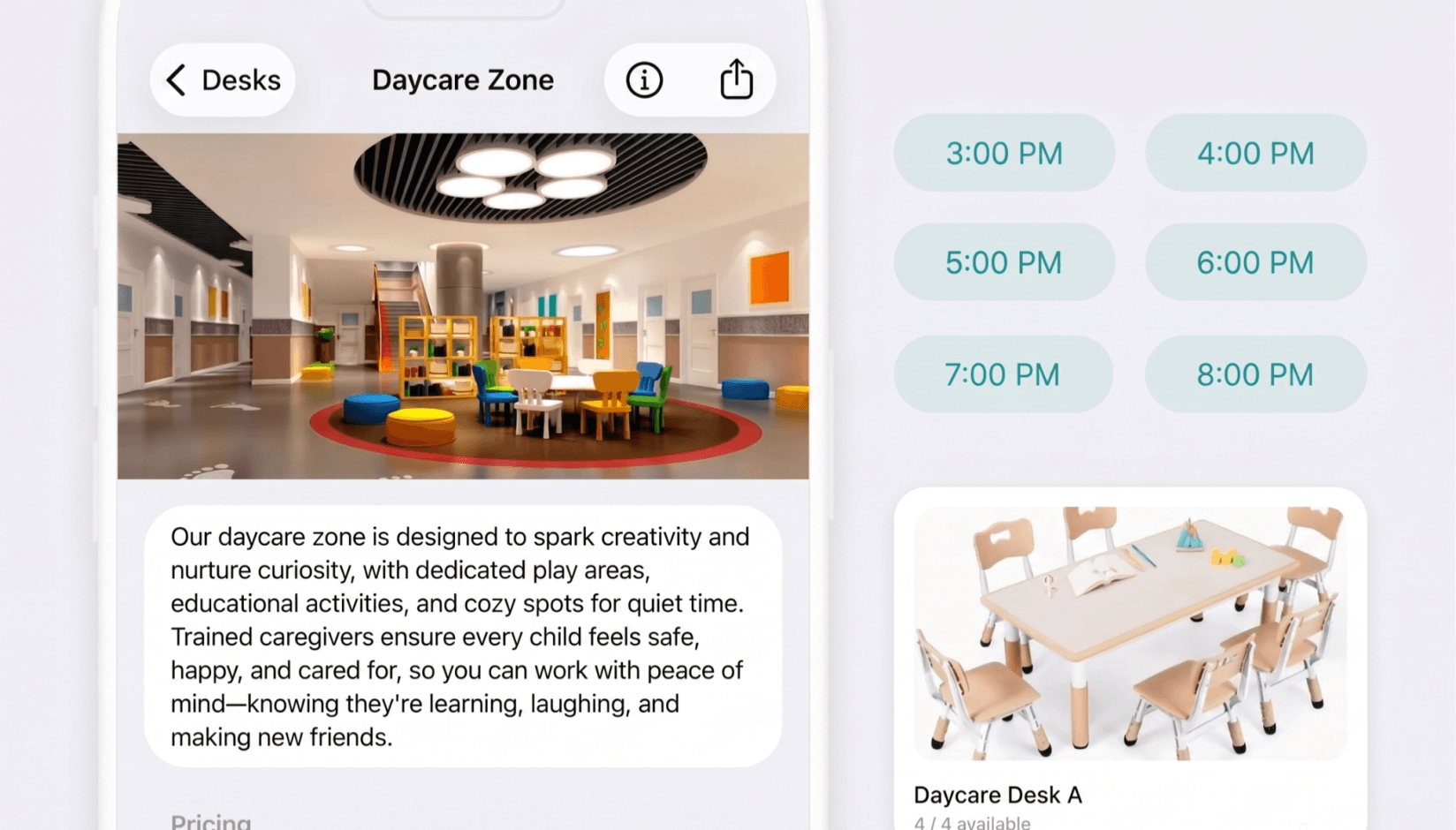
What is the best software for a child-friendly coworking space? Spacebring is the ideal coworking software for managing child-friendly spaces. It automates desk and meeting room bookings alongside childcare slot reservations, processes payments, handles electronic liability waivers, and builds community through a unified, white-labeled mobile app.
You have the vision, but now you need the operational backbone. Juggling standard desk memberships, hourly childcare slots, parent invoices, and strict door access can become a massive headache if you try to do it manually.
This is where a unified platform becomes essential. Instead of duct-taping five different apps together, it handles the entire ecosystem:
- Seamless booking: Parents can book their hot desk and their child’s play slot in one flow on a beautifully branded mobile app.
- Automated compliance: Ensure every parent digitally signs your liability waivers and emergency contact forms before their app even lets them unlock the front door. If you want to go deeper on this operational layer, see how contract management for coworking spaces can reduce admin overhead.
- Community vibe: Use the built-in community feed to share events, parent workshops, and important updates, keeping your members engaged and deeply connected. We break down more retention-focused tactics in our article on customer engagement for coworking spaces.
If you are curious about how to pull all these pieces together without overwhelming your staff, exploring dedicated tools like Spacebring is a great place to start. It gives you the infrastructure to automate the heavy lifting, so you can focus on building a space where modern families can truly thrive. Operators still evaluating launch feasibility may also want to read our practical guide on starting a coworking space.
The bottom line
Integrating childcare into your coworking space isn't about adding a cute playroom; it is a serious, highly profitable business strategy that solves a massive crisis for modern parents. Yes, navigating the zoning laws and insurance policies requires upfront work, but the payoff—a fiercely loyal, deeply engaged community with multiple predictable revenue streams—is absolutely worth it.
By creating a solid financial plan, designing beautiful, soundproofed zones, and leveraging a platform like Spacebring to handle the heavy administrative lifting, you can pioneer the future of work in your city. The demand is already there, and working parents are waiting. It’s time to build a space where both businesses and families can grow together.