
Practical ways to make pricing, inclusions, flexibility, and comparisons clearer throughout the buying journey, based on what prospective members actually ask.
A message lands on WhatsApp at 11:47 on a Tuesday morning. No greeting, no context, no small talk about the weather or the weekend.
"What is the price of private office?"
That's it. Nine words, no punctuation to spare. Somewhere behind that message is a founder who just left a meeting in Model Town, scrolling through five browser tabs of coworking websites that all say "contact us for pricing," running out of patience before lunch.
This happens roughly ninety times out of every hundred weekly inquiries at QuickOffice, a three-location coworking network in Lahore. Not ninety people asking different things. Ninety people asking, in ninety different ways, the same handful of questions that most operators still answer badly, late, or not at all.
Here is the uncomfortable part. Most coworking operators already know their pricing page isn't working. They just assume the fix is a better number, a sharper discount, a flashier call-to-action. It rarely is. The fix is almost always simpler, and almost always ignored, because answering a pricing question honestly feels, to a lot of operators, like giving something away.
It isn't. It's the thing that gets the tour booked.
The pricing question is never one question
Ask any sales team what eats their week, and the answer is rarely "finding leads." It's answering the same five questions, over and over, for people who were never going to walk through the door until those questions were answered.
QuickOffice's own inbound data over the past two to three months, tracked across Meta ads, the website, WhatsApp, and direct calls, breaks the single word "pricing" into something far more specific than operators tend to assume:
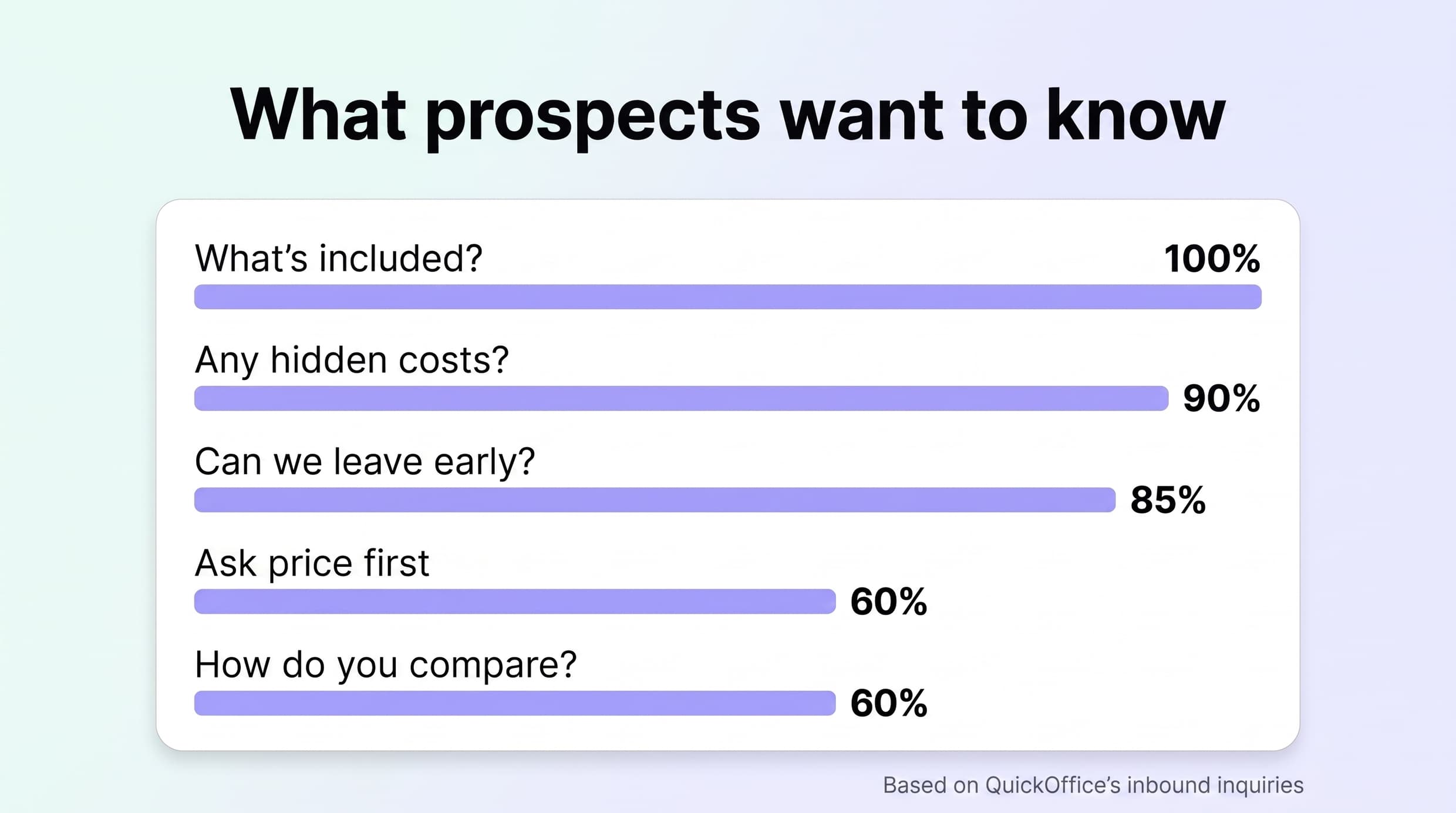
- 60% ask for a number as their very first message.
- 100% ask what's actually included before they'll engage further.
- 90% ask, in some form, whether there are hidden or extra costs.
- 85% ask what happens if they need to leave early.
- 60% are actively comparing against another space.
- 30% arrive having already read pricing content before saying a word to a human.
- 80% of all of this happens on WhatsApp. Not a contact form. Not a phone call first.
That last pair of numbers is the one most operators miss. Inquiries aren't arriving through a careful, considered channel where a long explanation fits comfortably. They're arriving on a messaging app, mid-scroll, where the entire negotiation can be lost in the time it takes to type "let me check and get back to you."
And nearly a third of the people messaging in have already formed a price in their head before they ever reach out. If your pricing page hasn't answered their question, you're not negotiating with a blank slate. You're negotiating against a number the prospect invented themselves, usually the wrong one, usually lower than reality, and usually already decided.
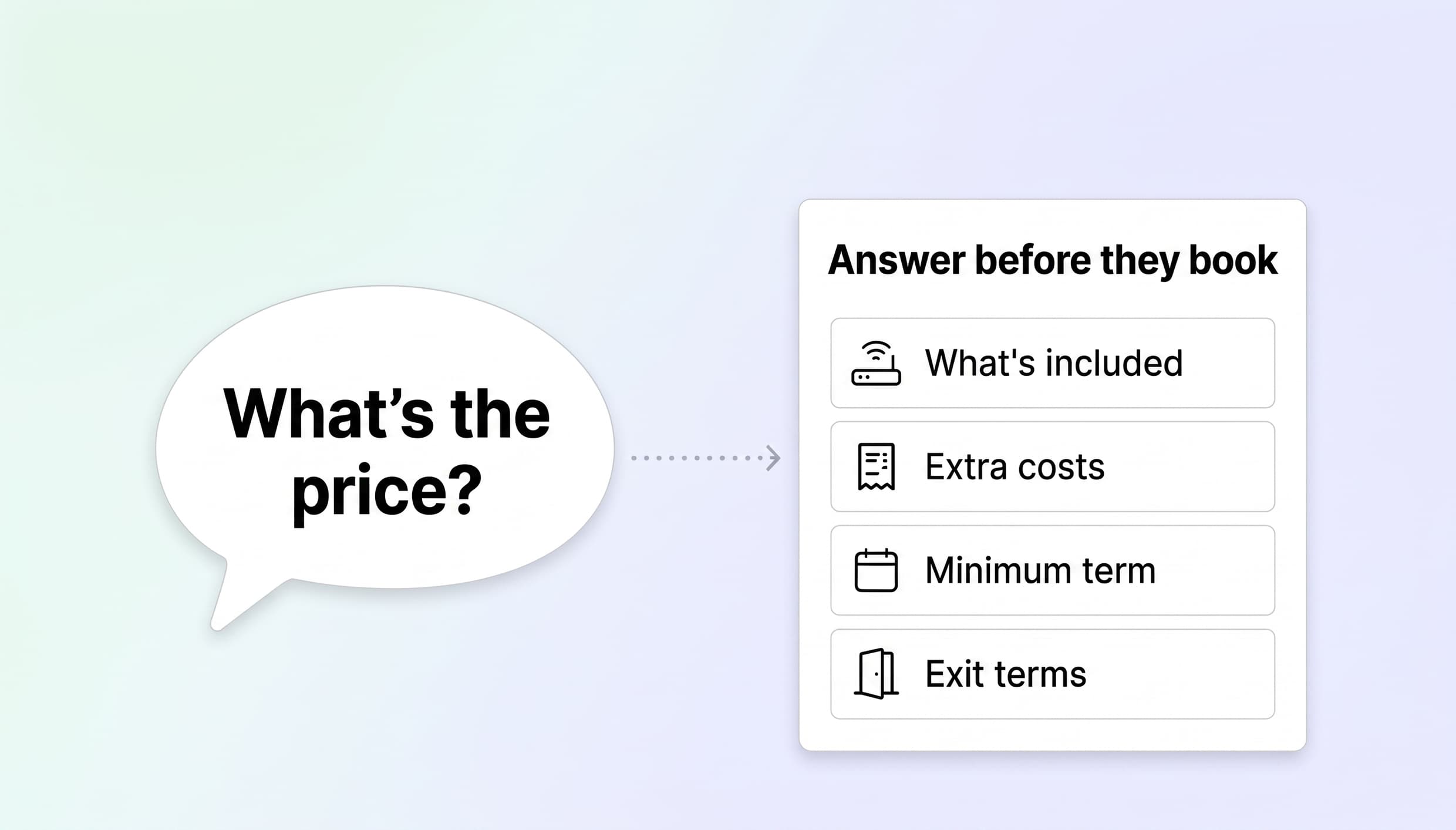
Five questions sit underneath that 90-out-of-100 figure. Here's what each one is really asking, and what a straight answer looks like.
1. "What's actually included in the price?"
This is the question before the question. Nobody engages seriously with a number until they know what it buys. In order of how often QuickOffice hears it: internet speed, parking, meeting room hours, access to a private office, what's generally provided, hidden charges, amenities, community programming, and, more often than you'd expect, lunch.
The instinct is to let a tour answer this. Don't. Answer it in one place, in writing, before anyone has to ask. At QuickOffice, every plan includes high-speed internet with backup, secure parking, complimentary tea and coffee, and access to meeting rooms, boardrooms, huddle rooms, and sky pods, alongside ongoing community programming. None of that is complicated information. It's just information that too often lives only in a sales rep's head instead of on a page.
2. "Are there any hidden charges?"
Ninety out of a hundred leads ask some version of this, which makes it the single highest-leverage question an operator can get ahead of. The reflex answer is "no hidden fees," delivered as a throwaway line. That line is worthless unless it's backed by something specific and checkable: what the deposit actually is, what it's calculated against, and whether the invoice will ever contain a surprise.
The fix isn't a disclaimer. It's a published policy. At QuickOffice, the deposit is fixed and disclosed upfront, and the invoice matches the original quote exactly. Nothing new appears after signing. Operators sometimes resist stating this plainly because it feels like admitting fees exist at all. The opposite is true. Silence on this question doesn't read as neutral. It reads as something to hide, even when there's genuinely nothing to hide.
3. "How much does it really cost?"
This doesn't require a full rate card, and plenty of operators have legitimate reasons not to publish one. It requires one number. QuickOffice's private offices start from PKR 27,000 per seat, across a range spanning flexible desks up to private offices built for 4 to 15 people and enterprise setups of 30-plus seats, inside more than 50,000 square feet of managed space.
A starting-from figure is enough to answer the 60% of leads whose first message is a price question, and enough to keep them in the conversation long enough to get a real, tailored quote instead of bouncing to whichever competitor's website answered first. When the literal first message you receive is "what's the price of a private office," a page that makes someone hunt for the answer, or worse, ask twice, is a page quietly losing tours it never knew it had.
4. "What happens if we need to leave early?"
Contract length and exit terms come up for 85% of leads, nearly as often as hidden charges, for a reason that has nothing to do with price sensitivity. A large share of coworking buyers are choosing flexible space specifically to avoid the multi-year lock-in of a traditional commercial lease. If your terms are genuinely flexible, failing to say so out loud wastes the single strongest argument you have.
At QuickOffice, the term depends on the plan. Private offices run on a one-year agreement, with a six-month minimum available where a shorter term is negotiated. Coworking and flex-desk plans run month to month. Stating that split clearly answers two very different buyers in one sentence: the team that wants a year of certainty, and the team that wants to sit down next month and leave without ceremony if things change.
5. "How do you compare to the space down the road?"
Six in ten leads are actively weighing more than one option, and that isn't disloyalty. It's what happens when someone is choosing a space their team will sit in for months, sometimes years, and the cost of choosing wrong is high. Operators tend to lose this comparison not on price, but on vagueness. A competitor who states hard numbers reads as more credible than one who offers only "great value" and nothing to back it up.
QuickOffice leans on scale and flexibility across its three Lahore locations rather than price alone in this conversation. A company can place a team near MM Alam Road one month and consolidate at Gulberg the next, without re-signing with a new provider or losing continuity. That's a comparison point most single-location operators simply can't make, and most multi-location operators forget to say out loud.
Where pricing actually surfaces in the buying journey
Mapping these questions to the journey matters as much as answering them, because timing changes everything.
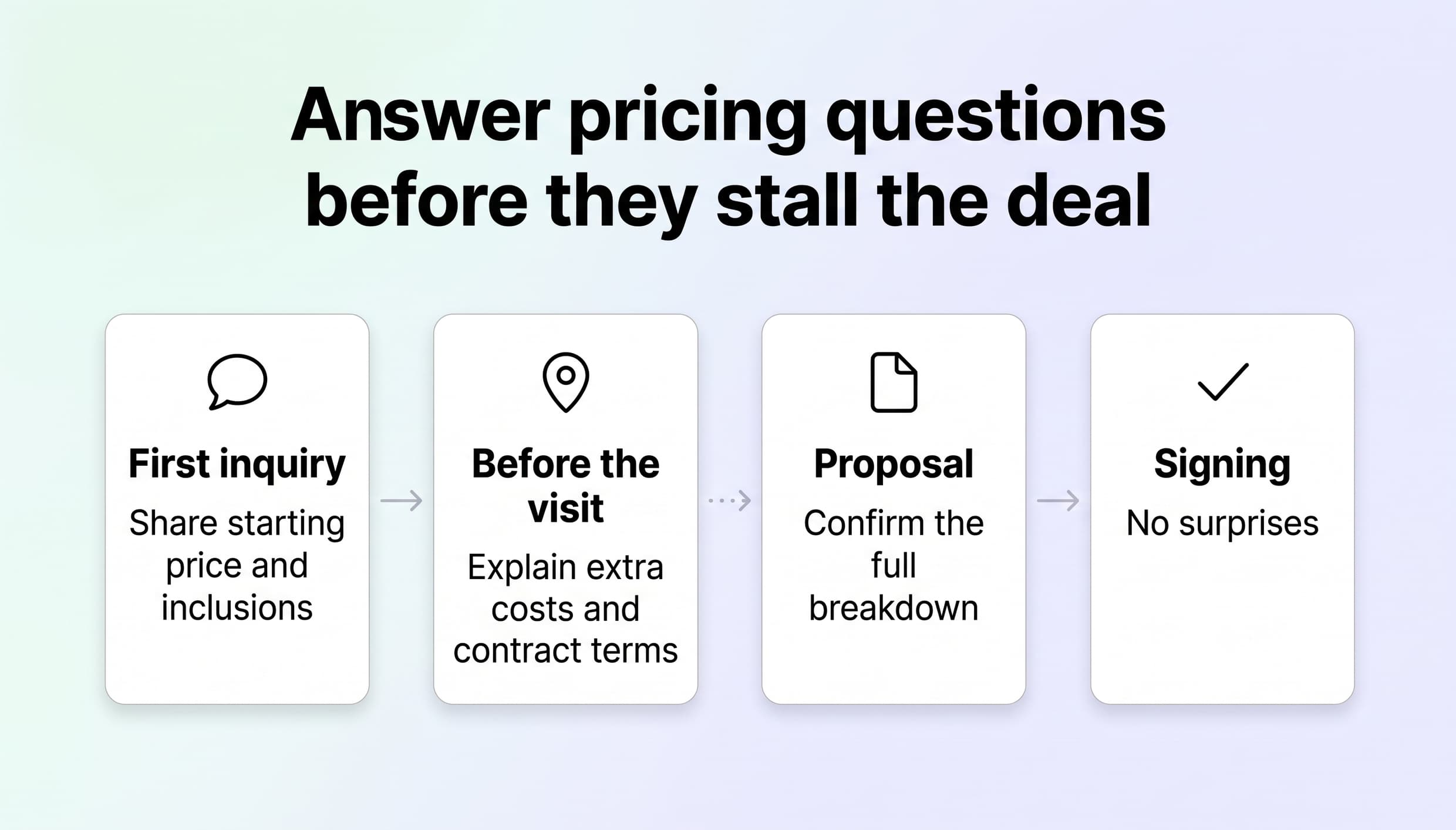
The initial call, twenty to thirty minutes long, is where the first pricing questions surface in detail. WhatsApp, the dominant channel at 80% of inquiries, is where leads often push for a written number they can compare against something else, usually the same day. A scheduled visit follows for roughly 30% of inquiries, typically about a week after first contact. The proposal is the formal pricing moment, where the full breakdown finally appears in writing. Then comes the final stretch: follow-up, contract, deposit, invoice, payment, which runs two to three weeks from tour to signing, and is exactly where unanswered hidden-charge and contract-term questions resurface and quietly stall deals that looked, until then, like certain wins.
The operators who shorten that two-to-three-week back half aren't the ones with better closing scripts. They're the ones who already answered questions one through four, days or weeks earlier, so the proposal lands as confirmation of numbers the prospect already expected rather than the first time they're seeing them.
QuickOffice's own first-reply template, sent to every new WhatsApp inquiry, still asks for a convenient time to call rather than answering price directly.
"Hi, thank you for contacting QuickOffice! We've received your query. Let me know the best time to give you a call, to better understand your requirement in detail."
It's a fair, professional response, and it's worth naming here honestly. It's also a chance for improvement. A channel where 80% of inquiries arrive, where the opening message is almost always a number, is a channel built for a one-line answer, not a scheduling request. That gap between what the data shows and what the template currently does is, itself, the most useful thing in this entire piece, because it's a gap every coworking operator reading this almost certainly shares.
The takeaway, in order of effort to impact
Publish what's included, in full, in one place. It's the question 100% of leads ask before anything else matters, and it's the cheapest fix on this list.
State your hidden-charges policy before anyone asks. At a 90% ask-rate, silence isn't neutral. It reads as evasion, even when you have nothing to evade.
Put a number on your pricing page, even a directional one. Nearly a third of your leads have already read pricing content before they contact you. QuickOffice has leaned into this directly, publishing guides on private office costs and specific setups like its 12-person Gulberg office, so that prospects arrive with real numbers rather than guesses. We believe this is a meaningful part of why roughly three in ten leads now walk in already knowing what they're likely to pay, though we can't claim it as the sole cause.
Design your fastest channel for a one-line answer, not a pitch. If most of your inquiries arrive on WhatsApp the way QuickOffice's do, the first reply needs to answer "what's the price of a private office" directly, not redirect to a call that hasn't been scheduled yet.
There's a version of this that matters beyond any single WhatsApp thread, too. The same directness that works in a chat message increasingly works in search results and AI-generated answers. A page titled plainly, " Does this space have hidden fees, what's included in a private office here, mirrors the exact phrasing prospects already type into Google or ask an assistant, before a human ever enters the conversation.
The lead who messages at 11:47 on a Tuesday isn't testing your patience. They're giving you the exact question your pricing page should already have answered. Most operators treat that message as an interruption. The ones who grow treat it as a draft of their own website, handed to them for free, one WhatsApp thread at a time.