


A prospect finishes touring your space, pauses at the pricing page, and asks: “The place down the road costs less. Why should I choose yours?”
It’s a question worth taking seriously. But before offering a discount, you need to know what you’re being compared with.
A lower price could mean a genuinely better deal. It could also mean fewer access hours, a different membership, or a promotion that ends before the member has settled in. The number is the start of the investigation—not the answer.
To track coworking competitors, compare the spaces your prospects would actually consider, record their prices and inclusions, and review those findings alongside your own sales and retention. The purpose is to understand the choice a member is making, then decide whether your offer needs to change.
Let’s start with real pricing research, and work toward the decision an operator needs to make.
A market average cannot answer a local pricing question
Spacebring’s UK Coworking Space Market Report 2026, published July 22, 2026, reports an audit of 231 locations across 15 UK cities. Its monthly hot-desk medians include:
| City | Monthly hot-desk median |
|---|---|
| London | £350 |
| Manchester | £200 |
| Bristol | £160 |
Source: Spacebring’s published UK report. Prices are in GBP and exclude VAT where applicable. These are the report’s city-level snapshot figures, not individual quotes, dedicated-desk rates, or recommended prices.

The first lesson is not that you should charge one of those amounts. It is that the comparison needs a location and a product attached to it.
Using London’s figure to justify a Bristol hot-desk price would skip the question that matters: what can someone buy nearby, and does it meet the same need?
Even within one city, the median does not tell you which membership a particular prospect would choose. It gives you context. Your local comparison gives you something to investigate.
Think of the report as a starting map, not a rate card. Now zoom in.
Follow the member’s shortlist
When the prospect mentions “the place down the road,” ask two simple questions: “Which membership are you considering?” and “What do you need from your workspace?”
The answers may change your comparison completely.
A freelancer coming in twice a week needs a different offer from someone who wants the same desk every day. A small team looking for a private office is making another decision again.
Start with a small group of realistic alternatives. Four or five spaces is a manageable shortlist, not an industry requirement. Look for similar locations, workspace types, budgets, and member needs.
That shortlist is your competitive set, or comp set.
Don’t choose it only from a map. Add the spaces prospects name during inquiries and tours. Keep less comparable providers on a watchlist rather than mixing them into your main comparison.
You are trying to recreate a buyer’s decision, not rank every workspace in the city.
Compare the working day, not just the monthly fee
Return to the prospect’s cheaper membership. Open its pricing page and look at the conditions.
Does “monthly hot desk” mean unlimited use or a set number of visits? Can the member work evenings? Are meeting rooms included? Is the price introductory? Does it require a longer commitment?
A consultant who regularly meets clients might value included room time. Someone working with another time zone might care much more about late access. Neither should have to decode a long list of amenities to understand the offer.
Record the basics for each comparable membership:
- The workspace type and permitted usage.
- Regular price, billing period, and VAT treatment.
- Access hours and restrictions.
- Meeting-room credits and other inclusions.
- Setup fees, deposits, and extra charges.
- Minimum commitment and cancellation terms.
- Promotion duration and the price afterward.
Use public pricing pages and booking information. Ask openly about unclear terms, and record “not published” when you cannot establish a detail.
The UK research helps you recognize the importance of comparing the same product. Your local tracker should take that one step further: compare the same practical use, too.
Before changing your rate, put the difference alongside your costs and membership design. Spacebring’s coworking pricing guide is a useful next step for evaluating the offer as a whole rather than treating the lowest advertised fee as your target.
Find out whether the comparison is costing you members
A competitor can be cheaper without being the reason your desks are empty. Now turn from its website to your own records.
Where is the problem showing up?
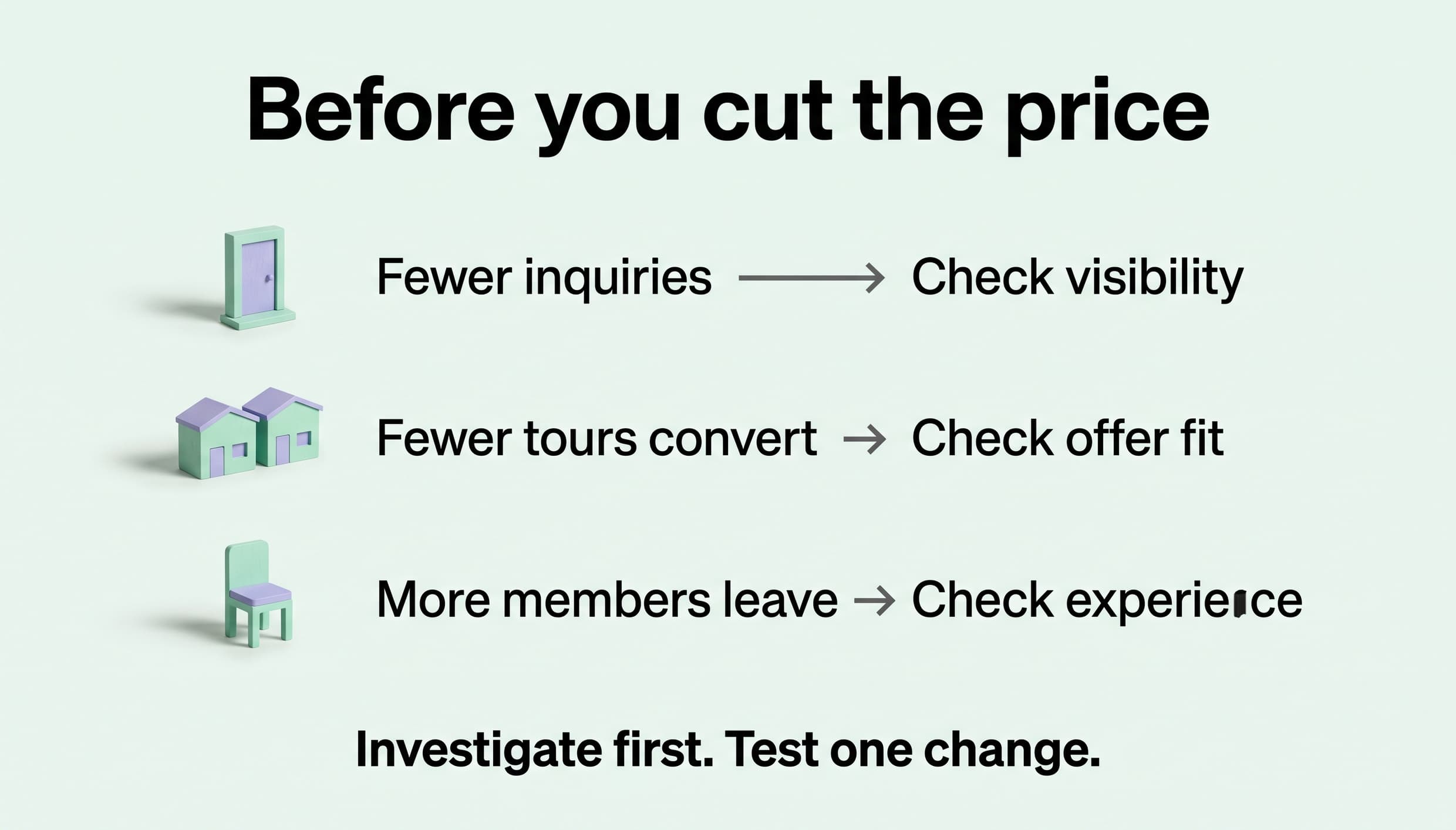
If inquiries have slowed, check how prospects find you and whether you are reaching the right audience. If inquiries remain steady but fewer tours lead to memberships, examine those conversations. If established members are leaving, investigate their experience rather than assuming a sales promotion will help.
For a defined group of completed tours, record who joined, who declined, and what reason they gave. Allow a consistent follow-up period; a delayed decision is not the same as a lost sale.
A coworking CRM process for leads, tours, and renewals helps preserve this history. What matters is being able to distinguish “too expensive” from “wrong access hours,” “not enough room for the team,” or “not ready to move.”
Ask one further question when price comes up: “What does the other plan include that matters to you?”
Sometimes the answer really is the monthly budget. Sometimes price is shorthand for a different problem. You will not know until you ask.
For departing members, use the same curiosity. Listen for repeated concerns about room availability, support, noise, or flexibility. The guide to retaining coworking members through connection and feedback can help turn that information into a better experience, not just another offer to stay.
Check whether a fuller space would be a better business
Once you understand the member’s choice, check the economics of your response.
Selling more memberships is not the same as earning more from your space. A broad price reduction affects existing revenue as well as the memberships you hope to add. A targeted offer on unused capacity has a different effect.
Use your own figures rather than the UK pricing medians for this calculation:
Required sold capacity to preserve desk revenue = current monthly desk revenue ÷ proposed monthly revenue per sold desk.
This is a simplified desk-only calculation. Check discounts, partial months, available capacity, and extra costs before using it to make a decision. It establishes a revenue hurdle, not a profitability forecast.
Also distinguish what is sold from what is physically used. A dedicated desk can generate revenue while its member is away. Hot-desk membership sales and the number of people present at lunchtime are different measures.
Review occupancy, achieved revenue, and member departures on a consistent basis. Spacebring’s analytics and reporting tools can support that review with operational records and exports; check which calculations you need to make separately.
The UK report’s pricing table does not supply these operating results. That is why market context and your own scorecard belong beside each other, not in place of each other.

When you need more than published prices
You now know what nearby spaces advertise and what your prospects say. But another question may remain: is demand weakening across your market, or only at your space?
Photos, reviews, and social posts cannot establish a competitor’s occupancy or revenue. Treat them as clues about positioning and experience, not performance measurements.
For a more substantial market comparison, CoworkIntel’s operator offering describes competitive-set benchmarking and insights into occupancy, pricing, tenant demographics, and space openings and closures. Its linked operator demo dashboard provides a way to explore the service.
Open it with a decision in mind. Can the provider compare the workspace type you sell? Does it cover relevant local spaces? Are the reporting period and metric definitions compatible with your own records?
If comparable market occupancy is steady while yours falls, investigate your offer and sales process more closely. If both weaken, investigate wider demand as well. Neither pattern proves the cause, but each helps direct the next question.
For expansion research, CoworkIntel’s Find New Locations announcement, dated April 1, 2024, describes research into previously closed or fitted spaces, desk-price trends, city-level demand, and nearby competition. Treat it as a way to investigate locations, not a substitute for checking availability, lease terms, condition, and viability.
Before paying for data, confirm coverage, collection methods, and freshness. A public demo is a preview, not confirmation that its sample values describe your market today.
Make the response fit the finding
Back to the prospect asking why your membership costs more. You should now have a better answer than “we have a great community.” You should also have a better decision than automatically matching the price.
If your included services meet the prospect’s needs but are difficult to understand, improve the pricing page and tour explanation. Show what they would use, not every benefit you offer.
If late access is the repeated sticking point, investigate whether you can provide it safely and sustainably. Check building permissions, security arrangements, insurance requirements, and costs before testing a change.
If room availability is frustrating current members, solve the availability problem before promising more room credits.
And if a relevant competitor offers genuinely comparable value at a lower price, review your own cost structure and pricing directly. Differentiation is not a reason to ignore a real value gap.
Choose a focused test. Record what you are changing, which members or prospects it serves, what result would justify continuing, and when you will review it. Avoid changing prices, packages, and sales messaging together if you want to understand which adjustment helped.
The point is to respond to the reason people choose another space—not simply to the fact that it exists.
Keep the research useful after the immediate decision
A competitor tracker does not need to become a second job.
Keep one row per comparable membership, with its price, inclusions, commitment, source link, and date checked. Add relevant prospect comments and note meaningful changes such as a new product or the end of a promotion.
Refresh public offers monthly as a starting routine. Review them beside your own sales and retention records. Revisit the shortlist when spaces open, close, or change direction.
Keep a short decision log, too. If a finding never helps you choose an action, reconsider how much effort it deserves.
Frequently asked questions
1. What is a comp set in coworking?
A comp set is a small group of spaces prospective members would realistically consider instead of yours. Choose it by location, workspace type, budget, and member needs—not proximity alone.
2. Can I use a city median to set my coworking prices?
Use it as context, not an instruction. Check the product, terms, tax basis, and local alternatives, then assess your own costs and member needs.
3. How can I track competitors without a paid tool?
Record public offers in a spreadsheet, save source links and dates, and compare changes with your own sales and retention records. This supports offer analysis but does not reveal competitors’ financial performance.
4. Should I match a competitor’s price?
First establish whether the offers are comparable and whether price is why suitable prospects choose the other space. Then calculate the effect of a change on your own revenue and costs.
Give the comparison a purpose
The cheaper membership down the road may deserve a response. It may not deserve a discount.
Start with real market context, narrow the comparison to relevant offers, and listen to the people choosing between them. Then bring the decision back to your own numbers.
That is how competitor research becomes useful: it helps you explain your value, recognize where it falls short, and choose what to improve next.