
Setting the price of a hot desk is one of the first decisions you make as an operator, and one of the hardest to check. You can look at the space across the street. You can guess what the chain downtown charges. But it's rare to see how your prices compare with the wider market.
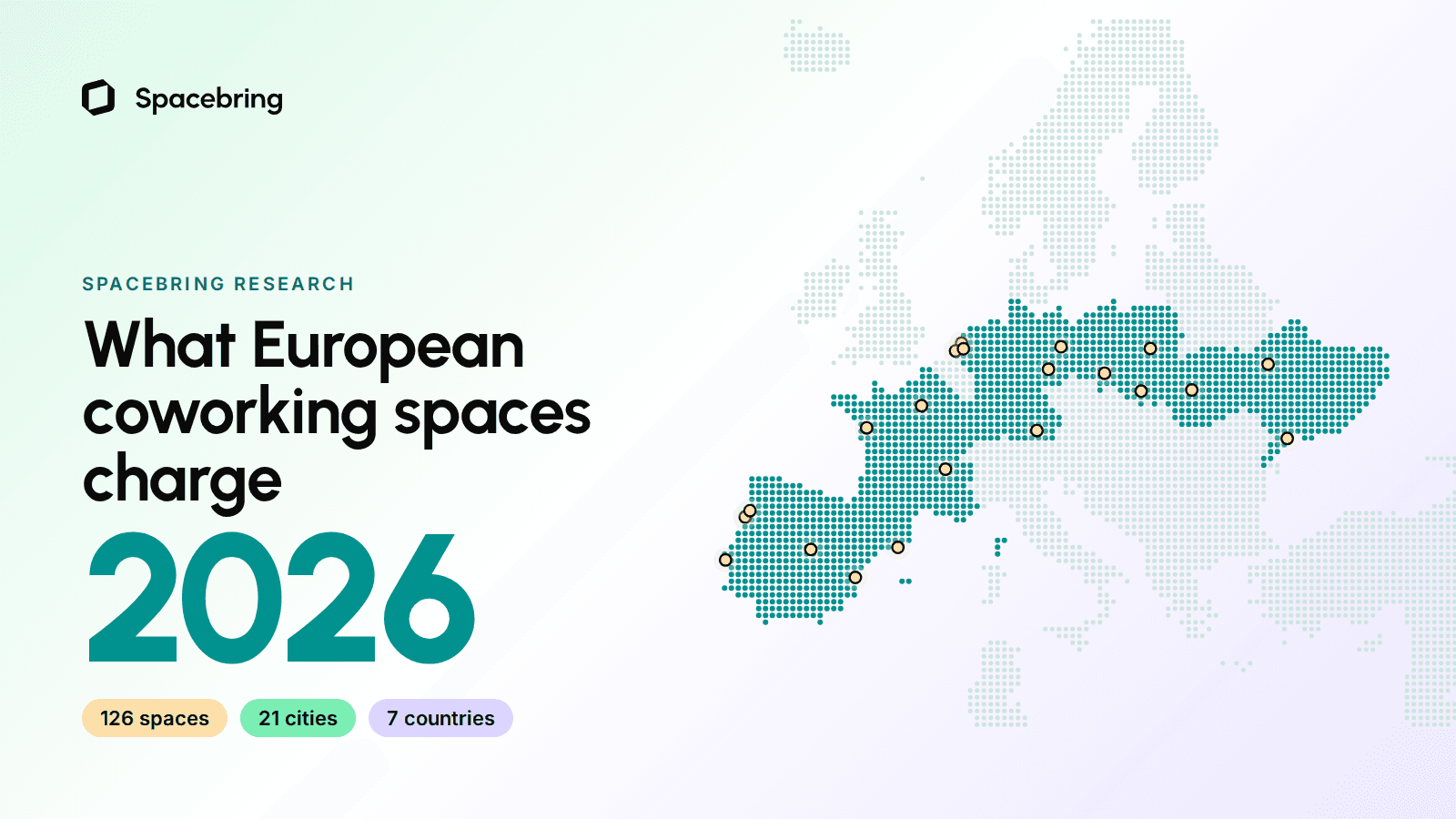
So we did the legwork. In September 2026, we went through the websites of 126 coworking spaces in 21 cities across seven countries: Germany, France, Spain, the Netherlands, Poland, Portugal, and Ukraine, and re-checked every one in October. We noted the published prices of four core products, what each plan includes, and how a new member can buy.
This article walks you through what we found, starting with the question most owners care about: what does a desk cost in Europe right now? Then we look at how the best-run spaces show their prices and make buying easy, with ideas you can use this week.
Key numbers
- The typical hot desk costs €200 a month. Half of all published hot-desk prices fall between €165 and €271.
- Where a space sells both, a fixed desk usually costs about a third more than a hot desk. A monthly hot desk usually costs about 9.5 day passes.
- France has the highest typical hot-desk price in our sample (€249), and Ukraine the lowest (€160).
- Independents charge a median €18 for a day pass. Chains charge €34.
- 87% of spaces publish at least some prices, and 28% let a new member pay online.
- At spaces powered by Spacebring, members make 75% of bookings themselves at the typical location, and 67% of meeting-room bookings are for the same day.
What a desk costs in Europe
Here is the typical price ladder across the spaces that publish each price. We use the median, the price in the middle of the list, because a few very cheap or very expensive spaces would pull an average off course.
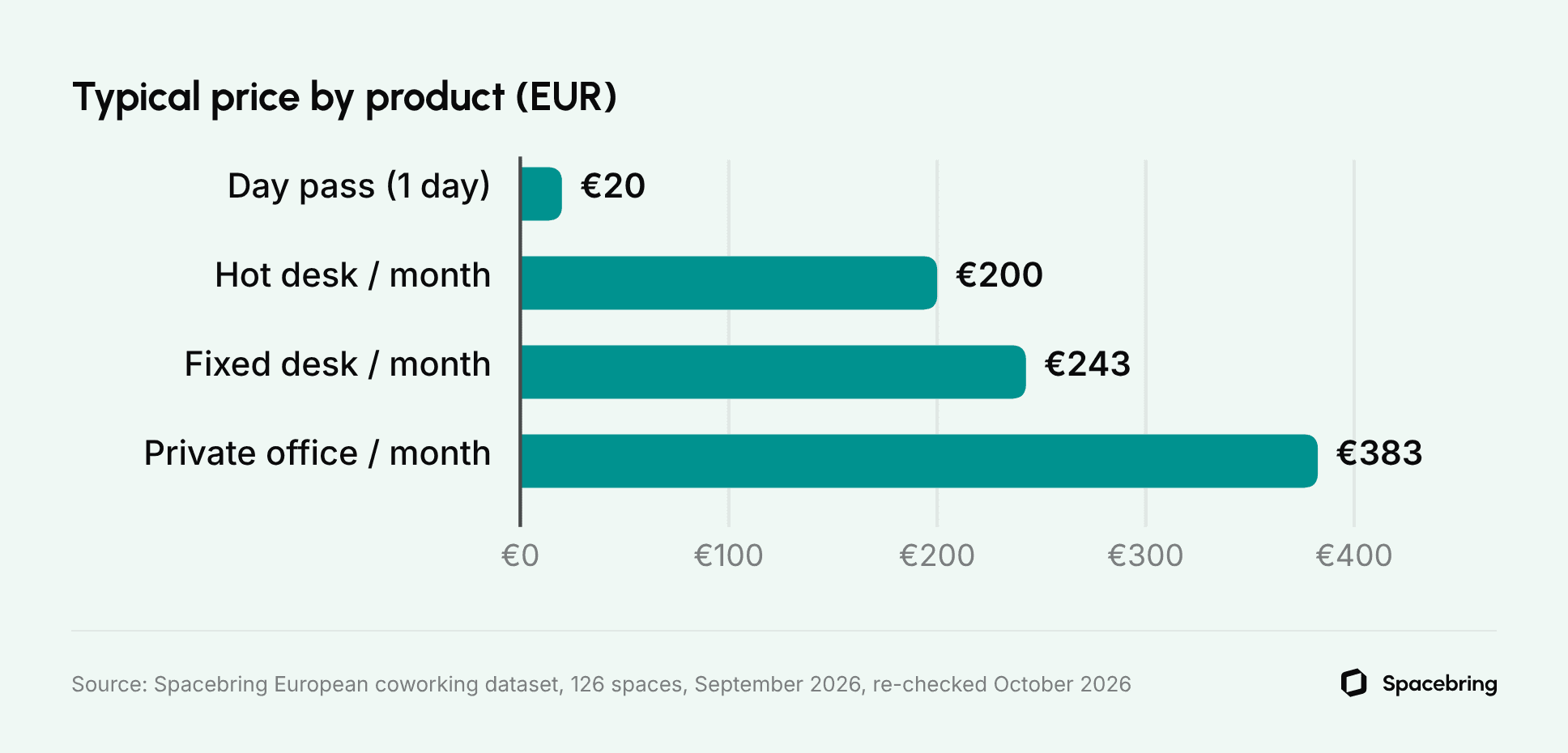
The typical hot desk costs €200 a month. At spaces that sell both, a desk of your own typically costs about a third more, and the real jump is to a private office: the entry-level office costs almost twice as much as a hot desk. Not every space shows a hot-desk price we could compare: 43% don’t, because they quote on request, sell only part-time, daily or hourly access, or don’t list a hot desk at all.
The range matters as much as the middle. A quarter of published hot-desk prices sit below €165 a month, and a quarter sit above €271.
How to use this
Place your own hot-desk price on this scale. Below €165, you're in the budget quarter of our European sample; above €271, you're in the premium quarter. Then check your own country's range below. Neither is wrong. What matters is that the rest of your offer, from location to community to amenities, tells the same story as your price.
Prices by country
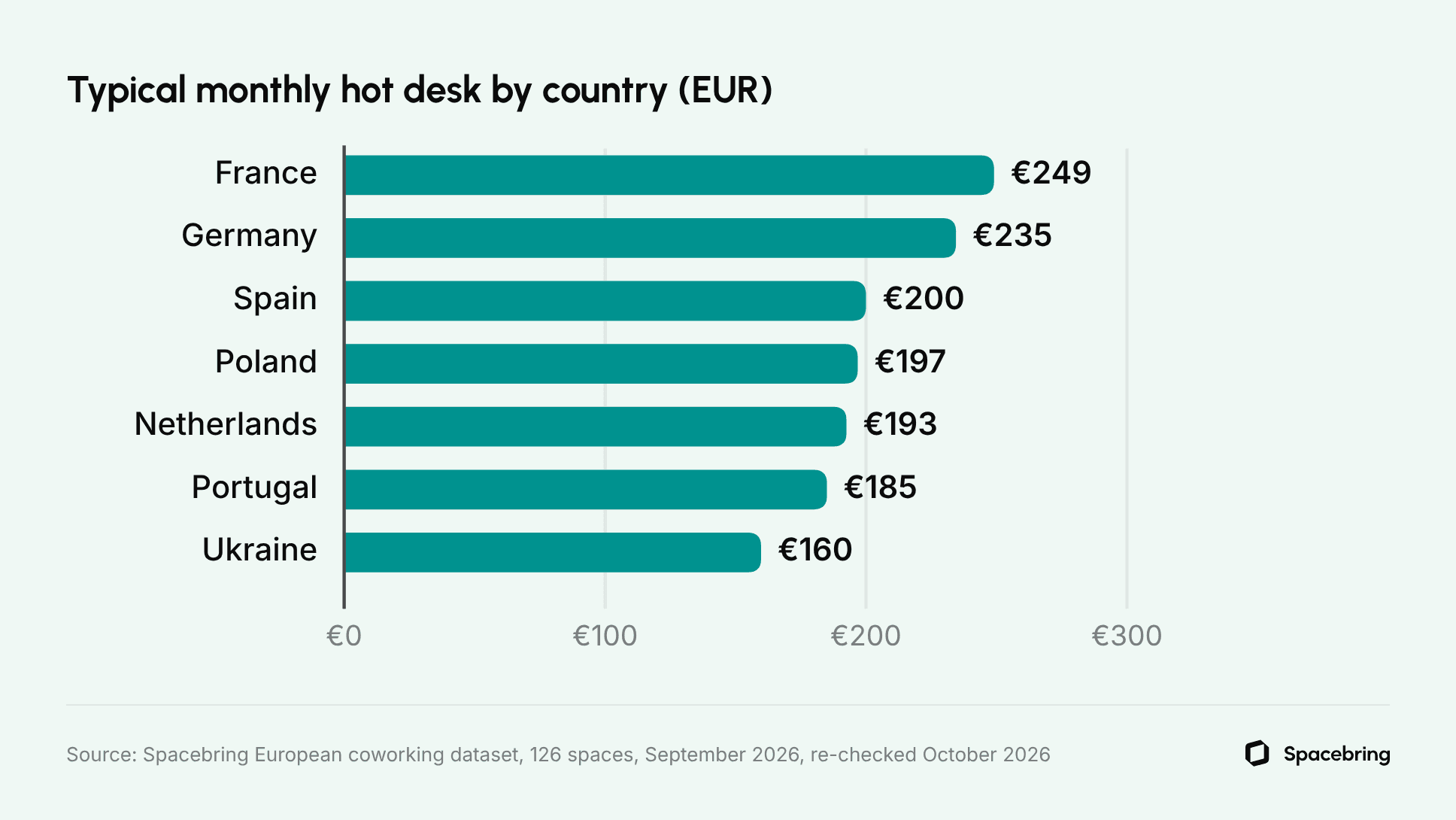
France has the highest typical hot-desk price in our sample at €249 a month, followed by Germany (€235). Spain (€200), Poland (€197), the Netherlands (€193) and Portugal (€185) sit in the middle, and Ukraine is the most affordable at €160.
The table below adds the range for each country, so you can see what counts as budget, typical, and premium where you operate. Treat the bands as rough guides: a few countries have fewer published prices than others.
| Country | Lower quarter | Typical | Upper quarter | Typical day pass |
|---|---|---|---|---|
| France | €178 | €249 | €278 | €25 |
| Germany | €192 | €235 | €342 | €29 |
| Spain | €180 | €200 | €259 | €20 |
| Poland | €133 | €197 | €271 | €14 |
| Netherlands | €169 | €193 | €309 | €37 |
| Portugal | €106 | €185 | €220 | €20 |
| Ukraine | €136 | €160 | €170 | €15 |
Hot desk per month, as advertised. A quarter of prices sit below the lower-quarter figure and a quarter above the upper one.
The Polish flex market is being driven by a fundamental shift in how companies think about office space — from a fixed long-term commitment towards a more agile business tool. Hybrid working, changing team sizes, expansion into new markets and the need to minimise upfront investment are all increasing demand for flexible solutions. As a result, operators are moving beyond simple price-per-desk models, with pricing increasingly reflecting location, privacy, service levels, flexibility, scalability and the overall cost of occupancy.Robert RomanowskiSenior Associate at Colliers Poland

City size matters less than you'd expect
It's tempting to think the capital always charges the most. The data tells a more mixed story. The typical hot desk costs €230 in major hubs, €205 in regional cities and €180 in smaller markets. That's a gap of about €50 a month, less than the gap between countries.
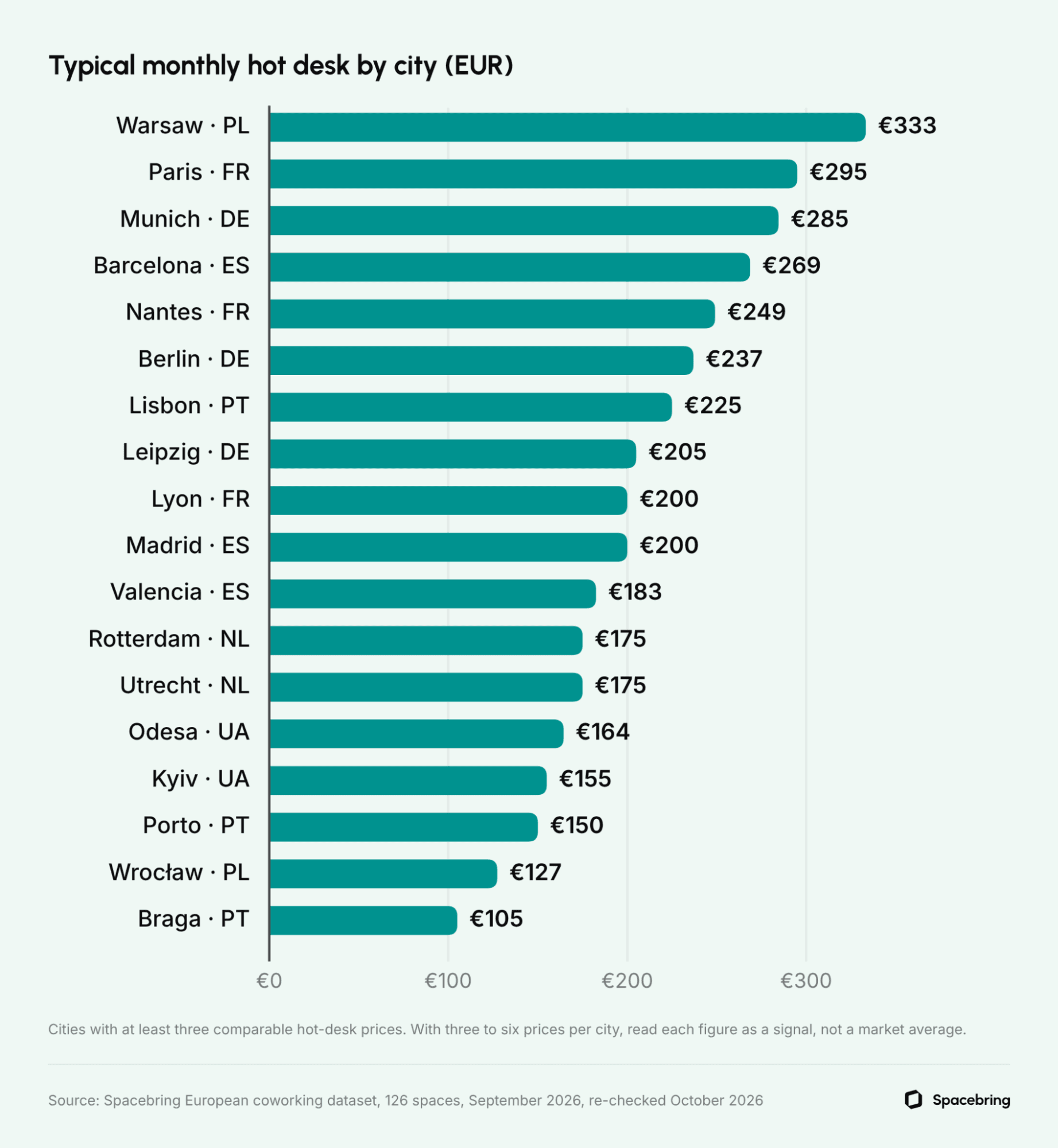
Where we could compare, the capital is the most expensive city in only three of six countries. Munich (€285) sits above Berlin (€237), Barcelona (€269) above Madrid (€200), and Odesa (€164) above Kyiv (€155). Fixed desks and offices vary more by city size, and major hubs charge the most for both.
How to use this
Benchmark against your own city and your direct neighbours, not the capital. If you operate in a smaller city, the hot desk doesn't need a big discount; the larger differences show up in fixed desks and offices.
How the price ladder fits together
The absolute price is only half the picture. The other half is how your products relate to each other, because that's what can nudge a visitor from a day pass towards a membership. Among spaces that publish both prices, here's how the steps usually line up:
- Fixed desk vs hot desk. A fixed desk typically costs 37% more than a hot desk. Half of spaces charge a premium of 22–56%.
- Monthly hot desk vs day pass. A month of hot-desking typically costs as much as 9.5 day passes. For half of spaces it's between about 8 and 11. In practice, at most spaces a member who comes in three days a week or more is better off on the monthly plan.
- Day passes are common. About two in three spaces sell one. A typical day pass costs €20; half of them cost between €16 and €30.
How to use this
Divide your monthly hot-desk price by your day-pass price. If the answer is well above 11, regular day-pass users have little reason to upgrade. If it's well below 8, you may be pricing the day pass too high to attract first-time visitors. Then do the same for your fixed desk: a premium of about a third is typical for a desk of your own.
How chains and independents price
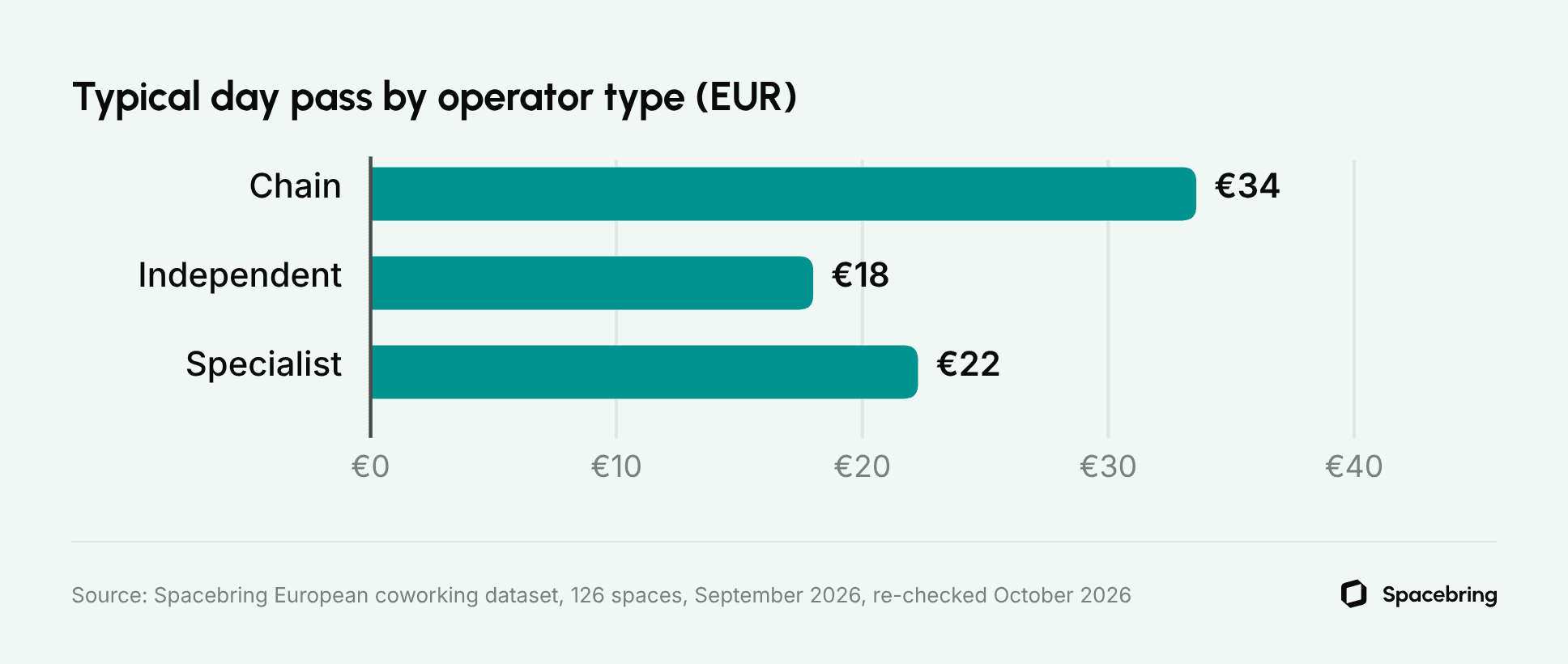
The biggest difference between chains and independents is the day pass. The typical chain day pass costs €34; at independents it's €18, about half. Monthly hot desks are closer: €259 at chains and €190 at independents. Keep in mind that several chain plans are network passes that work across many locations.
We saw the same day-pass pattern in our UK study earlier this year, so it doesn't seem to be a local quirk.
How to use this
If you're an independent, your day pass is already an attractive way for people to try your space. Treat it as the start of a relationship: welcome day-pass visitors properly, and follow up with a membership offer while the visit is still fresh.
What the price includes
Two spaces with the same price can offer very different value, so we also recorded what the headline plan includes.
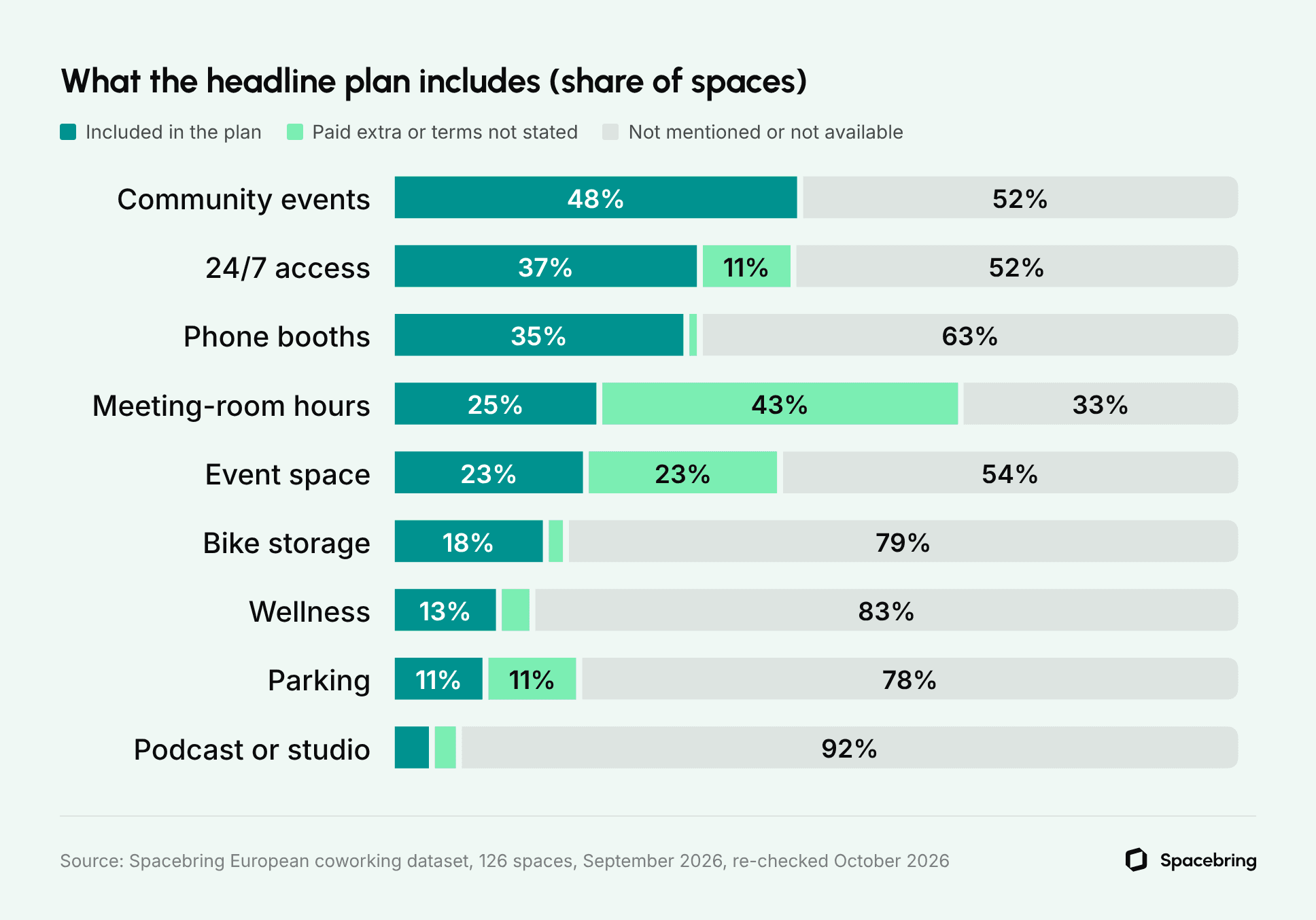
Community events are the most common inclusion (48% of plans), followed by 24/7 access (37%) and phone booths (35%). Meeting-room time is included in only a quarter of plans (25%).
Many spaces don't mention some amenities at all, though they may still offer them.
How to use this
List what each plan includes right next to its price: access hours, meeting-room time, phone booths, events, coffee. It's the easiest way to explain why your price is what it is, and it saves you answering the same questions by email.
How prices are shown
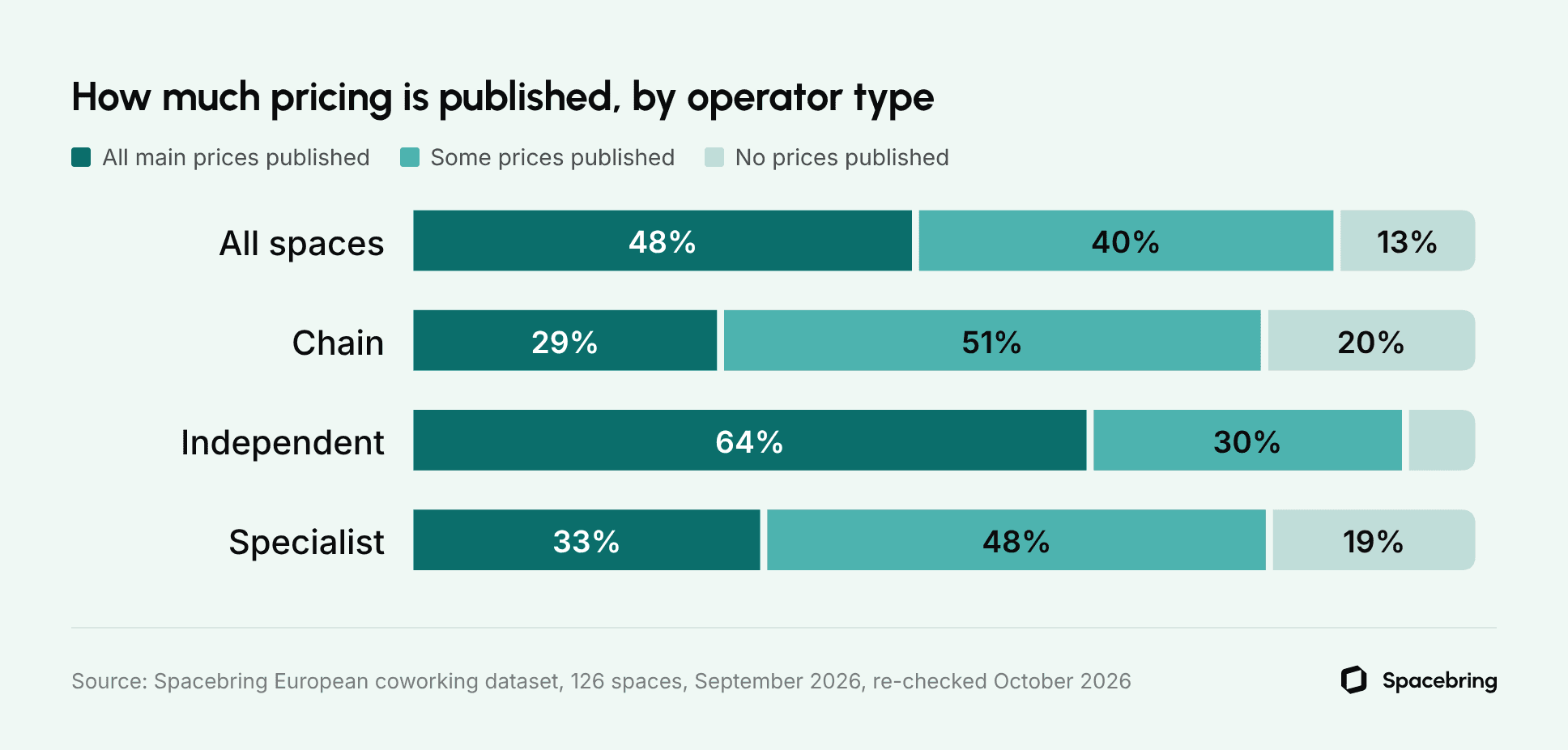
Most spaces are open about price. 48% publish prices for all their main products, and 40% publish some, typically the hot desk and day pass, with offices on request. Only 13% publish no prices at all.
Independents are the most open: 64% publish complete pricing, compared with 29% of chain locations. Chains more often price private offices and fixed desks on request.
One small detail is worth checking on your own site: whether each price says if VAT is included. 43% of spaces don't mention it, which mostly matters to freelancers and small companies comparing offers.
How to use this
Publish at least a “from” price for every product, including offices. A starting price helps visitors decide quickly whether you're in their budget, before they get in touch.
How members can buy
Once a visitor has seen the price, the next step is booking. We recorded the easiest path for a new customer at every space.
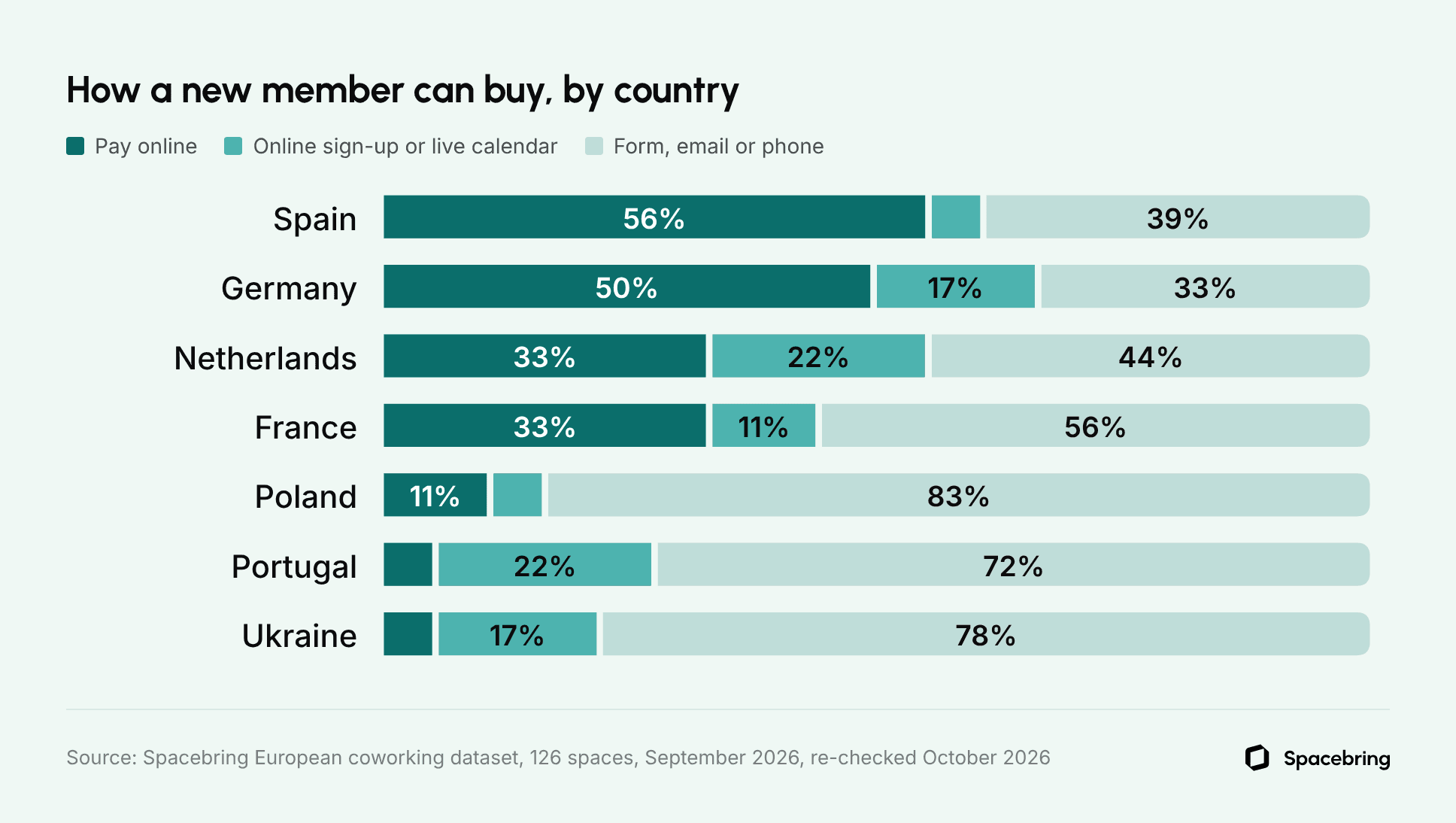
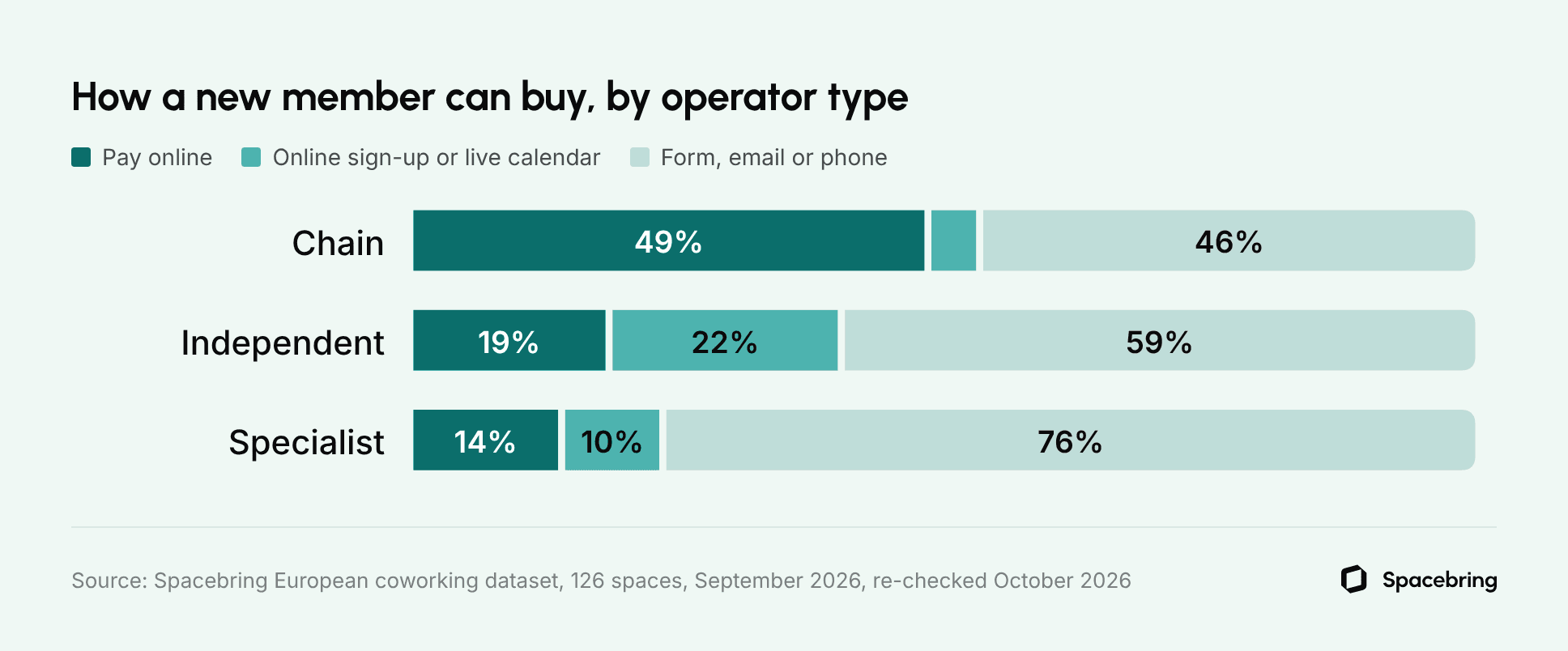
Across all 126 spaces, 28% let a new member pay online, 14% offer a live calendar or an online sign-up, and 58% ask visitors to get in touch by form, email or phone. Chains are furthest ahead: 49% of chain locations take payment online, compared with 19% of independents.
If only 30% of coworking spaces have an easy online process in place for booking a day pass — meaning they are also properly organized to welcome day users and make them feel comfortable — we can reasonably assume that the remaining 70% are missing out on an interesting revenue opportunity. Some operators may believe that day users are not an attractive customer segment to accommodate. But in an era of hybrid working, it may be worth thinking twice.Jean-Yves HuwartFounder and CEO Coworking Europe

Spain (56%) and Germany (50%) have the most spaces with online checkout, and every country in our sample has at least one. A contact form works well for private offices and custom deals. For a day pass or a monthly desk, an online checkout lets people buy the moment they decide.
We have the policy of making it seamlessly easy for people to become betahaus members. An online check-in form helps to give them the possibility to decide today and become a member the next day. For larger teams we have tailor-made offers as well.Madeleine Gummer v. MohlCo-Founder of betahaus

Spaces doing this well
- betahaus Berlin shows its memberships and day pass with “Buy Now” buttons that open a checkout with a date picker.
- La Vaca Coworking in Barcelona has a “Buy it” button on its Flex plan that opens a card checkout, and tells members that once payment goes through they can simply show up.
- Cooffice in Odesa takes card payments online and links to member portals for booking. (Full disclosure: Cooffice runs on Spacebring.)
How to use this
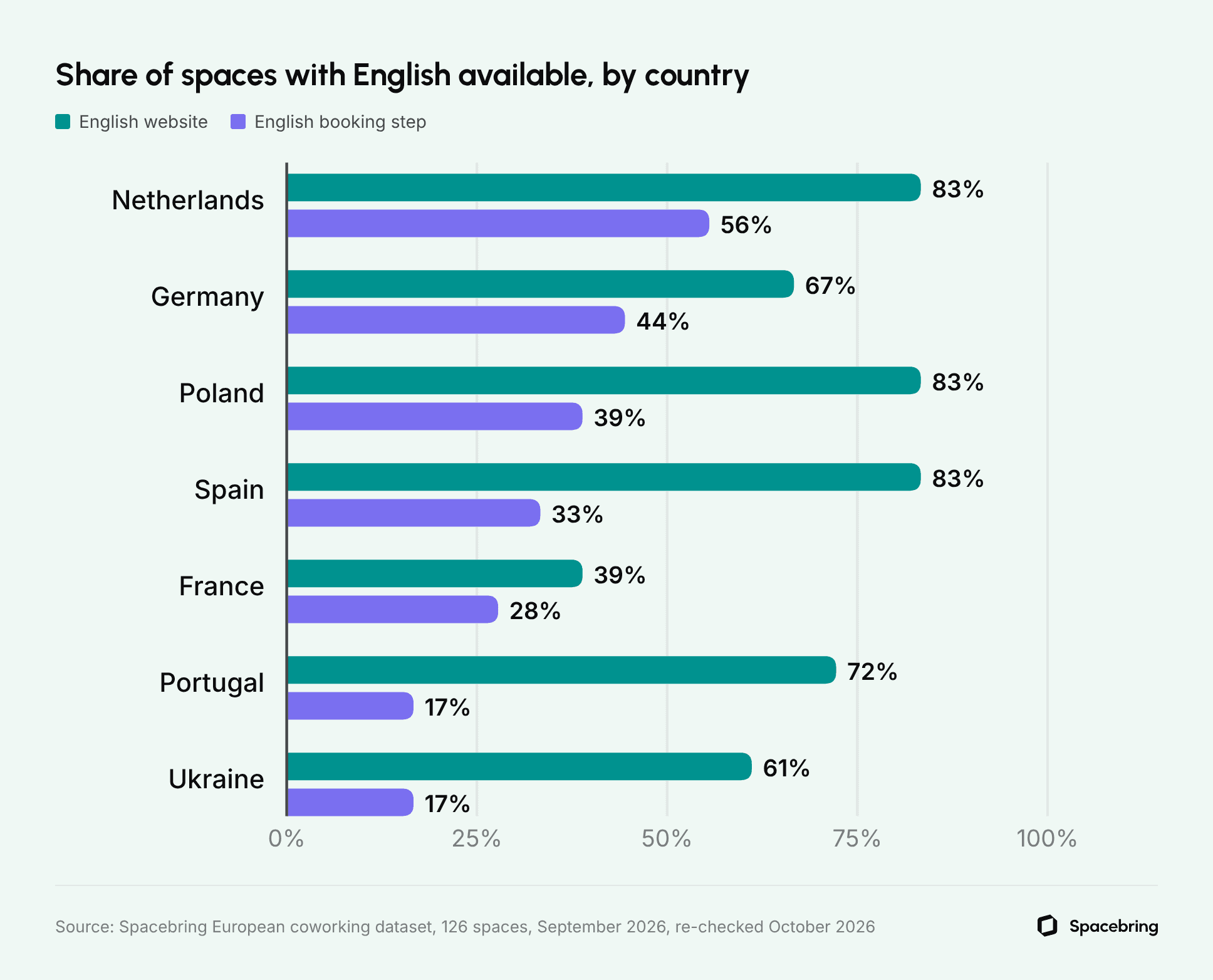
Start small. Add online checkout for your day pass and monthly hot desk, two products people often buy without a conversation. If you have international members, make sure that checkout also works in English: 70% of the spaces we studied have an English website, but only a third (33%) clearly let visitors book in English.
Inside spaces powered by Spacebring
Websites show how spaces sell. To see what members do next, we looked at anonymised, aggregated booking data from coworking spaces powered by Spacebring in the same seven countries, covering two years of bookings from October 2024 to September 2026. We only share percentages and typical values.
One thing to keep in mind: every one of these spaces uses a platform that lets members book online, so think of these numbers as what self-service looks like in practice, not an average for the whole market. Every location counts once, so a busy space doesn't drown out a quiet one.
1. Members make most bookings themselves
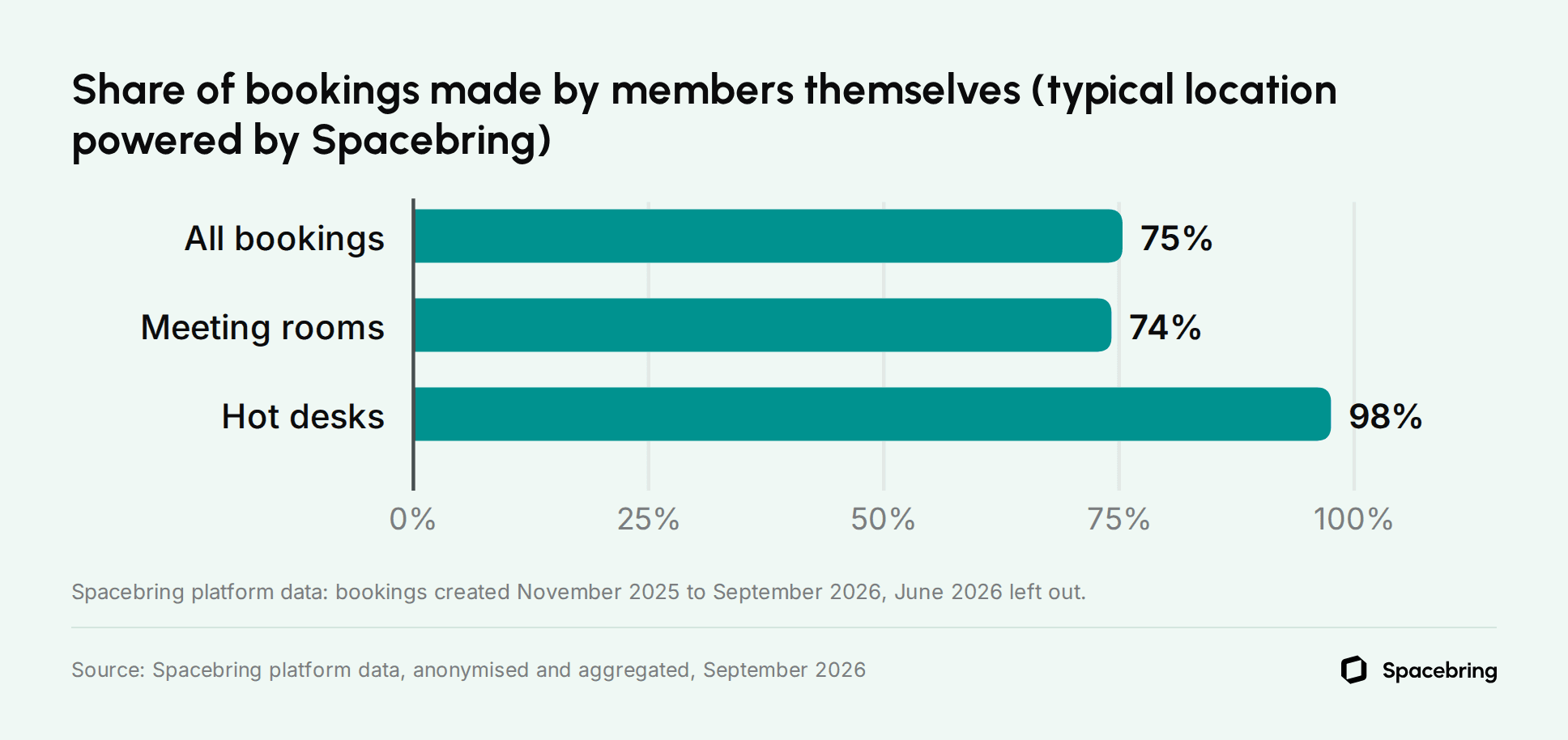
When members can book on their own, they do most of the booking. At the typical location, three in four bookings (75%) are made by members, not staff, including 74% of meeting-room bookings and almost every hot-desk booking (98%).
And members don't wait for office hours: about one in five of their bookings (18%) is made before 9:00, after 18:00 or at the weekend.
 \
\
2. Rooms are booked at short notice
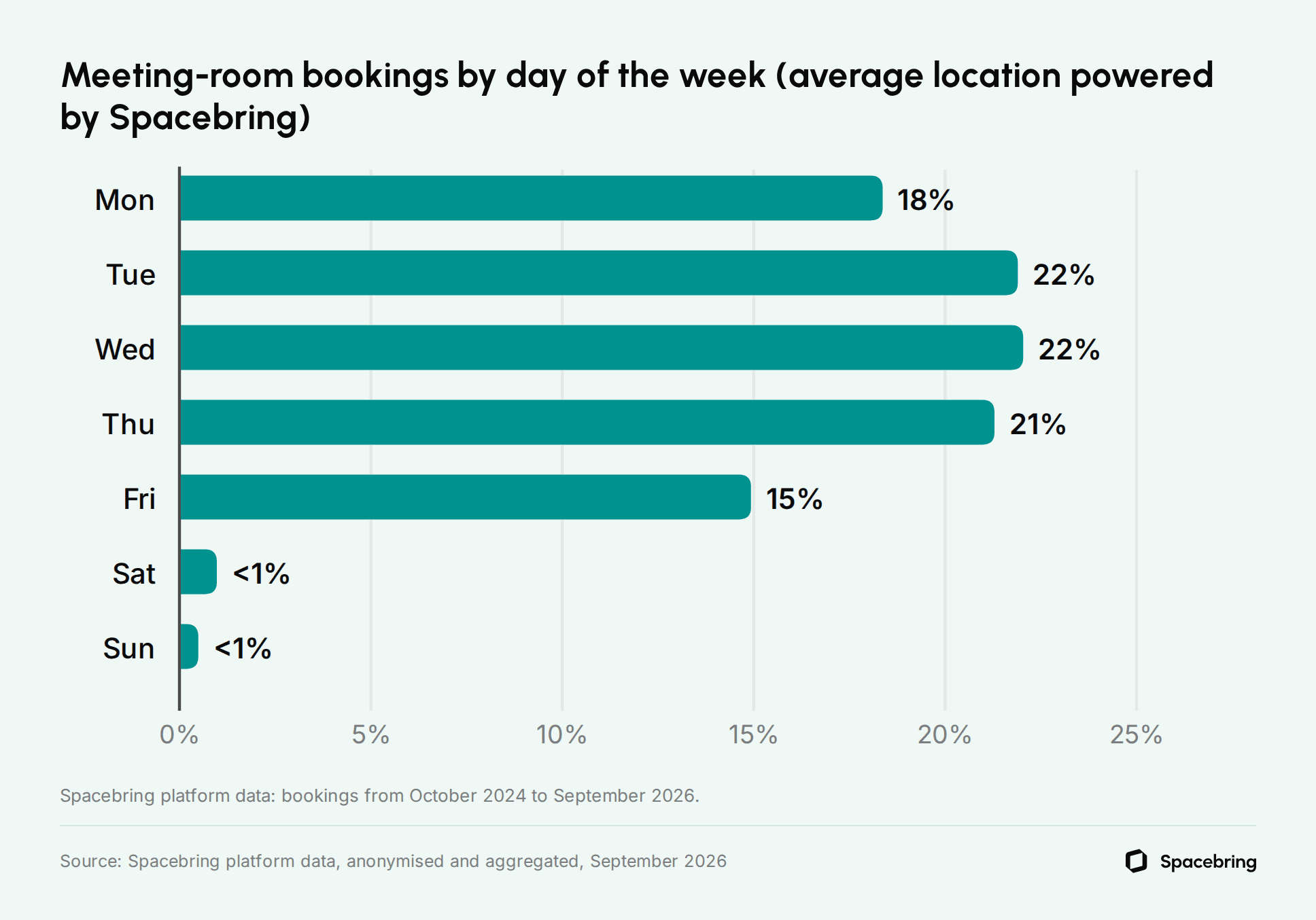
Meeting rooms are mostly an on-the-day decision. At the typical location, a room is booked only about 2 hours before the meeting, 67% of room bookings are for the same day, and the typical booking lasts 1 hour. Tuesday to Thursday are the busiest days; Friday is the calmest weekday. Hot desks are planned a little further ahead: 43% of hot-desk bookings are made on the day, about half in the week before, and hardly any (4%) more than a week ahead.
3. Credits do a lot of the work
Most bookings don't involve a money payment. At the average location, 50% carry no charge at all: the team booked them as free, or the room or desk is free for anyone to book. Another 34% use credits or day passes, and 17% are paid with money.
Among bookings members make themselves, credits take the lead: together with day passes they cover 42%, while 24% are paid with money, mostly by card. That average hides big differences: at more than half of locations card payments are rare, while at about one in five they're the main way members pay.
How to use this
Try booking at your own space at 8 pm, from your phone, without asking anyone. If it takes more than a couple of taps, that's an easy win. Most room bookings happen on the day, so make sure a member can book a room from their phone in under a minute. Keep members' credit balance visible when they book, because credits are part of your price. And if Fridays are quiet at your space too, they're a natural slot for trial days, tours and events.
A quick pricing check for your space
- Where does your hot-desk price sit against your country's range in the table above?
- Is your fixed desk roughly a third more than your hot desk?
- Does your monthly hot desk cost somewhere between 8 and 11 day passes?
- Does every plan list what's included, next to the price?
- Can a new member buy a day pass or a monthly desk online?
If any answer surprises you, that's the place to start.
How we did this
In September 2026, we visited the websites of 126 coworking spaces in 21 cities: the largest hub, a regional city and a smaller market in each of the seven countries, with a mix of chains, independents and specialist spaces in every city. In October 2026, we re-checked every space. We looked at what a future member sees before talking to anyone: the prices, what the plan includes, and how to buy.
Prices are the standard monthly price of an unlimited hot desk, a fixed desk and an entry-level private office, plus a one-day pass, as advertised and converted to euros; all prices in this article are in euros. “Typical” means the middle price, so a few extreme prices don't skew the picture. Plans limited to a set number of days don't count as a hot desk. It's a hand-picked sample, not a census.
For wider context, Mordor Intelligence values the European coworking market at USD 11.80 billion in 2025. Germany had 1,852 coworking spaces at the end of 2023, according to the German coworking association BVCS, and France counted 4,041 tiers-lieux (shared community workspaces) in 2026. With growth reaching well beyond the big cities, local benchmarks like these matter.
The platform figures come from an anonymised export of the Spacebring platform on 28 September 2026, covering live locations in the seven countries (about 40% of them in Ukraine). Cancellations and calendar imports are not counted, and the self-service and payment figures use bookings created from November 2025 to September 2026, excluding June 2026.
Final thoughts
Across European cities of different sizes, the typical hot desk costs €180–€230 a month, a fixed desk about a third more where a space sells both, and a month about 9 to 10 day passes. Knowing where you sit on that ladder makes pricing decisions a lot less like guesswork.
The spaces that stand out combine a clear price with a clear list of what's included and an easy way to buy. None of that requires a new building. Most of it happens on your website.
Get the full report
The printable report, What European coworking spaces charge 2026, has every chart, the city-by-city price board, a quick pricing check for your space, the full methodology, and all sources.
Download the report (PDF)
Want members to book and pay on your website without waiting for a reply? That's what Spacebring helps coworking operators do.
Sources
- Bundesverband Coworking Spaces Deutschland (BVCS), coworking statistics for Germany, 28 February 2024.
- France Tiers-Lieux, Recensement 2026, 28 August 2026.
- Mordor Intelligence, Europe Coworking Spaces Market, updated 9 March 2026.
- Spacebring, UK coworking space market report 2026, July 2026.
- Spacebring platform data: anonymised, aggregated booking export, 1 October 2024 to 28 September 2026 (not counting cancellations or calendar imports). Self-service and payment figures use bookings made from November 2025, leaving out June 2026, when who made a booking was not reliably recorded. Figures are shares and typical values across locations.
- Spacebring European coworking dataset: 126 spaces, collected September 2026 and re-checked 9 October 2026. Prices are medians of advertised prices, rounded to the nearest euro; percentages are of all 126 spaces unless stated otherwise.