


Hot desking gives members access to any available desk rather than one assigned seat. For coworking operators, it can be an accessible entry-level plan and a good way to make better use of shared space. It works best when availability, cleaning, and booking rules are clear.
This guide is for coworking operators. It explains where hot desking fits in your membership plans, how to price it, and how to create a smooth experience for members and staff.
What is hot desking, exactly?
Hot desking is a membership type that gives someone access to your shared workspace without assigning them a specific desk. They show up, find an open seat — first-come, first-served, or reserved through a booking app — and work there for the day. The next day, someone else might sit in that same spot.
It's different from a dedicated desk (same seat, every time, usually with some personalization allowed — a monitor, a plant, a locked drawer) and different again from desk hoteling, where members reserve a specific seat in advance rather than walking in and grabbing whatever's free.
Some operators use "hot desking" loosely to mean any non-assigned seating, including the reservable kind; strictly, hot desking is the walk-in, no-reservation version, and hoteling is the booked version. Both usually sit below dedicated desks and private offices on a coworking membership menu—see our guide to structuring coworking membership plans for where hot desking typically fits in a 3–5 plan lineup.
Is hot desking still relevant in 2026, or is it fading out?
Hot desking is still relevant. CBRE reports that average office utilization increased from 35% in 2023 to 53% in 2025. As hybrid work becomes more common, more businesses are getting used to sharing desks and planning space around actual attendance rather than fixed assigned seats.
The experience depends heavily on how the space is set up. Leesman found that 85% of employees in well-equipped unassigned workplaces felt their environment supported productivity, compared with 41% where workspace variety was limited. Clear availability, enough suitable work settings, and good housekeeping make a meaningful difference.
The real pros of hot desking for coworking operators
Hot desking can benefit both members and operators. For operators, the main advantages are flexibility, better use of shared space, and an accessible way for new members to get started.
- It is an easy entry point. A hot-desk plan is often the most flexible and affordable option on your menu. It gives new members a simple way to try your space before choosing a dedicated desk or private office.
- It helps you use shared space more efficiently. Dedicated desks and private offices are assigned to one member or team. Hot desks let you plan around real attendance, since not every member uses the space every day.
- It can bring in new members. Day passes and hot-desk memberships can appeal to freelancers, remote workers, and people trying coworking for the first time. A low-commitment option makes it easier to get started.
- It gives members flexibility. Members can choose when they need to work from your space without committing to the same desk every day. This can work well for hybrid workers and people with changing schedules.
- It creates an upgrade path. As members visit more often, they may need storage, a regular desk, more privacy, or meeting-room access. A clear next-step plan makes it easier for them to upgrade when their needs change.

Generate recurring revenue and offer exceptional customer experience at your shared or coworking space
The real cons—also operational, not philosophical
- Cleaning and turnover. A desk that changes occupants daily needs to be reset daily—wiped down, decluttered, chair pushed in, monitor cable untangled. This is one of the common member complaints operators report about hot-desk areas, and it's a staffing cost, not a footnote.
- No-shows and phantom occupancy. If members can reserve a hot desk and then not show up, you've got a seat that reads as "taken" in your booking system while sitting empty in the room—which frustrates the member who actually walked in looking for a spot. This is one of the common reasons operators eventually add booking software with no-show tracking, rather than running hot desking on an honor system.
- Lower per-seat revenue, so the margin math has to be deliberate. Hot desking is priced low on purpose—that's the point—but it also means you need more hot-desk members per square foot than dedicated-desk members to hit the same revenue. If you don't cap how many hot-desk plans you sell against actual seat count, you'll eventually oversell the room on your busiest days and undersell it the rest of the week.
- It often generates more questions from new members. Because it's the cheapest, most flexible option, hot desking draws people who aren't sure what they need yet—which means more pre-sale questions, more mid-membership upgrade requests, and more edge cases (can I bring a guest, can I use a meeting room, do I get storage) than a dedicated desk or office plan generates.
What Spacebring data shows about hot-desk plans
We analyzed anonymized Spacebring membership-plan data from August 2026. These patterns can be useful benchmarks, but every coworking space should adapt its plans to local demand, available desks, and member needs.
- Ten visits per month was the most common allowance for flexible, hot-desk-style plans in our analysis. It can be a useful starting point for members who want regular access without paying for a full-time desk.
- 42% of these plans required an approval step before a member could sign up. For a low-commitment plan, a self-serve sign-up option can make it easier for interested members to join without waiting for a reply.
- Company memberships lasted longer than individual memberships on average: 6.9 months compared with 2.8 months. This comparison covers ended subscriptions across all membership-plan types, not hot desks alone. It suggests that small teams may be a valuable audience for flexible plans.
Pricing still varies widely by city, location, and included amenities. One April 2026 estimate from Wezoo placed U.S. hot-desk memberships at roughly $200–$450 per month, with day passes around $25–$60.
Use these figures as a starting point, then compare them with local competitors, your costs, and how often members actually use your space.
How to run hot desking smoothly
- Cap seats against real attendance, not desk count. Use desk booking software to track availability and demand (or start tracking it if you don't have it yet) before you decide how many hot-desk memberships to sell. Selling to headcount instead of attendance is how spaces end up oversold on Tuesdays and empty on Fridays.
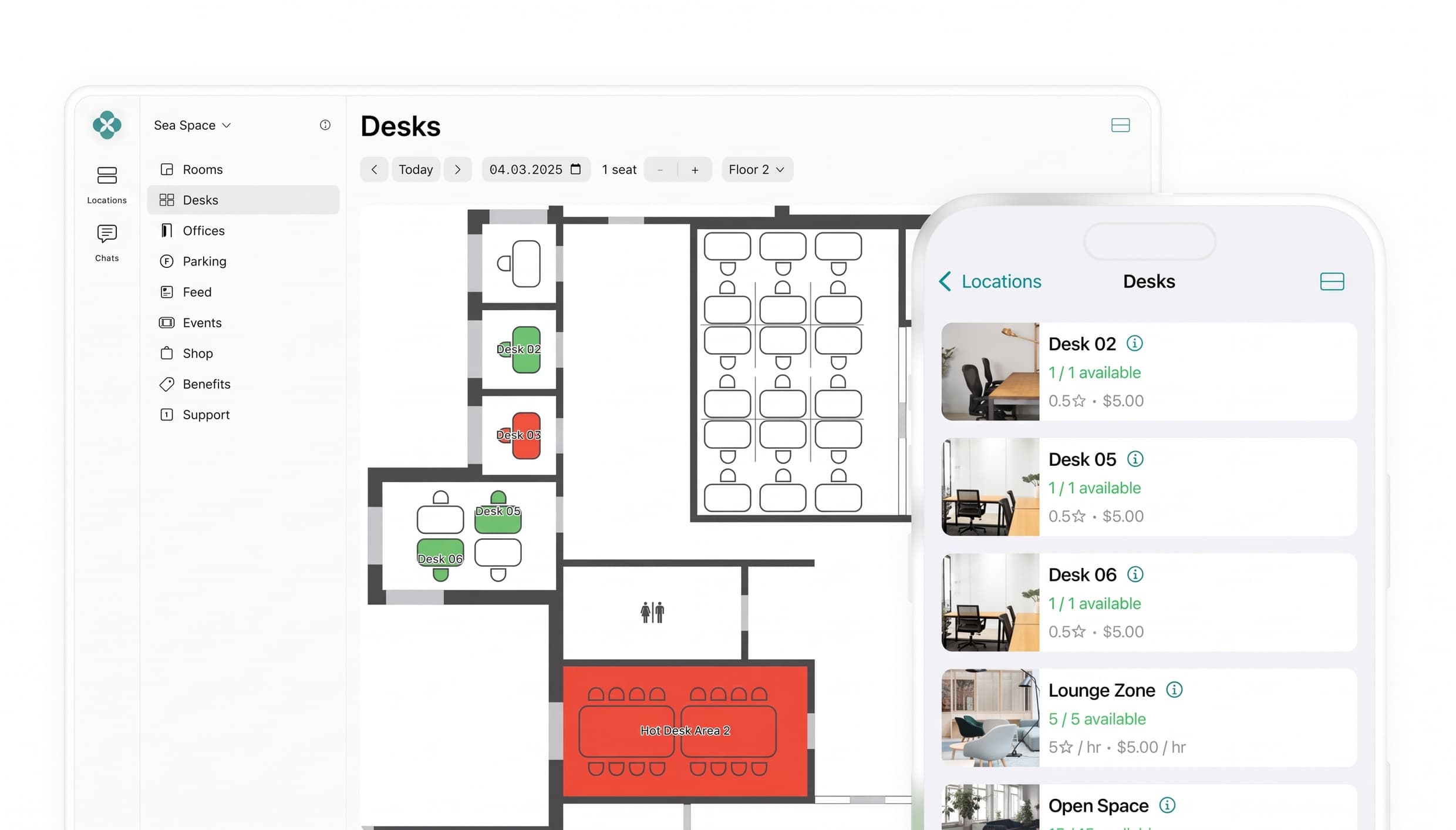
- Make the purchase self-serve. In our analysis, 42% of flexible, hot-desk-style plans required an approval step before sign-up. Put your hot-desk plan on a page where someone can sign up and pay without talking to anyone, and keep the assisted option for people who want it.
- Put cleaning on a schedule, not a hope. Provide supplies, remind members to leave desks ready for the next person, and schedule staff checks during your busiest periods. Review booking and check-in data regularly to see when extra support is needed.
- Track no-shows and act on the pattern, not the individual instance. One no-show is a fluke. A member who no-shows regularly is costing you a seat you can't sell to someone who'd actually use it — some booking platforms can flag this automatically so you're not doing it by memory.
- Give hot-desk members a real reason to upgrade. Storage, guest passes, meeting room credits, and priority booking are the levers that turn a hot-desk member into a dedicated-desk member. If there's zero difference in day-to-day experience between your cheapest and second-cheapest plan, you've priced yourself out of upgrades.
Hot desk vs. dedicated desk vs. private office
| Hot desk | Dedicated desk | Private office | |
|---|---|---|---|
| Seat assignment | None — first available | Same seat every visit | Enclosed room, team-sized |
| Typical buyer | Freelancers, remote/hybrid workers, first-time trial members | Solo professionals, small teams wanting consistency | Small-to-mid teams needing privacy or compliance |
| Price position | Lowest tier on most menus | Mid tier | Highest tier |
| Operator workload | Highest (cleaning, turnover, no-show tracking) | Moderate | Lowest per member (fixed footprint) |
| Best sold as | Entry point / acquisition plan | Retention plan | Expansion / long-term revenue |
Common mistakes operators make with hot desking
- Treating it as "the cheap plan" instead of a managed product. Pricing it low is fine; running it with no cleaning SLA, no seat cap, and no self-serve checkout is not—that's how a cheap plan becomes an expensive support burden.
- Not separating hot desking from desk hoteling in member communication. If your app lets people reserve a specific seat in advance, you're running hoteling, not pure hot desking—members get confused (and annoyed) when the terminology and the actual booking mechanics don't match.
- Ignoring the duplicate-tier trap. If your hot desk and your day-pass product overlap too much, you're competing with yourself for the same buyer instead of giving them a reason to pick one over the other.
- Never revisiting the seat cap. A cap that made sense at 40% occupancy doesn't make sense at 75%—review it quarterly against your actual utilization data, not the number you picked when you opened.
Hot desking works best when memberships, bookings, and member communication are easy to manage in one place. Spacebring helps coworking spaces create flexible plans, let members book desks and meeting rooms, and keep track of day-to-day operations. Explore Spacebring’s coworking management software to see how it can support your space.
FAQ
1. Is hot desking dying in 2026?
No. Hybrid work has made shared desks more familiar for many businesses. The key is to make the experience reliable: members need to know where they can work, how to book a desk when needed, and what to expect when they arrive.
2. What's the difference between hot desking and desk hoteling?
Hot desking is walk-in, first-come, first-served, with no reservation. Desk hoteling is the same non-assigned-seat idea, but members reserve a specific desk in advance through a booking system. Many coworking spaces run a hybrid of the two without realizing it—worth clarifying in your own member communication.
3. How much should I charge for a hot desk membership?
There's no universal number—price against your market and your cost per seat—but a 2026 US marketplace snapshot put typical hot-desk memberships between roughly $200–$450/month and day passes between $25–$60. Use that as a sanity check, not a target.
4. Do I need booking software to run hot desking well?
Not on day one, but you'll want it quickly. The two biggest hot-desking complaints—no-shows and unclear availability—are both solved by a booking system with real-time seat visibility and no-show tracking, not by an honor system on a whiteboard.
5. What's the biggest mistake operators make with hot desking?
Making the plan unclear or difficult to join. Explain whether desks are first-come, first-served or reservable, set realistic capacity limits, and make sign-up simple for members who are ready to buy.