


Quick answer: Managing a coworking space comes down to a few habits done well: know your numbers, give every important job a clear owner, make members feel welcome and supported, and reduce repetitive admin wherever you can. This guide explains how to build those habits in a practical way, whether you run one small space or several locations.
What "managing a coworking space" actually covers
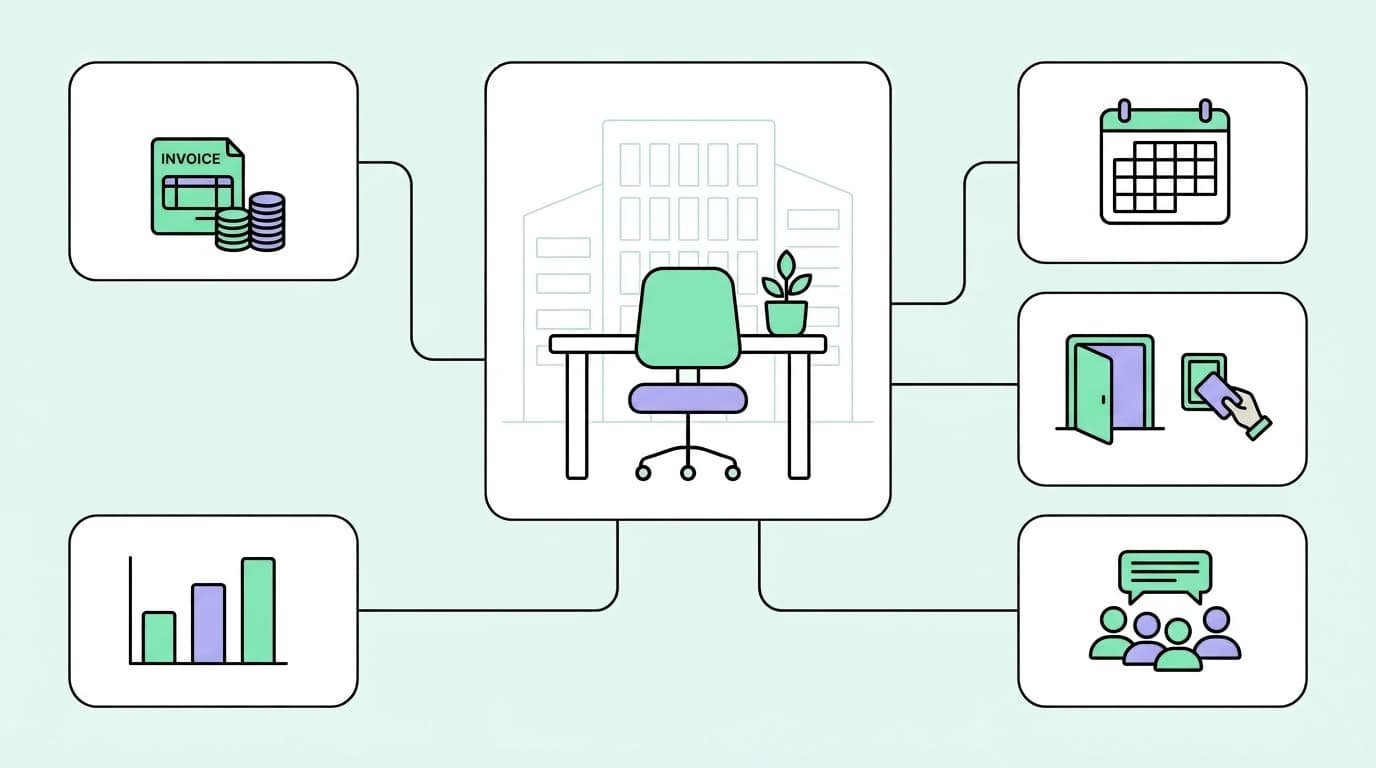
People searching this phrase are usually holding one of two jobs: they just signed a lease and are building the operation from scratch, or they've been running a space for a year or two and something isn't working — margins are thinner than expected, the front desk is drowning in admin, or members are quietly not renewing. Both versions of that job break down into the same six things, whether one person does all of them or a team of six splits them up:
- Filling and keeping desks (sales and renewals)
- Making the place feel worth staying in (community)
- Running the money side without errors (billing, invoicing, collections)
- Keeping the building running (cleaning, maintenance, vendors, access)
- Choosing and running the software stack that ties all of the above together
- Knowing your numbers well enough to catch a problem before it shows up in the P&L
Most of what goes wrong in coworking operations isn't a mystery — it's one of these six left unattended for too long. The sections below go through each one, plus the two most common failure patterns operators run into.
Get the ownership structure right first
The advice to “hire the right people” is only useful when you know what work needs to be owned. Think in terms of six roles rather than six job titles. In a single-location space, one person may cover two or three of them:
| Role | What it actually owns | Who typically holds it in a small space |
|---|---|---|
| Operator / GM | Pricing, P&L, lease, hiring, expansion decisions | The owner, full-time |
| Community manager | Onboarding, events, day-to-day member relationships, conflict resolution | First hire once the owner can't be at the front desk and on sales calls simultaneously |
| Sales / tour lead | Inquiry response time, tours, follow-up cadence, close rate | Often the community manager in a small space |
| Finance / billing | Invoicing, failed payments, reconciliation, reporting | The owner or a part-time bookkeeper, almost always the first thing operators try to automate away |
| Facilities | Cleaning schedules, vendor contracts, access control, repairs | Outsourced to a cleaning vendor plus a part-time handyman in most single-location spaces |
| Software owner | Which tools the space runs on, integrations, member-facing app | Whoever set it up — usually the operator, by default, whether or not they wanted the job |
The bigger risk is not always understaffing; it is leaving an important role unowned. When a job belongs to “everyone,” it can easily become nobody’s priority. If you run the space yourself, be realistic about what you can cover this week and what needs help, automation, or a later deadline.
When hiring, look for hospitality skills, reliability, and a genuine interest in people—not only prior coworking experience. Before writing a job description, be clear about which of the six roles the person will own. A “community manager” role that quietly includes sales targets, billing, and facilities work can quickly become overwhelming.
The numbers to track — and how to use benchmarks
Benchmarks can give you useful context, but they are not targets to copy blindly. Your ideal occupancy and revenue depend on your rent, location, membership mix, and operating costs. Use industry data to ask better questions about your own performance.
- Occupancy. Compare desks and offices separately, then look at revenue occupancy too. A busy space is not automatically a high-performing one: review both how full your space is and how much revenue each available desk or office generates.
- Profitability. Measure profitability against your own operating costs, not a generic industry figure. For context, Deskmag’s 2025 global survey found that 54% of surveyed coworking businesses were profitable over the previous 12 months, while 18% reported a loss. Rent, staffing, debt, fit-out costs, and local demand all affect what healthy performance looks like for your space.
- Retention. Track cancellations and non-renewals every month, then ask why people leave. Churn is rarely just a sales problem; it can point to unclear value, poor onboarding, pricing, service, or a membership mix that is not working.
- Revenue per desk. Track revenue per occupied desk and revenue per available desk alongside occupancy. These metrics help you see whether fuller rooms are actually improving revenue.
- Market direction. Keep an eye on local demand, new openings, and what members ask for. Broad industry trends can be useful background, but they cannot replace a clear view of your own market.
At minimum, review occupancy, cancellations, renewals, and revenue per available desk each month. The goal is not to chase an industry average. It is to spot changes early and understand what needs attention.
Community: the part that actually drives renewals
Community is one of the main reasons people stay. Price may bring someone through the door, but it rarely creates loyalty on its own. Members are more likely to renew and recommend your space when they feel welcome, know other people there, and see real value beyond a desk and Wi-Fi. That is why community should be part of your operating plan, not an optional extra.
What concretely earns that loyalty, beyond "host events":
- A real onboarding sequence for the first two weeks — an intro to the space, introductions to a few relevant members, and a follow-up check-in around day 10. Early churn often starts when a member has not yet formed a connection to the space or its community.
- Segment your programming. A weekly happy hour serves extroverts; it does nothing for the freelancer who joined for quiet focus time. Run at least one recurring event type per member segment you're targeting — skill-shares or lunch-and-learns tend to land better with a B2B, professional-services membership base than purely social mixers.
- Make renewal a conversation, not an autobill. A 5-minute check-in at the 60-day and 11-month marks — "what's working, what isn't" — catches quiet dissatisfaction before it becomes a cancellation with no warning.
- Give members a way to be visible to each other. A member directory, a skills/needs board, or even a simple "who's new this week" post in your community feed does more for retention than another round of free coffee.
Five mistakes that quietly kill coworking margins
These are common mistakes that can quietly reduce revenue, increase admin work, and make members less likely to stay:
- Under-planning the real cost base. Rent and buildout are the obvious costs; the ones that sink margins are recurring — cleaning, insurance, software subscriptions stacking up one point-solution at a time, and the labor cost of manual admin work no one budgeted for. Model your break-even occupancy before you sign the lease, not after.
- Under-investing in community in year one to protect cash flow, then wondering why renewal rates are weak in year two. Community-building is cheapest and most effective before the space is full — waiting until occupancy is a problem to start caring about retention is backwards.
- Running it like a serviced office, not a coworking space. Members can feel the difference between a landlord and an operator who's actually present. If your front desk only exists to hand out access cards, you're competing on price against buildings with lower overhead than yours — and you'll lose.
- Going it completely alone on partnerships and referrals. Cross-referral relationships with nearby spaces, chambers of commerce, and coworking associations bring in leads at close to zero cost — most solo operators never build this because it feels like a distraction from "real work," but it's usually the cheapest lead source available.
- Piecing together five separate tools instead of one system. A spreadsheet for billing, a separate booking calendar, a generic CRM, and a Slack channel for member support can each work on their own. Together, they can make it hard to see the full member journey, while small errors—such as a missed invoice or double-booked room—turn into member complaints.
Manual, patchwork, or all-in-one: what running your stack actually costs
Every space ends up somewhere on this spectrum. Here's the honest trade-off, not the sales pitch version:
| Manual / spreadsheets | Multiple point tools | Single coworking platform | |
|---|---|---|---|
| Upfront cost | Lowest | Moderate — each tool is affordable on its own, but costs can add up | A predictable monthly fee, which varies by provider and features |
| Admin time per week | Highest — every invoice, booking, and access change is manual | Moderate, but time lost to reconciling data between tools | Lowest — one system of record for billing, bookings, and members |
| Where it breaks | Scales badly past ~30 members; errors increase with volume | Breaks at integration points — a payment updates in one tool but not another | Breaks if the platform doesn't cover a workflow you actually need — check before committing |
| Best for | Pre-launch or a very simple operation | Spaces with a specialist workflow that one platform does not coverwell | Spaces that need billing, bookings, member communication, and access data in one place |
Start by automating the tasks that create the most errors or take the most staff time. For many operators, that means billing and payment follow-up first, then bookings, access, and reporting. A coworking management platform can bring these workflows into one place, but choose a system based on the needs of your members and team—not a feature checklist alone. For more help choosing the right setup, see our guides to coworking space CRM and coworking space pricing.

Schedule a personal demo to discover how Spacebring could benefit your shared space business
A realistic weekly operating rhythm
"Manage the space well" is too vague to act on daily. Here's a cadence that holds up across most single-location operations:
- Daily: Check overnight/failed payments, confirm cleaning happened, walk the floor once, respond to member support tickets same-day.
- Weekly: Review new inquiries and tour conversion rate, check upcoming renewals in the next 30 days and reach out proactively, scan the meeting room utilization report for booking conflicts or chronic no-shows.
- Monthly: Pull occupancy, churn, and RevPAD; reconcile billing against your accounting software; run one community event tied to a specific member segment; review vendor invoices against contracts.
- Quarterly: Revisit pricing against your market and your own occupancy trend; audit your software stack for tools that have quietly become redundant; survey members on what's working.
FAQ: coworking space management
1. What's the single most important thing in managing a coworking space?
Retention. New sales matter, but long-term members create more predictable revenue, referrals, and community. Make renewals a regular conversation so you can solve problems before a member decides to leave.
2. How many staff does a coworking space need?
There is no universal staffing ratio. Your needs depend on opening hours, member expectations, the mix of desks and offices, events, and how much work you outsource. Start by assigning clear ownership for community, sales, billing, and facilities; add dedicated help when service quality or follow-up starts to slip.
3. What software does a coworking space actually need to run day to day?
At minimum, you need a reliable way to manage billing, desk and room bookings, member communication, and access. Whether that is a set of separate tools or one platform depends on your budget, workflows, and the time your team spends keeping systems in sync.
4. What occupancy rate should a coworking space be targeting?
Industry occupancy data can be useful context, but your real target is the occupancy level at which your space covers its costs and delivers the return you need. Calculate that number from your own rent, payroll, services, and pricing, then review it as costs or your membership mix changes.
5. What's the biggest mistake new coworking operators make?
A common mistake is treating community and retention as optional until occupancy becomes a problem. Building member loyalty early is more effective than trying to fix high churn later.
Build a simpler, stronger operation
You do not need to overhaul everything at once. Choose one recurring problem—late payments, booking conflicts, slow tour follow-up, or unclear renewals—and improve that workflow this week. Then review the result, keep what works, and move to the next priority.
When your team is ready to bring memberships, billing, bookings, access, and member communication into one place, see how Spacebring supports coworking operators.