

A coworking sales funnel is the path someone takes from discovering your space to becoming a paying member. For a membership business, a useful way to track that journey is discovery, interest, a tour or trial visit, decision, and sign-up.
Think about the last person who asked about your space but never joined. Did they find a suitable plan? Did anyone invite them to visit? After the tour, did they know what to do next?
Those questions are more useful than jumping straight to “we need more leads.” Before spending more on marketing, look at what happens to the people already coming through your door.
This guide will help you build a simple, manageable process: attract people your space can genuinely serve, help them choose, and make joining easy.
Start with the member you can serve well
Your funnel needs a clear destination. “Anyone who needs a desk” is too broad to guide your marketing or your tours.
Choose a priority audience based on the space and capacity you actually have. A remote employee who needs quiet calls, a freelancer who wants company, and a six-person team looking for a private office have different questions.
Write down:
- Who you want to attract.
- What their current workspace makes difficult.
- Which available plan solves that problem.
- Why they would choose your location rather than another option.
For example:
“Remote professionals within a short commute who need reliable call space and a desk two or three days a week.”
Now you have something useful to say on your website—and a reason to recommend one plan rather than recite every option.
The five stages of a coworking sales funnel
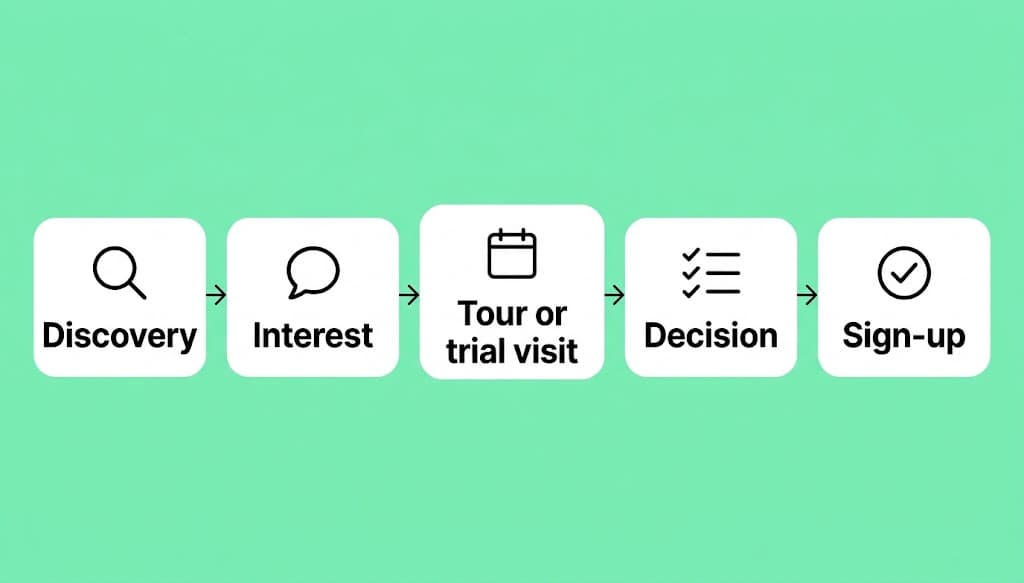
Use these stages as a working model, not a rule everyone must follow. Some people book a day pass and join without a tour. A team may need several visits and approval from someone who never enters the building.
| Stage | The prospect’s question | Your next step |
|---|---|---|
| Discovery | Is there a workspace that could suit me? | Help the right people find you |
| Interest | Does this fit my needs and budget? | Answer practical questions and offer a visit |
| Tour or trial visit | Can I picture working here? | Show how the space fits their working day |
| Decision | Is this the right choice now? | Resolve the remaining questions |
| Sign-up | How do I get started? | Make the agreement, payment, and arrival clear |
After sign-up, onboarding and retention matter too. A funnel that fills seats with people who leave quickly is not doing its job well.
1. Discovery: help nearby, relevant people find you
Start with a few channels you can maintain, rather than trying to be everywhere.
Make local search useful
Check that your Google Business Profile has the correct address, contact details, opening hours, website, and recent photos. Distinguish staffed hours from member access hours so visitors know when someone can welcome them.
Google says complete and accurate business information can help your visibility in local results. Treat your profile as a practical guide to visiting, not just a listing to claim once and forget.
On your website, explain your location, plans, prices, and working environment in readable text. Include details people need to decide: transport, parking, call spaces, accessibility, and how to arrange a visit.
Clear information is useful for people searching through AI features, too. Google’s guidance for AI Overviews and AI Mode says the usual SEO practices still apply; there is no special optimization required. Focus on answering real questions accurately rather than chasing an “AI-friendly” writing formula.
Give members an easy way to refer someone
Try a specific invitation: “Do you know someone nearby who would enjoy working here? They’re welcome to arrange a visit.”
A referral reward is optional. If you offer one, decide when it is earned, what it costs, and whether the resulting membership is worthwhile for your business. Keep rewards separate from requests for honest public reviews.
Build relevant local relationships
Consider nearby businesses, professional groups, and employers whose people may need your type of workspace. Offer something relevant—a useful introduction, a visit, or a small event—not an unsolicited stream of promotions.
For paid ads, begin with one audience, one available product, and one next step. Measure inquiries and paid memberships, not just clicks. An ad for private offices is little help if you only have hot desks available.
For a broader channel plan, explore these coworking space marketing strategies.
2. Interest: answer the questions that hold up a visit
Imagine someone checking your pricing page between meetings. Can they quickly find out whether your space is worth visiting?
Help them answer:
- What is the total price, including any mandatory fees or deposit?
- What is included, and what costs extra?
- Which access hours and booking limits apply?
- What are the commitment and notice periods?
- Is the plan available when they need it?
If private-office pricing varies, explain what affects the quote and what information you need to provide one. You do not need to pretend every workspace has a fixed price.
Use photos that show the actual working environment: desks, call areas, meeting rooms, and the space at a representative time. A beautiful lounge is welcome, but it does not answer whether someone can take four video calls a day.
Give the page one clear next step, such as “Book a tour.” Keep the initial form short: contact details, workspace need, team size, and preferred timing. You can learn more in conversation.
Make the first reply helpful
Try a message like this, adapting the details to the inquiry:
Hi Alex, thanks for getting in touch. Based on your need for a desk three days a week, our flexible plan could be a good fit. It includes [relevant benefits] and costs [total price]. Would Tuesday morning or Thursday afternoon suit you for a visit?
Set a response target your team can realistically meet during staffed hours. An automatic acknowledgment can explain when to expect a personal reply, but it should not replace one.
If someone is interested but not ready to visit, ask whether they would like you to check back at a particular time. Send information connected to their needs, rather than a generic newsletter sequence they did not request.
Connect your website to the next step
Your marketing website explains why someone might choose you. Your booking and membership software handles what happens when they are ready. Connect the two so visitors do not have to repeat their search or email you for something they could arrange themselves.
Match each button to the page it appears on. A day-pass page should lead to desk booking; a membership page should lead to the relevant plan; a private-office page should offer the appropriate application or inquiry route. Someone who still needs advice should be able to contact a person instead.
For example, Spacebring’s desk booking tools support connecting your marketing website to external hot-desk booking. Keep your existing site and give visitors a clear route to the relevant booking page, rather than sending every inquiry through email. A link to a booking service does not require a native plugin for your particular CMS.
Test the route as a first-time visitor on a phone. Check the destination, location, price, sign-up steps, and confirmation. If your website and booking portal use different domains, ask whoever manages your analytics to check how completed bookings are attributed before judging a campaign by button clicks alone.
3. The tour: show a working day, not just a building
A tour is a chance for both sides to assess fit. Your job is to help the prospect make an informed decision, not to persuade everyone to join.
Before they arrive
Confirm the time, entrance, directions, and who will meet them. Include a simple way to reschedule.
Ask what they need from their workspace and when they hope to start. For a team, find out who else needs to approve the decision. Check availability before showing a product you cannot offer.
Use a simple tour conversation
Start with a question:
“What would make working here better than where you work now?”
Then follow their answer. Someone struggling with calls needs to see call spaces and understand booking rules. A team needs to know about office capacity, guests, meeting rooms, and room to grow.
A useful tour has four parts:
- Understand their work. Ask about attendance, calls, visitors, and anything their current setup makes difficult.
- Show the relevant spaces. Demonstrate how they would use them, including any limits or shared-use rules.
- Explain the plan. Cover the total price, inclusions, availability, and commitment terms.
- Agree on a next step. Ask what they still need to decide and when it would be helpful to reconnect.
Show the space as it really is. Do not promise silence in a lively open area or unlimited room access when credits are capped. Introduce a member when it is welcome and appropriate, without interrupting their work.
End with an open question:
“How does this compare with what you had in mind?”
That gives someone room to mention a concern you might otherwise miss.
Follow up with a recommendation
Aim to send a personal recap by the next working day, or at the time you agreed. Keep it easy to act on:
Hi Alex, it was lovely meeting you. You mentioned needing a quiet place for calls and a desk three days a week. I’d suggest [plan], at [total price], because [specific reason]. Here are the inclusions and terms: [link]. Would you prefer to try a working day first, or shall I send the agreement for your preferred start date?
Record the next step. If their move is three months away, schedule a relevant check-in rather than repeatedly asking whether they are ready now.
4. Decision: resolve the real concern
“Let me think about it” can mean several things: budget, commute, uncertainty about the atmosphere, unavailable space, or simply a later start date.
Ask gently:
“Is there anything about the space, plan, or timing that you’re still unsure about?”
Use the answer to help, not to argue.
| Concern | A useful response |
|---|---|
| The plan feels expensive | Clarify the total cost and offer a smaller suitable plan if available |
| They are unsure about noise or calls | Arrange a visit or working day at a representative time |
| A team needs internal approval | Send a concise proposal with capacity, costs, terms, and start date |
| They are not ready to move | Agree on a future check-in |
| You do not have the right space | Be honest; offer a waitlist or another option only if relevant |
Use trials and discounts deliberately
A trial day can be useful when the unresolved question is “Will I enjoy working here?” Make the arrangements clear: hours, included facilities, any charge, and whether anything happens afterward. Follow up on their experience, not just their willingness to buy.
Make the visit easy to arrange and plan who will welcome the prospect. This guide to coworking member onboarding includes trial visits and the first impressions that help people settle in. Treat the experience as a chance to assess fit, not just a discount to redeem.
Avoid making a membership start automatically unless the person has clearly agreed to it and understands the billing terms. The aim is a confident decision, not an unexpected payment.
Discounts are not automatically bad. They need a reason and a cost limit. A launch offer, referral reward, or longer-term commitment may suit your business; a blanket discount may simply reduce what someone was already willing to pay.
Before launching an offer, ask:
- What behavior are we trying to encourage?
- What will this cost, including staff time and any extras?
- Will the membership still make sense at the standard price?
- How will we compare results with memberships sold without the offer?
Be equally careful with prepayment offers. Cash received today still comes with a commitment to provide workspace later. Do not offer a long-term discount just because it creates an immediate cash boost.
5. Sign-up: make the first day easy to reach
Once someone chooses a plan, send a short summary of what happens next:
- The agreement, with price, inclusions, start date, and key terms.
- The payment instructions and any required deposit.
- Confirmation of when their workspace will be ready.
- Arrival details, access setup, and a named contact.
Walk through the process yourself on a phone. Check for confusing instructions, unnecessary steps, and gaps between signing, paying, and receiving a welcome message.
For teams, confirm the billing contact, signer, member list, and invoice requirements early. A delay may be an approval issue rather than a change of mind.
Your welcome should answer a simple question: “What do I do on my first morning?” Explain where to go, how to get online, how to book a room, and whom to ask for help.
Measure your coworking sales funnel without overcomplicating it
Start with one shared tracker. For each prospect, record the inquiry date, source, location, requested plan, current stage, owner, next action, and outcome. Record why someone did not join when they choose to tell you; do not guess.
Decide what counts as a lead and a sale. A useful starting point is one lead per buying decision: a five-person company looking for one office is one opportunity, not five leads.
Keep day-pass purchases separate from membership sales. Record direct sign-ups too, rather than forcing them into a tour stage they skipped.
Track a few clear rates
| Metric | Calculation |
|---|---|
| Inquiry-to-tour booking rate | Leads who book a tour ÷ eligible inquiry leads × 100 |
| Tour attendance rate | Leads who attend ÷ leads with tours due to take place × 100 |
| Tour-to-member conversion | Tour attendees who become paying members within your chosen window ÷ tour attendees × 100 |
| Inquiry-to-member conversion | Leads who become paying members within your chosen window ÷ inquiry leads × 100 |
Count each opportunity once in these rates. Keep canceled and rescheduled appointments in a separate operational log so repeat bookings do not inflate your funnel.
Choose a measurement window that reflects your sales cycle—for example, 60 days—and apply it consistently. Do not compare this month’s new inquiries with this month’s sign-ups: some of those sign-ups may have first contacted you months ago.
Here is an illustrative example, not an industry benchmark. Of 40 membership inquiries received in January, 20 book a tour, 15 attend, and six of those attendees become paying members within 60 days. Assuming there are no direct sign-ups:
- Inquiry-to-tour booking: 20 ÷ 40 = 50%.
- Tour attendance: 15 ÷ 20 = 75%.
- Tour-to-member conversion: 6 ÷ 15 = 40%.
- Inquiry-to-member conversion: 6 ÷ 40 = 15%.
These numbers tell you where to ask questions. They do not tell you the cause. Missed visits could reflect confusing directions, scheduling friction, or changed plans. Low conversion could reflect pricing, availability, fit, or the visit itself.
Compare results by source and plan when you have enough data. With small numbers, look at individual conversations as well as percentages. Also track acquisition spending and whether new memberships remain active; a cheap lead is not necessarily a valuable member.
Choose one improvement at a time
Use your tracker to decide where to focus:
| What you notice | What to check | One improvement to test |
|---|---|---|
| Few relevant inquiries | Location visibility, audience, and available plans | Clarify one location or plan page |
| Inquiries but few visits | Reply speed, pricing clarity, and booking friction | Send a personal reply with two visit options |
| Booked visits but poor attendance | Directions, confirmations, and rescheduling | Add a clear reminder and rebooking option |
| Visits but few memberships | Fit, availability, objections, and follow-up | Tailor the tour and record the unanswered question |
| Decisions stall after a positive visit | Approval process and missing information | Send a concise proposal with an agreed next step |
| People agree but do not complete sign-up | Agreement, payment, and setup instructions | Test the full process on mobile |
Do not change your pricing, tour, website, and ads all at once. Pick one change, record when it started, and review the results once enough prospects have completed the process.
Keep the process manageable for a small team
A shared spreadsheet and calendar can be enough to start. The important part is ownership: every active lead needs a person responsible and a dated next action.
Review upcoming visits, overdue follow-ups, and stalled decisions regularly. When several people handle sales, choose tools that let them see the same information without searching through someone else’s inbox.
Keep the sales process distinct from member administration. Spacebring’s customer management tools organize member and company information, activity, notes, and files. For deciding how to handle pipeline stages and follow-ups, use this guide to choosing a coworking space CRM. Choose tools around the work you need to track, rather than assuming one system handles every stage.
Use software to support a clear process—not to replace the conversation that helps someone decide whether your space suits them.
Coworking sales funnel automation: what to automate first
Automate repeatable handoffs: booking confirmations, reminders, agreed paperwork, and practical welcome messages. Keep recommendations, objections, and decisions about fit personal.
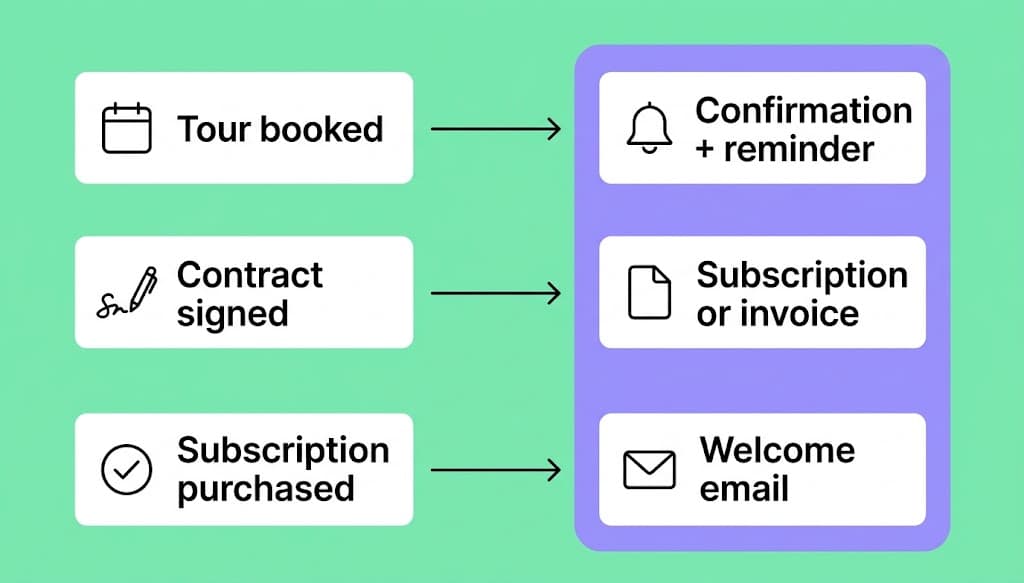
Examples of workflows you can configure using scheduling, contract, and email tools—not automations enabled by default.
Before connecting tools, write down the trigger, action, and owner. For example: “When a tour is booked, send the confirmation and notify the host.” Add what happens if the action fails. A workflow without an owner can lose a lead just as easily as an unattended inbox.
Tour scheduling and reminders
An online scheduler lets prospects choose from times you can actually host. Include directions in the confirmation and make rescheduling straightforward.
Spacebring’s HubSpot tour scheduling integration adds a “Book a tour” button to the member web portal, with a meeting link for each location. Calendar invitations and reminders support the booking process. This connects scheduling to your portal; it does not mean the entire sales pipeline or personal follow-up is automatically managed.
Agreements and the billing handoff
Once a prospect agrees to join, use the approved plan, start date, and charges to prepare the agreement. Check these before sending it, especially for a team with several signers or a negotiated office arrangement.
Spacebring’s contract management supports reusable templates and electronic signatures, and signed contracts can become active subscriptions or issued invoices. This can reduce re-entering agreed details between signing and billing. Payment collection is a separate step: check the available payment options, your gateway, and the member’s payment setup rather than treating a signature as proof of payment.
A useful welcome after purchase
Send practical instructions once the relevant purchase is complete: where to arrive, how to access services, and whom to contact. Avoid sending “your desk is ready” before your team has actually prepared it.
For a subscription purchase, you can configure a welcome-email workflow through Zapier and your email platform. Spacebring’s customer management tools include Zapier and Mailchimp integrations for custom onboarding messages. Match the trigger to how the person joins, test it before relying on it, and prevent duplicate or mistimed messages. This is a configured workflow, not a promise that a welcome sequence runs automatically for every account.
Keep a human check in the loop
Start with one workflow and test it end to end. Check a rescheduled tour, a duplicate inquiry, and a purchase that is not completed. Decide which messages should stop after someone joins or declines, and keep service messages separate from optional marketing subscriptions.
Your automation is working when the right person gets the right next step and your team can see what happened—not simply when more emails are sent.
A good funnel helps people choose well
Start with the next inquiry. Give that person a useful answer, offer a relevant visit, and agree on a clear next step. Record what happened.
As you repeat the process, patterns will become easier to see. You may need more visibility, a clearer plan, a better visit, or less paperwork. Work on the part your evidence points to.
The goal is not to convince everyone. It is to make joining straightforward for people who will be glad they chose your space.
Frequently asked questions
1. What is a coworking sales funnel?
It is the journey from discovering a coworking space to becoming a paying member. A practical model includes discovery, interest, a tour or trial visit, decision, and sign-up, with onboarding and retention following afterward.
2. What is a good coworking tour-to-member conversion rate?
Use your own consistently measured results as a starting point rather than adopting an unsourced percentage as a target. Compare similar plans, locations, lead sources, and time windows. Investigate changes through prospect feedback as well as the numbers.
3. Should a coworking space offer a free trial day?
Consider one when experiencing the space would answer a prospect’s remaining questions. Explain the terms, choose a representative working day, and follow up on the experience. A paid day pass may be a better fit for your capacity and business model.
4. Do I need a CRM to manage coworking leads?
Not necessarily. Start with a shared tracker, clear ownership, and dated follow-ups. Consider a CRM when handoffs, multiple locations, or reporting become difficult to manage reliably with your current setup.
5. How can I improve my funnel without increasing my ad budget?
Review existing inquiries first. Test clearer pricing, helpful replies, easier tour scheduling, more relevant visits, or simpler sign-up. Measure the change before deciding that more traffic is the answer.
6. Can I connect my coworking website to membership software?
Yes. A practical approach is to link website buttons to the relevant plan or booking page. Spacebring supports connecting a marketing website to external hot-desk booking. This gives visitors a route from learning about a service to arranging it, without requiring a native integration for your particular CMS.
7. Which parts of a coworking sales funnel should I automate?
Start with scheduling confirmations, reminders, the agreement-to-billing handoff, and practical onboarding messages. Keep plan recommendations and conversations about fit personal. Give each workflow an owner and test what happens when someone reschedules, declines, or does not finish buying.