


More coworking spaces are renting private rooms by the hour. The people filling those hours have a hard requirement that desk members never mention: confidentiality. A therapist cannot work in a room where the next-door meeting can hear every word, and a coach doing sensitive calls cannot book a room where voices carry into the corridor. For the renters I work with, privacy is not a nice-to-have. It is the difference between a usable room and an unusable one.
The therapy sector has been solving this problem for decades, because its professional bodies make client confidentiality a condition of practice rather than an option. Coworking operators expanding into hourly room rental can learn from established therapy-room practices: stronger acoustic separation, deliberate scheduling, and discreet booking processes. Many first-line improvements are affordable, although structural weaknesses may need specialist advice.
This article covers what actually makes a room private, why scheduling matters as much as walls, and why confidentiality is the quiet differentiator in the hourly rental market.
For therapists, privacy is a condition of practice
Professional and ethical standards treat confidentiality as a duty. The Ethical Framework of the British Association for Counselling and Psychotherapy (BACP), which its members and registrants commit to follow, requires practitioners to "protect the confidentiality and privacy of clients" by actively protecting client information from unauthorised access or disclosure. A room where a session can be overheard could compromise a practitioner’s confidentiality obligations and make a repeat booking unlikely.
This changes how practitioners evaluate a room. They do not ask whether a space is pleasant. They ask whether a client could be heard, seen or identified by anyone else in the building. A room that fails that test is not discounted in their mind. It is removed from consideration. My read on the commercial consequence for operators is simple. The renters who need confidentiality, therapists, counsellors, coaches, solicitors and HR consultants running sensitive calls, are also the renters who book regularly and pay hourly rates without haggling. Cut them out and you lose the best hours of the week.
What actually makes a room private
Sound insulation is measured using different standards in different markets. US sources often use Sound Transmission Class (STC), while UK guidance commonly refers to measures such as Rw or DnT,w. Rather than treating those figures as interchangeable, operators should use them as a prompt to test the room and seek professional advice where needed.
Technical reference:
A basic single-layer drywall partition rates around STC 33 to 35, where normal conversation is clearly audible through the wall. A well-built wall with insulation and a double layer of drywall reaches roughly STC 50, where normal speech is effectively inaudible. In UK health buildings, the design guidance (HTM 08-01) points consultation and treatment rooms at roughly 40 to 45 dB of sound insulation, with more for mental health settings. The gap between "clearly audible" and "inaudible" is where most coworking rooms sit, and it is fixable.
Four weak points account for nearly all sound leakage, and I have found doors are a common source of sound leakage: most coworking room doors are hollow-core, hollow-core doors can provide limited sound insulation, and even a solid door is useless with a gap beneath it. Shared voids come next. Sound travels over the top of partition walls through ceiling voids, and along ducts and pipework, which is why a room can leak into the room next door even when the wall seems solid.
Thin partitions are the third, because lightweight stud walls without insulation pass conversation easily. Windows are the fourth, and single glazing transmits sound almost as well as it transmits light.
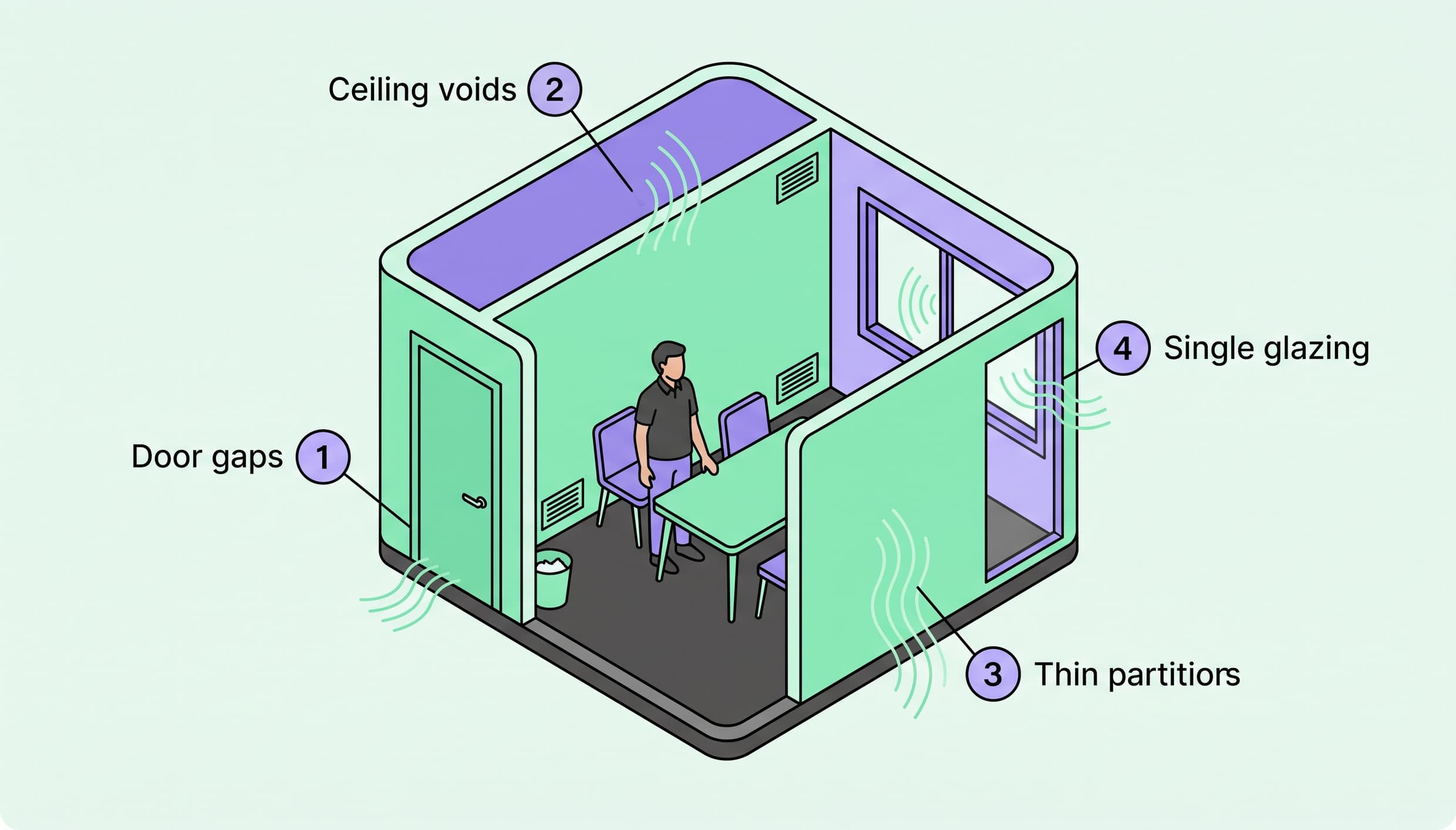
The encouraging part is that the fixes are modest. Replacing a hollow door with a solid-core one and fitting a compression seal and a door sweep around the frame is the single most effective upgrade, and it is often a relatively accessible first upgrade. Heavy curtains or removable secondary glazing tame a noisy window. A full bookshelf against a shared wall adds mass, and rugs with a thick underlay quiet a timber floor. Small things, but they add up. Acoustic foam panels are worth understanding before buying: they absorb echo inside a room, but they do not block sound passing through walls, and the two are regularly confused.
The practical test costs nothing. If I were kitting out a room tomorrow, I would start at the door, and so should you. Run the voice test on every room you plan to let by the hour: have someone speak at a normal volume inside while you stand in the corridor and in the neighbouring room. If you can understand the words, the room is not private enough yet, so start with the door seals and work through the weak points above. If the structure will never fully block sound, put a white noise machine or masking unit in the corridor. Raising the background noise, sound masking can reduce speech intelligibility, but it does not replace appropriate construction or acoustic assessment.
Scheduling is part of soundproofing
Walls are only half of privacy. The other half is who sees whom, and the therapy sector is disciplined about this in ways most coworking spaces are not. The norms are simple and cost nothing. Leave a gap between bookings so one client has left the building before the next arrives: a buffer—often around 15 minutes, depending on the setting—can reduce the chance of clients crossing paths a crying client leaving a session into a non-event rather than a corridor encounter.
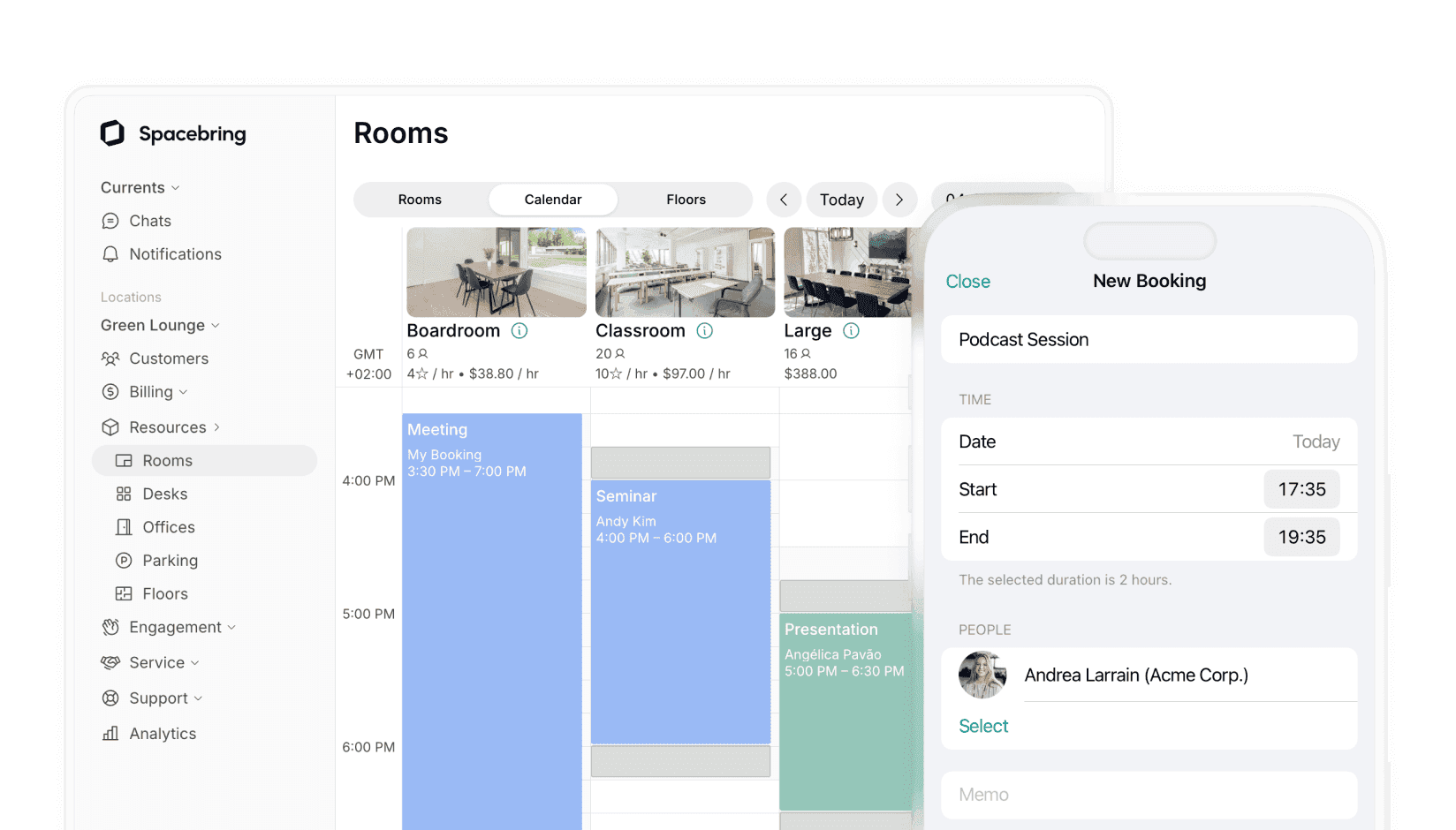
Never display a booker's name on a public screen or calendar, and show "booked" rather than "therapy session with [name]". Keep waiting areas arranged so clients do not face each other, do not call out visitor names over reception, and take note that practitioners often book the same weekly slot, which means the same handful of people use the corridor at the same time, and regulars do not surprise each other.
These rules also protect your other members. Most people do not want to explain why a colleague saw them coming out of a therapy session. A space where that happens quietly develops a reputation quickly. Booking settings are where privacy is often won or lost. Add buffer time between reservations, keep booker details visible only to authorised staff, and describe confidential-work suitability clearly in the room listing.
With Spacebring, operators can publish room availability, let external customers book and pay online, and manage room reservations in one place. That makes it easier to build buffers into the schedule while keeping the booking experience simple for practitioners.

Generate recurring revenue and offer exceptional customer experience at your shared or coworking space
Privacy is what gets a room booked again
The market data shows how much this matters. On Rent A Therapy Room, the UK marketplace for treatment rooms, published hourly rates cluster between £10 and £25, with £15 the most common, and monthly rents mostly run £200 to £500. Practitioners often value consistency because changing rooms during an ongoing client relationship can be disruptive.
A room with a leaking door and thin walls gets one booking and no repeat, while a room where a practitioner can guarantee their client was not overheard becomes their regular weekly booking, and practitioners talk to each other. In a small professional community, "the room above the gym is fine" is worth more than any listing.
Confidential hourly room rental depends on more than a pleasant room. Operators need practical acoustic improvements, discreet arrival and waiting-area processes, and booking rules that protect client privacy.
Spacebring helps coworking spaces manage room availability, bookings, payments, and access in one system. See how Spacebring supports room scheduling.
Frequently asked questions
1. How can I tell if a room is private enough for confidential work?
Run the voice test. Stand in the corridor and the adjoining room while someone speaks at a normal volume inside. If you can understand words, assume a client could be heard, and fix the door seals and other weak points first.
2. What is the cheapest way to improve a room's privacy?
Seal the door. A hollow-core door should be replaced with a solid-core one, and compression seals plus a door sweep close the gaps that let most speech escape. This is a small cost and the highest-impact single upgrade.
3. Does acoustic foam make a room soundproof?
No. Foam panels absorb echo and improve sound quality inside the room, but they do not stop sound passing through walls, doors or ceiling voids. Block transmission first, then treat the echo.
4. How should room bookings appear to other members?
Show availability without exposing booker or client names. Limit booking details to authorised staff, and consider what information is included in confirmation emails, notifications, visitor records, and public displays.
Sources
- BACP Ethical Framework: Confidentiality
- NHS England: Health Technical Memorandum 08-01 (Acoustics)
- STC rating chart: walls, doors and windows
- Rent A Therapy Room: how to soundproof a therapy room on a budget
- Rent A Therapy Room: what to look for when renting a therapy room
- Rent A Therapy Room live listings
- How coworking spaces can rent private rooms by the hour (Spacebring)