


The coworking industry has exploded over the last few years—remote and hybrid work have completely changed how people think about offices. But while the demand for flexible spaces is rising, so is the competition.
If you’re managing or marketing a coworking space, you’ve probably realized that just being “nice” or “well-designed” or photos & videos isn’t enough anymore. You need a clear sales strategy—one that not only attracts people to your space but also makes them say, “This is exactly where I need to work.” A flipbook creator can help you do that by creating a digital publication of your offer with photos, pricing, amenities, and other details. You can even add a lead capture form so interested people can get in touch.
This guide breaks down powerful yet simple strategies—not abstract marketing talk, but real methods used by successful coworking spaces around the world. Let’s turn your tours into sign-ups and your leads into loyal community members.
1. Use psychological pricing to influence buying decisions
Ever noticed how Apple shows the most expensive iPhone first? That’s no accident—it’s psychology. You can use the same trick to sell more coworking memberships.
Apply the anchoring technique
Anchoring helps people perceive value based on the first price they see.
Example: a workspace in Dubai added a “Private suite” at $2,400/month above their “Dedicated desk” plan for $690. Hardly anyone chose the suite, but sign-ups for the mid-tier plan skyrocketed by 25%—simply because the cheaper plan now looked like a steal.
How you can apply it:
- List your most expensive plan first on your website or brochures.
- Clearly highlight your mid-tier as the “most popular” or “best value.”
- Use visuals—color, icons, and layout—to make that middle option stand out.
This simple tweak can change how people perceive your entire pricing structure—without changing your actual prices.
Use framing to emphasize value
Framing is all about telling the right story. Instead of focusing on what something costs, you highlight what your customer gains.
Example: instead of saying, “Membership is $699/month,” try:
“For less than your monthly coffee and commute costs, you can work from a professional space that helps you focus, connect, and grow.”
Suddenly, $699 doesn’t sound like an expense—it feels like an investment.
Use comparison charts to show savings, or calculate how much time and money a person could save by joining your coworking space instead of working from cafés or home.
Build reciprocity with genuine offers
Human psychology says: when you do something nice for someone, they naturally want to return the favor.
Example: a coworking space in Berlin started hosting free “Trial Fridays” once a month. They offered coffee, workspace access, and a friendly community tour.
Result? One-third of the visitors became paying members.
You can offer small but memorable gestures like:
- A free day pass or meeting room credit.
- A coffee voucher for visitors.
- A handwritten thank-you card after tours.
These little touches make people feel seen, and that feeling often leads to conversions.
2. Personalize your sales funnel
Coworking spaces serve all kinds of people—freelancers, remote employees, startups, and even enterprise teams. But not everyone joins for the same reason.
Your marketing should reflect that. Stop sending one-size-fits-all emails or using generic language like “flexible workspace for everyone.” Instead, tailor your message to what each audience actually values. If use AI to draft follow-up emails, make sure the final version sounds genuinely personal, running it through an AI to human text converter can help soften the tone and avoid robotic phrasing.
Example:
- A freelancer might want affordability and community.
- A startup may look for scalability and investor-friendly space.
- A corporate team needs privacy and security.
Pro tip: when someone books a tour, ask a few questions upfront (“Are you looking for a private office or open space?”). Then, during the tour, highlight what they care about most. After the visit, send a personalized follow-up referencing what they said. Also, make sure to add them to your coworking space CRM (or at least a spreadsheet).
People buy when they feel understood.
3. Make your website work harder than you do
Your website should be your best salesperson—available 24/7, friendly, and always ready to close a deal.
Here’s how to make it happen:
- Add an online booking system so visitors can schedule tours instantly.
- Display clear pricing and membership plans—no hidden fees.
- Include real photos and videos of your community (not stock images).
- Use testimonials and social proof to build trust.
Example: a coworking brand in Toronto added a “Book a tour” button on every page—not just the contact page. Their tour requests jumped by 40% in one month.
Pro tip: if you use Spacebring, you can integrate your booking, pricing, and management features directly into your website—so visitors can go from browsing to booking in one smooth experience.
4. Create flexible memberships and add-ons
People love flexibility. A freelancer doesn’t want to commit for six months, and a startup might need extra space next week.
Example: a space in Amsterdam started offering “weekend-only” passes and “night memberships” for late-night workers. They also sold add-ons like mail handling and locker rentals. Within 60 days, their revenue increased by 15% without adding a single new member.
Ideas to try:
- Offer daily, weekly, or flexible-hour passes.
- Add services like virtual addresses, podcast studios, or storage lockers.
- Bundle perks—like “Private office + 4 hours of meeting room”—for easy upsells.
These options give customers control, and control builds trust.

Discover how hundreds of spaces worldwide unlock success and grow better with Spacebring
5. Use data to sell smarter, not harder
Sales isn’t about guessing—it’s about understanding patterns.
Track these metrics regularly:
- Tour-to-member conversion rate.
- Most popular membership tier.
- Churn rate (how many members leave).
- Lifetime value per member.
Example: a workspace in Singapore noticed most cancellations happened at month three. They introduced a “Member success check-in” at week eight—a simple coffee chat with the community manager. Their retention jumped by 20%.
With Spacebring’s analytics, you can track occupancy, usage, and sales trends—turning your intuition into solid data-backed decisions.
6. Turn events into sales opportunities
Coworking spaces are built on community, and nothing sells community better than events. But the secret is to design events strategically.
Example: a space in Toronto hosted “Freelancer Fridays,” inviting non-members to work for free once a month. By the end of the first quarter, 40% of attendees signed up for full memberships.
Event ideas that convert:
- Networking breakfasts (bring local entrepreneurs together).
- Skill-sharing sessions with your own members.
- Open house days where anyone can visit and try the workspace.
These events don’t just fill your space—they fill your sales pipeline.
7. Tell a story, don’t just sell a space
Your coworking brand is more than desks and chairs. It’s a story about why you exist.
Example: a coworking hub in Copenhagen built its brand around sustainability—solar panels, recycled furniture, and green design. They didn’t compete on price; they stood for something. Their members joined not just to work—but to be part of a purpose.
What’s your story? Maybe you’re supporting local startups, empowering women entrepreneurs, or fostering creativity.
Share that mission proudly—on your website, during tours, and across social media. People connect with emotion before they compare features.
8. Build partnerships and reward referrals
Sometimes your best salespeople are your current members.
Example: a coworking space in Madrid launched a “Refer & earn” campaign. Each referral earned both the referrer and the new member a free week of coworking. Within two months, new memberships rose by 25%—all from word-of-mouth.
Ideas to implement:
- Give members credits, discounts, or small gifts for each referral.
- Partner with local cafés or fitness studios for cross-promotions.
- Collaborate with business service providers (like accountants or designers) for member perks.
When your community grows together, everyone wins.
9. Follow up—the step most people forget
You’d be surprised how many coworking leads disappear simply because no one followed up.
After a tour or inquiry, wait 24–48 hours, then send a friendly email like:
“Hi Sarah, it was great meeting you yesterday! I think the dedicated desk near the window would be perfect for your design work. Let me know if you’d like to start next week—I can reserve it for you.”
Example: a coworking space in Melbourne introduced a simple “three-touch” system—follow-up email, personal call, and LinkedIn message. Within 60 days, their closing rate jumped by 33%.
Automation tools can help, but never underestimate the power of a personal note.
Key takeaways
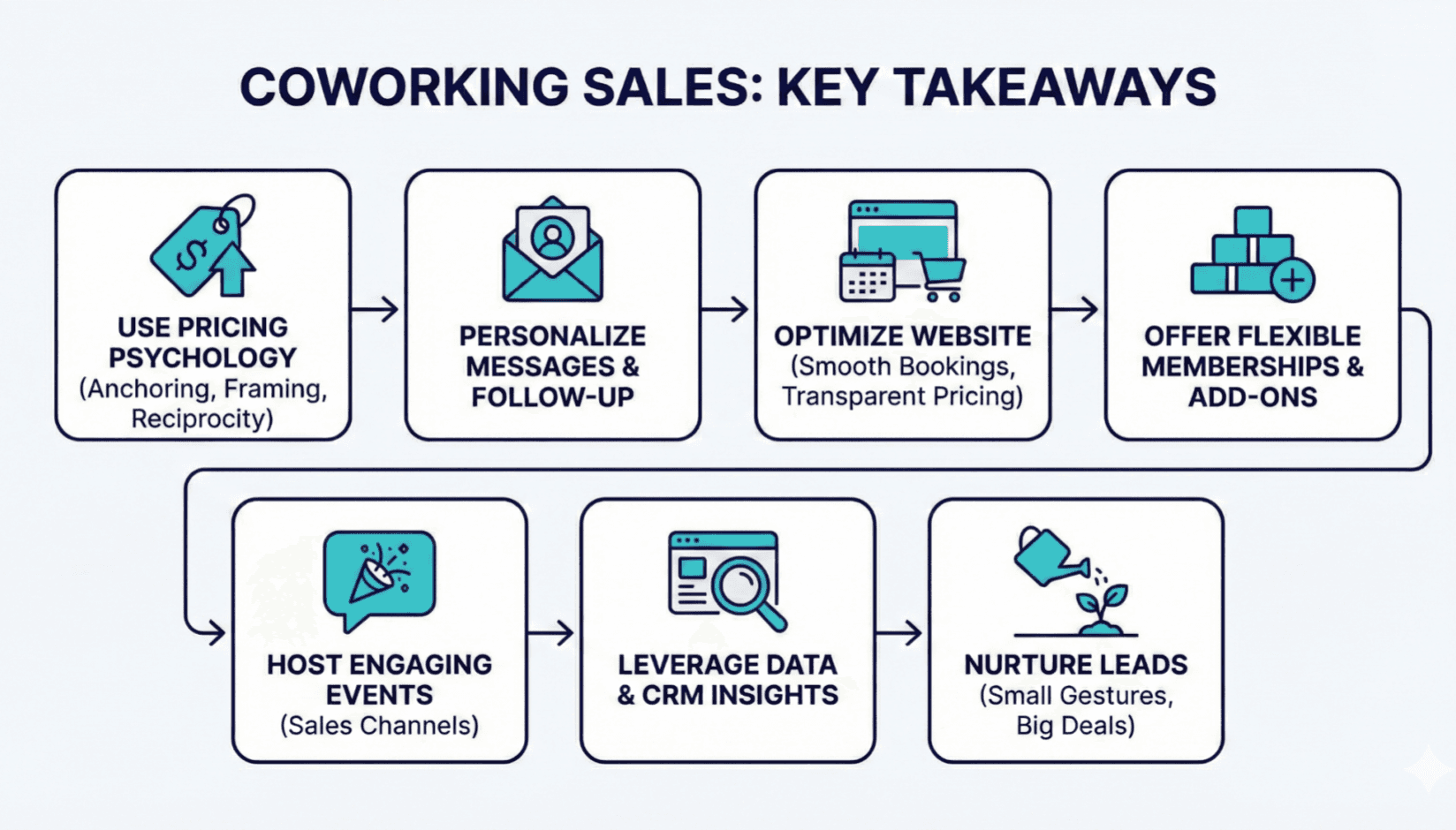
- Use pricing psychology (anchoring, framing, reciprocity) to boost conversions.
- Personalize every message and follow-up.
- Optimize your website for smooth bookings and transparent pricing.
- Offer flexible memberships and meaningful add-ons.
- Host engaging events that double as sales channels.
- Leverage data and CRM insights for smarter decisions.
- Keep nurturing leads—even small gestures can close big deals.
Final thought
Selling coworking memberships isn’t about pressure—it’s about connection. Every tour, event, and email is an opportunity to help someone find their ideal workspace.
When you combine psychology, data, and genuine human interaction, your sales won’t just grow—your community will thrive.
Ready to take your coworking sales to the next level? Book a Spacebring demo to see how the platform helps you attract leads, manage memberships, and convert interest into loyal customers—effortlessly.