


In the coworking industry, the relationship between the space owner and its users (aka members) is defined by a Service or Membership Agreement. This core legal document lays out the partnership—what members can expect, what the operator provides, how payments work, and where responsibilities fall.
It’s the framework that turns good WiFi and open desks into a structured, profitable business relationship. A strong agreement protects your space, sets clear boundaries, prevents disputes, and supports a smooth member experience that encourages ongoing renewals.
As more professionals and companies adopt remote or hybrid work, coworking spaces are serving both freelancers and business clients. Great news for revenue, but it also means more administrative complexity, with different contracts, membership tiers, and policies to manage.
Fortunately, platforms like Spacebring let you get rid of all this extra administrative headache. In addition to managing the most important aspects of coworking space management, Spacebring also offers electronic contracts and eSignatures that eliminate the need for paperwork and filing cabinets.
These features automate the sending and signing of the contract, and robust platforms like Spacebring even automate access revocation for late payments. However, while the operation is automated, the financial settlement often relies on traditional banking layers, and complex deals (like revenue shares) still require accounting oversight.
This is where smart contracts come in. They can take coworking automation to the next level. If you’re unsure how they work, no worries, keep reading to see what smart contracts are and how they fit into the coworking world.

Generate recurring revenue and offer exceptional customer experience at your shared or coworking space
What are smart contracts & how do they apply to coworking automation?
In plain terms, a smart contract is a self-executing agreement with the terms written directly into code. It's an application that runs on a decentralized network, typically a blockchain (such as Ethereum).
In the context of a coworking Membership Agreement, a smart contract is a digital, self-enforcing membership agreement that links payment, access, and service provision directly through code on a blockchain.
For a better understanding, don’t think of the smart contract as a document. Instead, think of it as an unbiased, autonomous program living on your network that continuously checks if specific, defined conditions have been met. When conditions are met, it executes the corresponding action without requiring a human manager or a separate admin system prompt.
Here are a few examples of how smart contracts work:
- Manage automated access: IF payment for a daily pass is confirmed, THEN grant temporary access to the Wi-Fi and door lock.
- Handle booking and payment: IF a meeting room is booked and the required payment is processed, THEN reserve the time slot and update the shared calendar.
Overall, when compared to traditional contracts, the benefits of using smart contracts become obvious. Besides the self-executing feature, they’re also decentralized, meaning they’re immutable (unchangeable) and transparent.
Also, since the code dictates the execution, you don't need to trust the other party or a legal intermediary to ensure the terms are honored. Trust is placed in the code itself.
Finally, they eliminate the manual steps often required in traditional processes. This speeds up transactions and reduces administrative overhead.
How to use smart contracts for workspace automation
The best part about smart contracts is that they move beyond simple membership billing and automate complex interactions, helping coworking spaces feel more fluid for both staff and members.
Here are a few examples of how implementing smart contracts boosts internal processes automation:
1. Membership management & physical access control
Automate late-payment monitoring by having the smart contract check each member's wallet status on the day of their membership renewal.
If the payment status checks out, the contract sends an API command to your lock system to renew the key card/app access for 30 days. However, if there’s no pay after a 3-day grace period, the system automatically deactivates the access credential until payment is made.
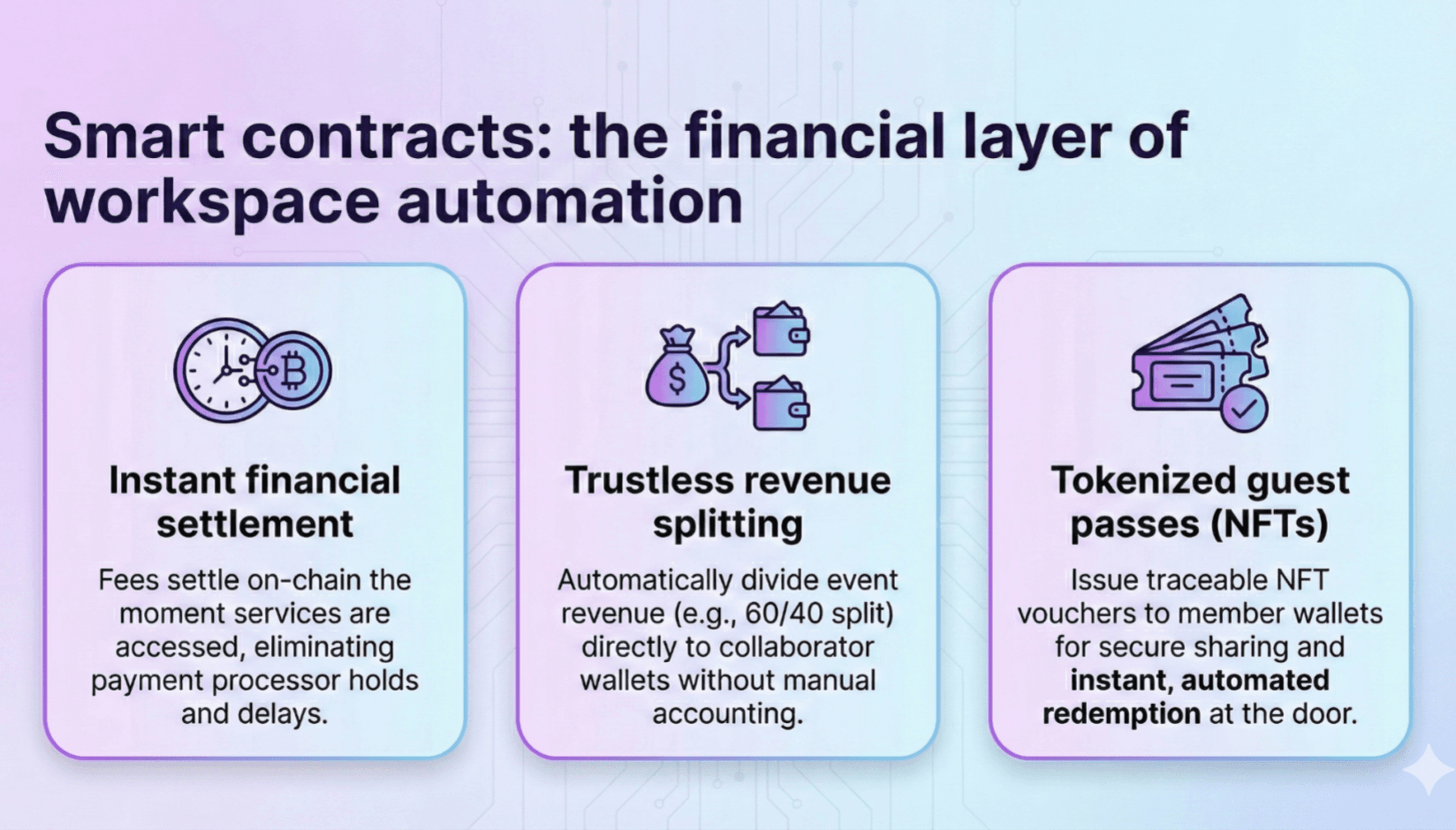
While leading coworking platforms already automate these access checks, smart contracts add a layer of financial immediacy—settling the payment on the blockchain the exact second access is renewed, eliminating credit card holds or payment processor delays.
2. The management of flexible memberships
Let’s say a hot-desk member needs a private office for three hours. They initiate the upgrade purchase via an app linked to the contract.
Once the contract receives the three-hour fee, it instantly executes the upgrade and grants temporary access credentials to the chosen (or available) private office for that specific time window.
This allows members to instantly pay for and receive service upgrades (like printing credits, extra guest passes, or private office time) without waiting for staff approval or manual activation.
Of course, the power of automated membership management extends beyond coworking spaces. It works across every industry that offers subscription-based services and recurring appointments, like telehealth, where platforms for online doctors can automatically schedule follow-ups, manage payments, update patient access, and trigger reminders without a receptionist juggling calendars.
3. Working with collaborators or partners
Many coworking operators open their spaces to non-members to diversify revenue streams, but the administrative side can get messy fast.
Imagine partnering with an outside professional to host a paid workshop with a 60/40 revenue split (60% for your space, 40% for the collaborator). Because this isn’t a recurring process, typical coworking platforms can’t fully automate the immediate split of funds. That leaves accountants and sales reps handling manual calculations and payouts—slower, more expensive, and prone to mistakes.
With a smart contract, the entire workflow runs itself.
Tickets are sold through a platform linked to the contract, payments flow into a shared pool, and once sales close, the contract automatically splits the revenue and pays each party’s digital wallet. No spreadsheets, no manual oversight.
The same applies to service vendors—maintenance, utilities, safety checks, and more.
For instance, instead of having team members track when electrical work is needed, you could plug your preferred commercial electrical contractor into a smart contract workflow. When a new membership is activated or usage hits a defined threshold, the system instantly triggers a notification or books the service, keeping operations running smoothly with minimal human intervention.
4. Managing member benefits
One way to increase the number of members who choose you over the competition is through your benefits game. The more creative and beneficial they are, the more likely they are to attract potential clients’ attention.
But again, this creates a bit of chaos behind the scenes. For instance, say you want to offer premium members 5 "Guest Day Passes" per month. They can offer these Day Passes to whomever they want.
Now, how do you handle this? The entire process involves several steps that require human supervision, such as generating the passes and making sure they are scrapped once used.
But with an upgradeable smart contract, you can just introduce a new clause and automate everything.
Here’s what this would look like in code:
- IF the member's fee is paid
- THEN the smart contract issues 5 non-fungible tokens (NFTs) or digital vouchers to the member's wallet
- The member digitally sends these unique tokens to their guests
- IF the guest scans the token at the front door/check-in, the contract verifies its authenticity and instantly grants one-day access (activating key card, Wi-Fi, etc.). The token is then scraped or marked as used.
By streamlining guest management, you prevent unauthorized use of benefits, keep members happy, and increase your business's visibility to new users.
Benefits & limitations of smart contracts in the coworking industry
No, smart contracts are not the answer to all your problems. While they push workplace automation further, they are rigid. A standard smart contract is deterministic—it follows fixed IF/THEN logic and always delivers the same output for the same input.
That’s where AI agents can step in, especially solutions like an AI Agent Builder that help teams create adaptive, intelligent agents capable of interpreting real-time data, learning from patterns, making predictions, and triggering smart actions on their own. They can interpret complex, real-time data, learn from patterns, make predictions, and trigger actions on their own.
In this setup, the AI becomes the decision-making layer that guides the contract’s execution.
Picture this: You have an AI agent analyzing market conditions, supply chain delays, and rising energy costs. With this addition, a smart contract could then read: “IF the AI predicts a 10% increase in utility expenses next month, THEN adjust membership fees by 3% for the next billing cycle.”
Suddenly, a limitation becomes an advantage—smart contracts gain flexibility without sacrificing automation.
It won’t be the perfect solution every time, but it expands the toolkit. With that in mind, let’s explore the key benefits and challenges smart contracts bring to the coworking industry.
The benefits
- Guaranteed, real-time enforcement: The contract terms (e.g., payment due, access rights) are enforced immediately by the code, not by a person. This eliminates administrative lag and reduces collections/dispute resolution costs.
- Trustless, transparent transactions: All transactions (payments, refunds, service activation) are recorded on an immutable ledger (the blockchain) visible to all parties. This builds member trust and eliminates disputes over money and service records.
- Reduced intermediation and cost savings: No need for traditional payment processors, manual accounting oversight, and other similar services. This leads to lower transaction fees (depending on the blockchain used) and reduced personnel costs.
- High automation of access and services: Direct links (APIs) between the contract code and physical systems (locks, Wi-Fi routers, booking calendars) allow services to be delivered instantly upon payment/verification, without human oversight.
The limitations
- Connecting code to the real world: Smart contracts are self-contained. They cannot natively verify real-world facts crucial to a coworking space. For this, they rely on secure data feeds. So, if the data that triggers the contract's "Payment received" action is compromised or fails, the contract will execute the wrong action (e.g., lock out a paying member).
- Immutability and bug risk: Once the smart contract code is deployed to the blockchain, it is nearly impossible to change. This also means that any mistakes discovered after the fact could be costly and complex to fix.
- Legal status and real-world liability: The legal enforceability of the code executed by a smart contract varies by jurisdiction. This means that a human judge is still required to settle complex liability disputes.
- Technical integration and cost: You’ll need full integration between smart contracts, your existing software, and your physical infrastructure. That means hiring specialized blockchain developers for coding and audits—which isn’t cheap—and ensuring your blockchain platform works seamlessly with current access systems like key cards and fobs.
In summary
Smart contracts may be the logical next step of workspace automation, but integrating them requires a significant upfront investment. The greatest challenge for a physical business like a coworking space is securely bridging the gap between the predictable, digital world of the blockchain and the unpredictable, physical reality of your office.
We may not be fully there yet, but with the acceleration of technologies like AI, that gap could close much faster than anyone expected.