
The United Kingdom's flexible workspace sector has officially crossed the threshold from an alternative real estate niche into a core pillar of corporate infrastructure. The market, valued at $571 million in 2023, is accelerating toward a projected $1.59 billion by 2030, driven by a compound annual growth rate of more than 15%. The UK now hosts over 4,200 active coworking space locations, representing one of the densest and most mature flexible office ecosystems globally. Contract lengths have stretched to an average of 22 months, signaling institutional confidence, while national occupancy remains remarkably strong, frequently exceeding 80%.
For space owners and operators, this macro-level growth appears highly favorable. However, on the ground, the operational reality in 2026 is vastly more complex and unforgiving. The era of leasing a building, installing standard furniture, and waiting for freelancers to organically fill the space has ended. Today’s operators face a hyper-competitive landscape where success is dictated by digital conversion rates, hyper-specific brand positioning, and the ability to capture corporate overflow in regional hubs. The physical space is now only half the product; the digital experience and the highly curated community form the other half.
Based on an exhaustive audit of 2026 market data across multi-site chains and independent hubs, this report details exactly what competitors are charging, how they are selling, and what amenities are actually moving the needle. Here is the evidence-based operational intelligence UK coworking space owners need to navigate the year ahead.
Download the full report
Access the complete UK coworking space market report 2026, including the full 231-location dataset, pricing benchmarks, booking-friction analysis, and regional market insights.
View or download the report (PDF)
Methodology: the 10 market metrics we tracked
To ensure this report delivers concrete, actionable intelligence rather than speculative trends, our primary dataset is based on a rigorous, line-by-line audit of 231 flexible workspace locations across the UK.
Our survey evaluated a comprehensive cross-section of the market. We tracked data across 15 major primary and secondary cities, including London, Manchester, Birmingham, Leeds, Edinburgh, Glasgow, Reading, Bristol, Cardiff, Sheffield, Nottingham, Derby, Liverpool, Cambridge, and Oxford.
The operators audited ranged from global corporate networks to localized independent hubs, including Work.Life, Cubo, Elementa (formerly Landmark), Fora, Regus, Spaces, WeWork, Colony, Square Works, The Melting Pot, and Tramshed Tech, as well as a diverse cohort of highly successful independent hubs such as Knotel, Generator Hub, The Residence Coworking, The Workshop Folkestone, and Native Space.
We systematically evaluated these 231 coworking and flex spaces against ten strict criteria. Operators can use this exact framework to benchmark their own spaces against local competitors:
Hard numbers & pricing
1. Monthly desk prices (Hot Desks vs. Fixed Desks). The actual advertised monthly cost, allowing owners to accurately benchmark rates and ensure they aren't leaving money on the table.
2. Private office entry prices. The baseline "starting from" price for small offices, which remains the primary revenue driver for most spaces.
3. Are day passes sold online, and how much do they cost? With micro-requirements (1–2 desks) accounting for nearly 67% of UK market demand, using desk booking software to implement a frictionless day-pass strategy is essential.
4. Pricing transparency. Do operators display prices openly on their website, or do they hide them behind a "Get a quote" form?
Branding & audience
5. Core marketing pitch. The primary headline and positioning on the homepage (e.g., "Community," "Luxury design," or "Productivity/corporate"), revealing which marketing angles are currently oversaturated.
6. Target audience. Who the website's copy is explicitly written for, from freelancers and tech startups to corporate remote teams.
7. The amenity checklist. What is included for free versus what incurs an extra charge (e.g., 24/7 access, podcast studios, free meeting room hours, bike storage).
Location & competition
8. Chains vs. independents. Whether the local city market is dominated by corporate giants or local independent operators.
9. Neighborhood clustering. The exact geographic distribution of spaces—whether they are clustered in trendy city centers or spreading out into the suburbs.
The digital front door
We tested the digital user journey to evaluate how easily a customer can purchase a pass or book a room, scoring each operator's booking friction on a scale of 1 to 3:
10. Booking friction score
- Score 1 (Easy). Click, pay, and book instantly online.
- Score 2 (Medium). Customers cannot buy instantly, but can pick a time for a tour on a live calendar.
- Score 3 (Hard). Forced to fill out a static contact form and wait for a sales representative to email back.
The pricing landscape: transparency vs. the gated trap
Pricing strategy in 2026 is defined by a widening structural chasm between London’s premium core and the rapidly standardizing regional markets. Based on our market dataset, the median monthly coworking space membership in the UK currently sits around £250 (a metric that specifically tracks flexible hot desking rather than a blended average of all desk types). For context, private office rates sit in an entirely different financial bracket, averaging roughly £680 per desk per month in London alone.
Greater London remains the undisputed heavyweight, containing roughly 33% of the UK’s total inventory. In the capital, operators command severe premiums. An analysis of major providers reveals that entry-level coworking space membership in London sits at a median of £350 per month, with dedicated desks and private suites scaling dramatically higher. The City and Westminster sub-markets have seen a massive influx of inventory, driving a highly segmented market where premium managed spaces can charge upwards of £1,000 per desk, while fringe zones occasionally offer rent-free periods to combat localized oversupply.
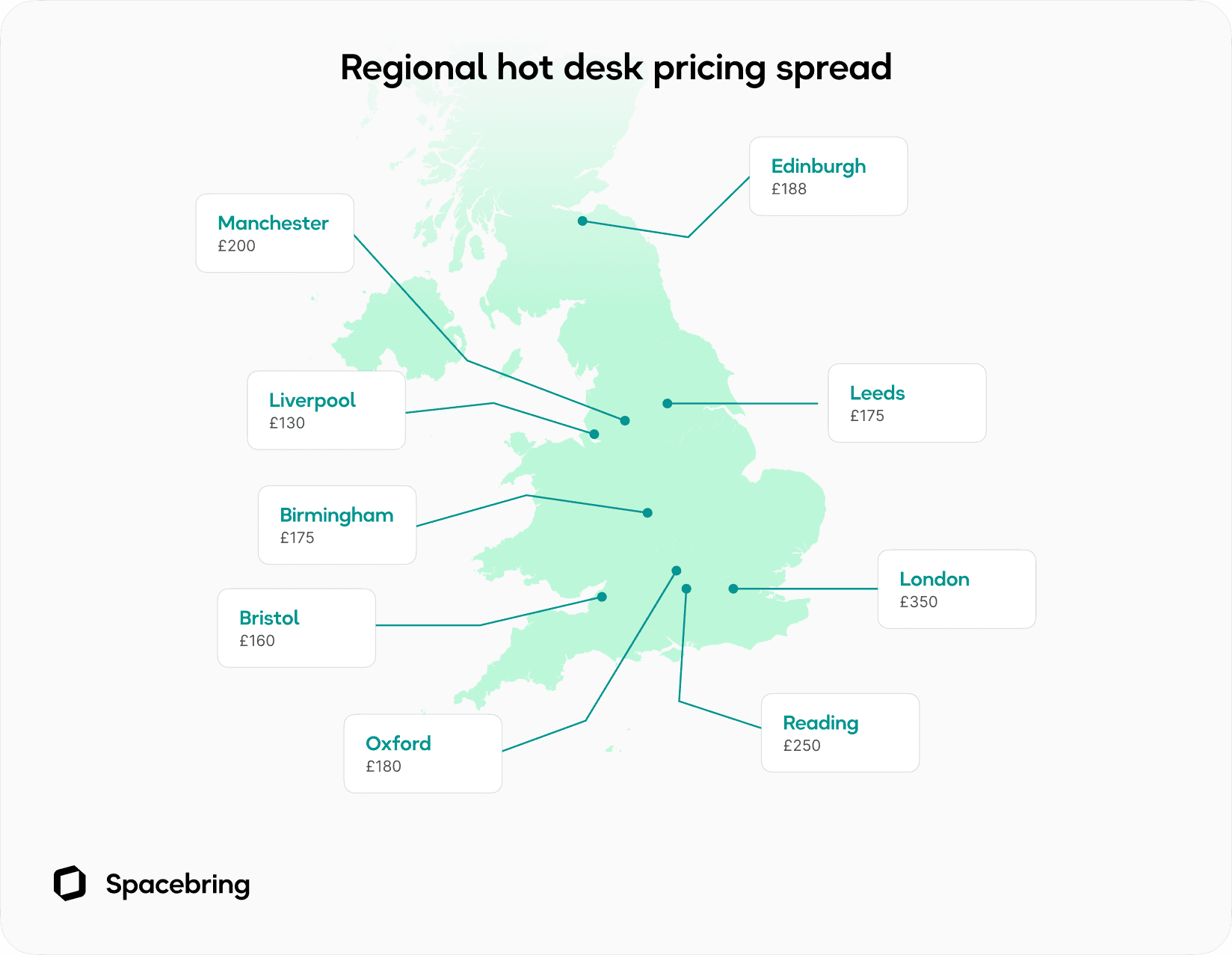
Conversely, regional powerhouses have standardized into a highly predictable pricing bracket. Regional markets remain far below London, but the exact medians vary: Manchester £200, Bristol £160, Leeds £175, and Edinburgh £187.50 per month in our snapshot.
Oxford stands out as a unique regional anomaly within our dataset; its city-wide median rate commands the highest price outside the capital at an estimated £179.50 per month, though individual premium operators in cities like Bristol and Edinburgh can peak much higher, while cities like Liverpool represent the value end of the spectrum at £130.
However, broader market data shared by our partners at the Instant Group indicates a slight national cooling in top-line flexible pricing averages entering 2026, alongside fierce competition in established secondary markets. While central hubs stabilize, London commuter towns are experiencing significant pricing power; High Wycombe and Marlow saw flexible pricing growth of 29% and 18% respectively, highlighting where the real heat in the market currently lies.
It is important to note that direct price comparisons can be nuanced depending on membership tiers. For example, a premium, unlimited access package at a high-end regional independent space (like Square Works in Bristol) can occasionally outprice the restricted, entry-level corporate tiers in central London.
| Operator | Location focus | Hot desk (monthly) | Fixed desk / Private office | Operational positioning |
| Cubo | Regional (Manchester, Leeds, etc.) | £175 | £199 | Premium / Corporate |
| Cubo | London (Soho) | £275 (Entry / 12-mo) | £575 | Premium / Corporate |
| Work.Life | London / Regional | £30 - £50 (Roaming) | £373 - £800 (Private) | Startups / SMEs |
| Square Works | Bristol | £320 (Unlimited) | £350 | Independent / Creative |
| The Melting Pot | Edinburgh | £200 | £300 | Community / Social Impact |
| Tramshed Tech | Cardiff | £199 | £250 | Tech / Digital Focus |
| The Residence Coworking | Bishop's Stortford | £144 - £231 (Part-time) | £438 | Suburban / Community |
| Generator Hub | Exeter | £125 | £225 | Regional / Tech |
| GAS | Southend-on-Sea | £50 | £270 | Creative / Local |
Data compiled from verified 2026 operator listings, rate cards, and our 231-location market audit. Note: Excludes VAT where applicable.
Beyond the raw numbers, the most pressing operational issue is the industry's approach to pricing transparency. The sector currently suffers from a consumer trust deficit. A comprehensive audit of our 231 digital storefronts reveals that the vast majority of large operators utilize a "partial transparency" model. Operators publicly list low entry prices for basic hot desks to capture top-of-funnel leads, but fiercely gate the pricing for dedicated desks, private offices, and essential add-ons behind mandatory contact forms and sales calls.
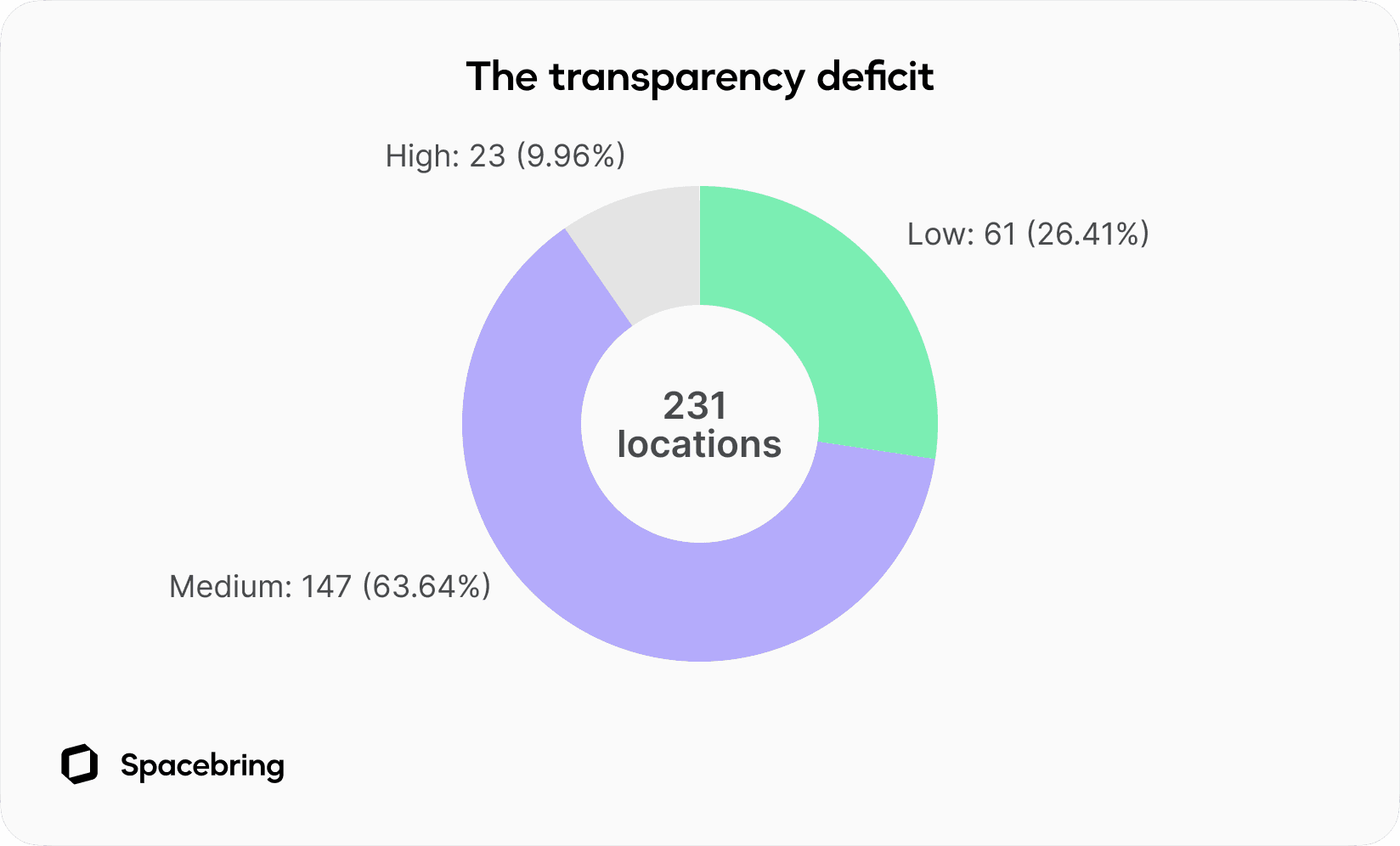
For example, premium managed office providers heavily obscure their rates. An operator might list basic space access—such as Elementa (formerly Landmark) officially offering casual coworking space memberships from £40 per month—but intentionally hide the £400 to £1,200 per person, per month reality of their private, productivity-focused suites until the prospect is on the phone.
This strategy is increasingly dangerous. The modern consumer—whether a freelance designer or an enterprise procurement officer—expects a digital experience akin to booking a hotel or subscribing to SaaS software. Hiding costs behind a "Request a quote" button builds frustration, not intrigue. Independent operators who publish fully itemized rate cards, including clear rules on meeting room credits and fair usage policies, are successfully leveraging this transparency as a distinct competitive differentiator.
Furthermore, new regulations from the Competition and Markets Authority (CMA) under the Digital Markets, Competition and Consumers Act 2024 specifically target opaque pricing. "Drip pricing" and the concealment of mandatory fees are now subject to strict enforcement, making absolute pricing transparency not just a marketing advantage, but a legal necessity for UK operators.
The digital checkout crisis: measuring booking friction
If there is one metric that defines operational success or failure in 2026, it is the booking friction score. For years, the coworking space industry operated on a high-touch, manual model: a prospect fills out a contact form, a community manager replies a day later, a physical tour is scheduled, and eventually, an invoice is generated.
Today, consumer behavior has fundamentally shifted. Customers are actively comparing an operator's website booking process to the frictionless ease of ordering an Uber or checking out on Amazon.
To quantify this, the market was evaluated on our three-point friction scale. Out of the 231 locations audited, our dataset reveals that Score 3 (High friction) remains endemic, affecting 52.8% of the UK market. Meanwhile, 8.2% offer medium friction (Score 2). However, by incorporating a cohort of modern independent spaces running on automated platforms, we found that 38.1% of the market now achieves a frictionless Score 1 checkout.
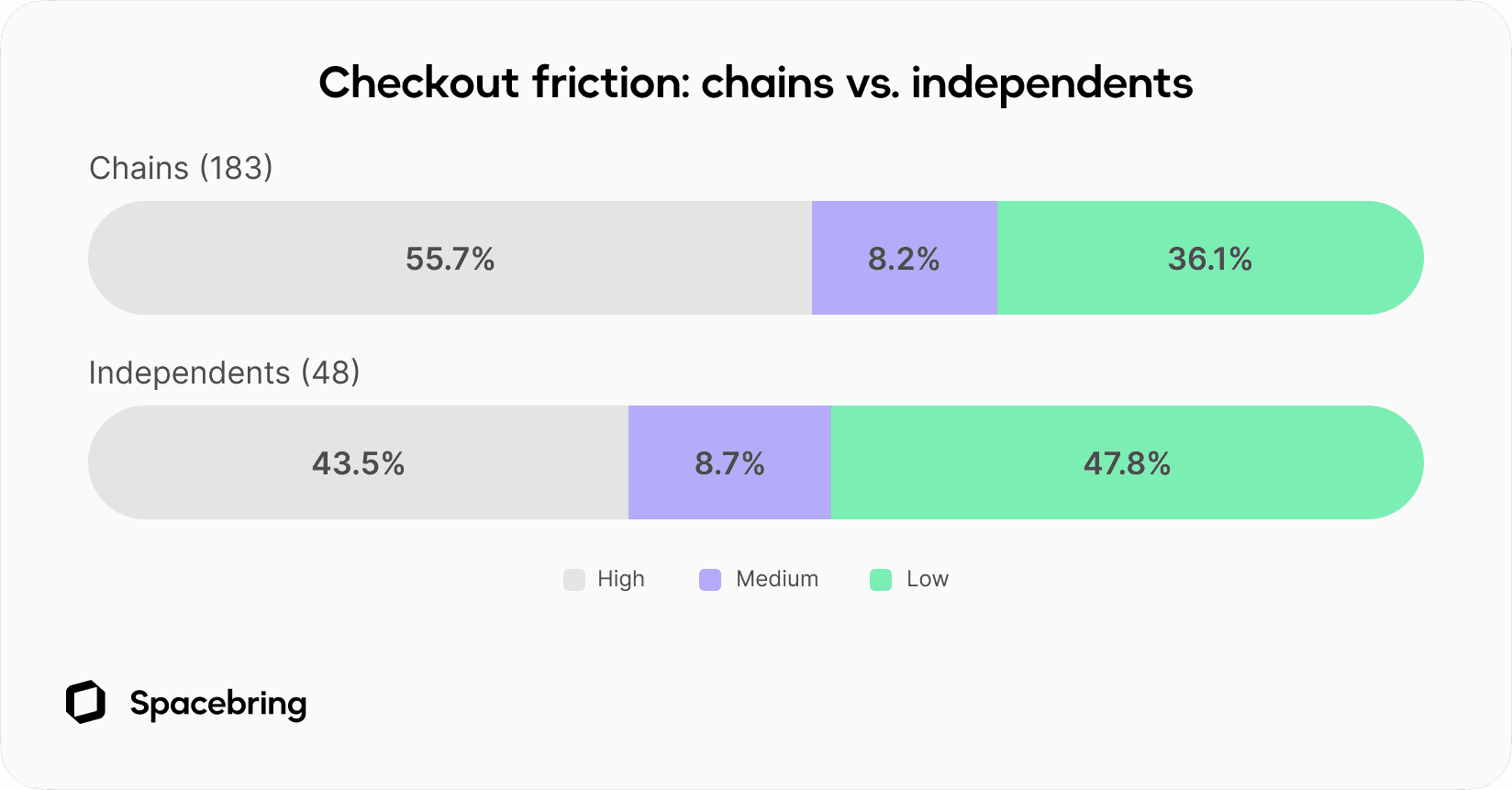
Even among well-capitalized chains, the digital journey frequently terminates in a static contact form. This represents a catastrophic loss of revenue. When a human or an AI agent lands on your website looking to book a meeting room for the following morning or secure a day pass while traveling, their decision window is incredibly narrow. If they cannot view real-time availability, confirm pricing, and check out instantly, they abandon the site for a competitor offering instant gratification.
The financial impact of this friction is most visible in meeting room utilization. Demand for collaborative space has surged, yet booking-to-occupancy ratios suffer deeply when the underlying technology is clunky. The market is currently experiencing a "meeting room tax," a compound loss of productivity and revenue driven by abandoned bookings, phantom reservations, and administrative overhead.
To survive, operators must transition from viewing their websites as static digital brochures to treating them as fully integrated e-commerce engines. The integration of live availability calendars, automated payment gateways, and instant-access credentialing is no longer a luxury; it is the baseline expectation. Platforms specializing in seamless digital buying experiences, with features like meeting room booking, are rapidly becoming the backbone of high-yield spaces. The checkout experience is a critical conversion point, and friction at this stage pushes highly qualified leads directly to competitors.

Brand positioning: the death of the basic desk
In 2026, the physical space offered by an operator is only half the product. The market is experiencing a massive "flight to quality," meaning operators can no longer compete simply by offering a desk and a functional Wi-Fi connection. If that is the extent of the offering, the customer will simply choose to work from their living room, where the commute is nonexistent, and the coffee is free. Positioning must be surgical. The most profitable spaces in the UK are abandoning the generalist approach in favor of hyper-targeted environments.
This shift is heavily reflected in changing demand profiles. According to recent data from the Instant Group, micro-teams are dominating the market, with 1-2 desk requirements growing to comprise nearly 67% of all workspace demand in Q1 2026, while mid-sized 3-9 desk inquiries have contracted.
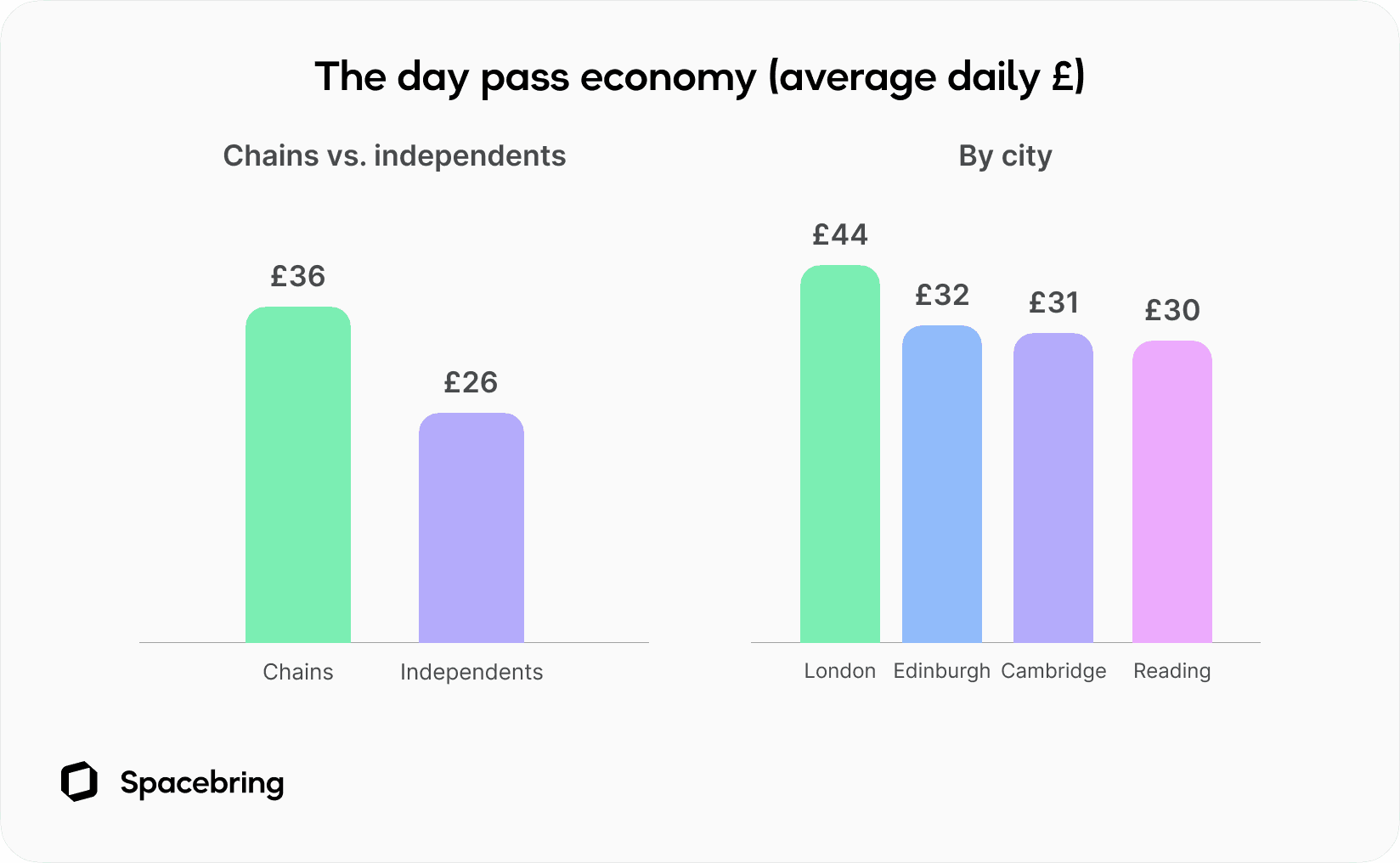
The data indicates three dominant positioning strategies yielding the highest returns:
1. The premium corporate hub
The flex market has shifted from a freelancer-first model to a core corporate real estate strategy, with enterprise teams now representing 35% of memberships. Operators like Cubo are capturing these enterprise teams and blue-chip organizations by mimicking the amenities of a high-end corporate headquarters.
For instance, enterprise-focused operators like Knotel continue to secure large-scale corporate footprints in London by delivering bespoke, managed solutions. These spaces feature extensive BREEAM-certified environmental controls, podcast studios, barista-led cafes, and executive boardrooms. The focus is entirely on seamless productivity, hospitality-grade service, and ESG compliance.
In fact, over 70% of businesses now explicitly prioritize BREEAM-certified or carbon-neutral workspaces when selecting a new location, making sustainability a primary revenue driver rather than a secondary marketing point.
2. The community and impact engine
Conversely, independent operators are thriving by leaning heavily into curation and social impact. The Melting Pot in Edinburgh successfully positions itself as a hub for charities, social enterprises, and community-driven work, commanding £200 to £300 per month by fostering a highly specific network.
At The Melting Pot, we've found that a community-led approach creates a stronger sense of belonging, collaboration and mutual support than a workspace alone can offer. Our members consistently tell us they value the relationships, shared learning opportunities and sense of purpose that come from being part of a diverse community of people working towards positive social change.Finlay ClarksonCommunity & Growth Manager at The Melting Pot

Similarly, mission-driven and niche spaces like Democracy House, Foundervine Spaces, and Facework Spaces are proving that highly specific positioning attracts fiercely loyal memberships. Work.Life continues to target SMEs with a relentless focus on community events, a welcoming, less corporate aesthetic, and transparent access rules.
Positioning ourselves around community and impact ensures that every founder who walks through our doors is connected to a network that genuinely understands their journey. Beyond flexible infrastructure, our members gain access to targeted mentorship, peer accountability, and tailored opportunities aligned with their values.Regina AntonyHead of Marketing at Foundervine Spaces

These spaces resolve the B2B paradox by offering curated market intelligence, client lead introductions, and exclusive networking that isolated remote workers cannot access at home.
3. The biophilic and wellness focus
Wellness is now a core business strategy. Operators are moving beyond simple natural light, utilizing dense indoor landscaping to manage acoustics naturally. Spaces like Uncommon in London and The Commons use sustainable materials, advanced air quality monitoring, and dedicated quiet zones to combat sensory overload and improve member retention.
This hyper-focus on lifestyle is also evident in specialized environments like Bodybox London and The Health & Performance Studio, which merge workspace with physical wellness to justify a premium price point.
What members value most is having a space that reflects the standard they’ve built their brand to — premium, considered, theirs. Aesthetics and wellness coworking works because it removes what was holding independent practitioners back and leaves only what moves them forward.Klavdiya ZorinaFounder and Director of Bodybox London

This invisible infrastructure is what justifies a premium price point in a saturated market. Private offices and focus pods are outpacing open-plan seating by a ratio of 3:1, as space design evolves toward purpose-driven, hospitality-first environments.
Operators must audit their own positioning. The spaces commanding the highest returns are those that sell an integrated lifestyle and a specific professional identity, not just a chair.
Market structure: chains vs. independents and the regional boom
While London remains the gravitational center of the UK flex market, the most aggressive growth trajectories and structural shifts are occurring outside the M25. The shift toward distributed hub-and-spoke real estate models by major corporations has flooded regional cities with enterprise capital. Professional services firms are actively piloting nearshore delivery teams outside London to control salary costs, which fundamentally enlarges the UK coworking space market beyond the capital.
Manchester, Birmingham, Bristol, and Edinburgh are no longer secondary markets; they are primary battlegrounds. Our dataset captures this density, with Manchester alone currently boasting over 118 flexible spaces, and Birmingham and Bristol following closely at 68 and 61 spaces respectively.
The data shows that major chains are aggressively acquiring footprint in these cities, fundamentally altering the competitive dynamics for independent operators.
Market data indicates a significant shift in flex leasing, moving away from legacy brands toward newer, high-end operators.
Cubo, for instance, accounted for roughly 33% of flex leasing deals in recent tracking, achieving record occupancy rates by rolling out standardized, premium locations across the Midlands, the North, and Scotland.
This regional resurgence is heavily corroborated by demand metrics from the Instant Group. Entering 2026, Belfast experienced an extraordinary 236% increase in flexible workspace demand, while emerging regional growth hubs like Chatham and Middlesbrough saw inquiries more than triple.
In parallel, independent operators are successfully capturing the suburban, coastal, and rural shifts. Workspaces such as Cowork & Country, Village in Farnham, Hinton Workspace in Sturminster Newton, GAS in Southend-on-Sea, and Propeller:Exmouth demonstrate that premium, localized flex space is thriving far beyond traditional metropolitan borders.
Tech and creative niches are also flourishing regionally, as seen with Wallasey's Focal Point Creative Technology Hub, Bacup's Alliance, and highly localized community hubs like Chapter, Studio 128, and Huddle in Lincoln.
However, operators in mature secondary cities must remain vigilant; the Instant Group notes that while Manchester remains the second-largest UK flex market, fierce competition for larger occupiers is putting downward pressure on localized rates as the industry rapidly expands outward from the central business district.
Looking macroscopically, the structural shift toward agility is permanent: research reveals that 60% of UK landlords expect over 30% of portfolios to offer flex products by 2030, with 80% of existing flex operators actively planning expansion.
For the complete findings, charts, and dataset, view or download the full report (PDF).
Conclusion: 4 strategic imperatives for 2026
The data is unequivocal: demand for flexible workspace in the UK is structural, deeply embedded in corporate real estate strategies, and projected for massive financial growth. However, capturing that demand requires a modernized approach to sales, operations, and product design. For UK space owners looking to maximize yield in 2026, the strategy relies on four core imperatives:
1. Eradicate booking friction by auditing the digital storefront immediately
If a prospective customer cannot purchase a day pass or book a meeting room with a credit card in under two minutes, revenue is actively being lost to competitors who have invested in e-commerce infrastructure. Transition away from inquiry-led flows toward coworking space management software.
2. Embrace absolute pricing transparency
The modern consumer is deeply suspicious of hidden fees and gated pricing. Publish rates clearly. If offering tiered private offices, provide realistic pricing bands rather than forcing a phone call. Transparency is a competitive advantage that builds immediate trust and accelerates the sales cycle.
3. Upgrade the amenities, not just the furniture
The basic desk is a heavily commoditized asset. Capital must be deployed into acoustic privacy, high-tier video conferencing infrastructure, biophilic design, and wellness-centric environmental controls. The physical space must be objectively superior to the member's home office to justify the commute.
4. Niche down to drive yield
The era of being everything to everyone is over. Identify the core demographic, whether it is enterprise satellite teams, creative freelancers, or local startups, and tailor the community events, operational rules, and physical layout entirely to their specific requirements. Depth of community and specificity of design drive higher retention rates and insulate against price wars.
The coworking space operators who thrive in the coming years will be those who seamlessly combine the highly curated hospitality of a boutique hotel with the frictionless digital experience of modern e-commerce.
Sources: market growth, size, and demand trends
- UK market valuation reaching £1.59B by 2030: https://www.nextmsc.com/report/uk-co-working-space-market
- UK & Ireland locations (4,550+ spaces) and regional distribution: https://www.coworkingcafe.com/blog/uk-ireland-coworking-report
- Demand size profile (66.8% demand for 1-2 desks) and regional growth hubs: sourced directly from the raw dataset collected by the Instant Group.
National & regional pricing medians
- The £250 national median, Oxford's £179.50 peak, and Liverpool's £130 value rate: sourced directly from the raw dataset collected by Spacebring.
- London private office averages (£680 per desk): sourced directly from the raw dataset collected by Spacebring.
Consumer protection & pricing transparency (DMCCA)
- CMA's new powers, "drip pricing" enforcement, and up to 10% global turnover fines: https://globallawexperts.com/drip-pricing-cma-uk
- UK Government official price transparency guidance: https://www.gov.uk/government/publications/price-transparency-cma209
- Further CMA transparency enforcement details: https://www.rpclegal.com/snapshots/consumer/winter-2025/cma-launches-first-dmcca-enforcement-cases-and-finalises-price-transparency-guidance
Digital booking friction & the "meeting room tax"
- Meeting room bottleneck statistics (29% unused, 6 mins lost to friction): https://www.coworkingcafe.com/blog/meeting-room-bottleneck-hidden-tax-hybrid-productivity
Operator-specific verified pricing (direct sources)
- Cubo (£175 regional, £275 London): https://cubowork.com/workspace/hot-desk
- Work.Life (From £30/mo, £35 day passes): https://work.life/coworking
- Elementa (formerly Landmark) (From £40/mo, gated private office pricing): https://www.elementaworkspace.com/product/coworking-spaces
- The Melting Pot (£200 unlimited hot desk, £300 fixed desk): https://www.themeltingpotedinburgh.org.uk/coworking/membership/
- Colony Manchester (£200-£240 floating desks): https://colonyco.work/hot-desking-manchester
- Square Works Bristol (£320 unlimited hot desk, £350 fixed desk): https://squareworksbristol.com/co-working-membership-bristol
- Tramshed Tech Cardiff (£165.83 full-time, £208.33 unlimited): https://www.tramshedtech.co.uk/memberships