

Leasing a space for coworking is exciting, until the “small details” start showing up. The HVAC can’t keep up once the place is full. The power isn’t where you need it. The landlord has strict rules about signage. The building’s layout makes your best floor plan impossible. Or worse: you’ve already signed, buildout is underway, and now you’re making expensive changes you didn’t budget for.
If you’ve ever thought, “We’ll figure it out as we go,” you’re not alone. But coworking is different from a standard office lease. You’re not just renting square footage, you’re leasing an operating platform. Your space has to support consistent comfort, reliable internet, smooth access, and flexible layouts day after day.
The good news: most surprises are preventable if you do a few smart checks before you sign. You don’t need to become an engineer or a legal expert. You just need a due diligence process that matches how coworking actually works.
Below is a practical, operator-focused guide you can use on your next deal.
1. Start with the lease: can you legally operate like a coworking space?
This sounds obvious, but it’s where many operators get stuck later. Some leases are written as if you’re a traditional single-tenant office. Coworking isn’t always treated the same way, especially if your model is membership-based.
Here’s what to confirm early:
- Permitted use: Does the lease clearly allow coworking, shared office, flexible workspace, or something similar?
- Hours: Are you allowed to operate evenings and weekends? Is 24/7 access permitted if that’s part of your model?
- Guests and visitors: Any limits on guest access, frequency, or check-in requirements?
- Events: Are meetups, workshops, or community events restricted?
- Signage: Are you allowed interior signage in common areas? Any exterior signage options?
Coworking operator tip: If the lease language is vague, ask for clarity in writing now—not later. It’s much harder to negotiate after you’ve committed emotionally (or financially).
2. Get the “rules of the building” before you design anything
Most coworking buildouts look great on paper. The problems show up when building rules quietly limit what you can do.
Ask for:
- Building rules and regulations
- Tenant improvement guidelines (the “work letter”)
- Construction rules (hours, noise, elevator usage, debris removal)
- Insurance requirements
- Any security/access procedures
You’re looking for things like:
- Restrictions on after-hours work
- Approval requirements for walls, doors, glass, or signage
- Limits on plumbing changes (kitchens, showers, additional sinks)
- Requirements to use certain vendors or building engineers
This isn’t just paperwork. These details affect timeline and cost.
3. Reality-check your “sellable seats” number
Coworking economics depend heavily on how many members your space can realistically support. A suite can look large but still be limited by code, egress, restrooms, mechanical capacity, or building policies.
Before you finalize your business model, ask:
- What is the occupant load for the space?
- Are there any egress limitations (number of exits, travel distance, stair access)?
- Are restrooms adequate for your planned capacity?
- Do building systems support peak occupancy?
You don’t want to design a layout for 140 members and later discover the building comfortably supports 90.
One simple way to sanity-check your numbers is to do a quick “pressure test” on how the space will actually be used. Open desks are one thing, but meeting rooms, phone booths, and event areas can spike occupancy quickly. If you plan to host workshops, community nights, or larger team meetings, ask how those temporary peaks affect your allowable capacity and building rules.
Also, confirm how the building handles shared-use areas. If you’re relying on lobby seating, outdoor patios, shared conference rooms, or common corridors as part of your member experience, you’ll want clarity on what is truly available to your business versus what is “sometimes allowed.” A coworking space can look amazing during a tour and still feel cramped once the space is operating at full speed.
Coworking operator tip: build a quick “seat math” sheet before you sign. List your target number of desks, offices, meeting rooms, and booths, then add your expected peak loads (events, tours, day passes). If the space only works when everything runs perfectly, it’s usually a sign you need a margin of safety.
4. HVAC: the most common “we didn’t expect this” problem
When coworking spaces feel uncomfortable, members notice fast. And HVAC upgrades are often expensive, slow, and disruptive.
What to ask:
- Is the HVAC zoned or controlled as one system?
- Are temperature setpoints controlled by the tenant or building management?
- Are there after-hours HVAC fees?
- Can the system handle high density (especially in meeting room clusters)?
Even if the HVAC worked fine for the previous tenant, your usage might be very different. A coworking space fills meeting rooms, shifts occupancy by hour, and packs more people into the same footprint.
Practical coworking operator tip: Tour the space at different times of day if possible. If it’s already occupied, ask nearby tenants about comfort issues.
5. Electrical capacity: don’t assume you can “just add outlets”
Coworking is more power-hungry than a typical office. Between monitors, laptops, phone booths, meeting room AV, access control, and kitchen appliances, the demand adds up quickly.
Ask:
- What’s the available panel capacity?
- Is there room for expansion in the electrical room?
- Are you allowed to add circuits freely, or does the building require approvals?
- Where are conduit paths and what are ceiling conditions?
Electrical upgrades can be straightforward, or they can become a major project depending on the building.
6. Internet and telecom: treat this like a dealbreaker category
For coworking, the internet is not a utility. It’s part of what customers pay for.
Confirm:
- Fiber availability (not just “internet available”)
- Provider options (multiple providers is better)
- Telecom entry point and routing path to your IT closet
- Whether redundancy is possible (secondary ISP)
If a building is limited to one provider or has poor routing options, it can create long-term operational headaches.
Coworking operator tip: plan your “network home base” early.
Before you sign, identify where your IT closet/rack would live and how cables would reach key areas (meeting rooms, phone booths, and any private office corridor). Some spaces make clean cabling easy; others force long runs, awkward pathways, or visible conduit that looks sloppy and becomes a support headache later. If you can, confirm the telecom entry point and ask how other tenants route service into their suites. Also think about redundancy: even if you don’t add a second ISP on day one, you’ll want to know it’s possible. In coworking, an outage isn’t just inconvenient, it can feel like your product is “down,” and it hits member trust fast.
7. Don’t trust drawings blindly—verify what you’re actually getting
Landlords may share floor plans or older as-built drawings. These are useful, but they’re not always accurate.
Common issues:
- Drawings reflect old layouts
- Measurements are inconsistent
- Renovations happened but drawings weren’t updated
- Utility locations aren’t documented clearly. That’s why a field-based verification mindset matters, not just a drawing review.
The surveyor’s “hidden” checklist (things that quietly break coworking layouts):
Floor plans and marketing drawings rarely show the full physical reality of a space. Site reviews often uncover constraints that look minor on paper but can seriously disrupt a coworking layout, reduce seat count, or trigger compliance upgrades.
Here are the hidden physical issues operators most often miss at first glance:
- Columns and structural bumps that aren’t obvious on plan but can ruin desk runs or shrink office sizes
- Ceiling conflicts like low soffits, large ducts, sprinkler mains, or bulkheads that limit where rooms and booths can go
- Small slab level changes or interior steps that create ADA path and layout problems
- Above-ceiling equipment that must stay accessible (VAV boxes, dampers, access panels) and can’t be boxed in
- Electrical and telecom entry locations that force long cable runs if your IT hub sits in the wrong spot
- HVAC and ventilation limits when coworking density exceeds the previous tenant’s load
- Restroom count and location versus your true occupancy target
- ADA paths from entry to suite to restrooms — tight doors, thresholds, and corridor turns
- Egress and travel-distance pinch points that quietly cap allowable occupancy
- Plumbing stack locations that block adding sinks, kitchens, or showers where you planned them
A quick real-world example:
A coworking layout once looked perfect on the plan, but a hidden column-and-soffit combination removed an entire row of offices after field verification — forcing a redesign before permits were submitted.
Before you finalize your layout or budget, verify key dimensions and physical constraints on site. A short field check early costs far less than a redesign after plans and permits are already moving.
8. Access, parking, deliveries, and trash: the unglamorous stuff that matters daily
Coworking operators deal with operations every day. If daily logistics are painful, the member experience suffers.
Check:
- Parking availability and rules (member parking vs tenant parking)
- Bike storage options
- Drop-off zones (rideshare matters more than it used to)
- Package delivery procedures (where do packages go?)
- Trash and recycling requirements (where does it go, who handles it, what’s allowed?)
This is also where you’ll uncover friction points with building management.
9. Zoning and compliance: avoid the “permit trap”
Permitting delays is one of the fastest ways to derail a coworking launch timeline. One of the biggest hidden risks is what many operators encounter as the “permit trap.” A space that looks like standard office use can be reviewed as higher-occupancy or partial assembly use because of your coworking layout.
On paper, you’re leasing office space. During review, however, high desk density, shared areas, larger meeting rooms, or event zones can shift how the space is classified. When that happens, new requirements may appear mid-design or mid-buildout, when changes are most expensive and timelines are tight.
Common triggers include:
- A large open area with lots of desks (high density)
- Bigger meeting rooms or training rooms
- An event space (even if it’s “only occasional”)
- A layout that increases the occupant load compared to the previous tenant
And here’s what the surprise requirements often look like:
- Egress/exits: You may need additional exit routes, wider corridors, or door changes.
- Restrooms: Your restroom count (and sometimes plumbing) may need upgrades based on the new occupant load.
- Fire/life safety: You might run into sprinkler, alarm, or signage updates tied to the new use/occupancy.
- Accessibility details: Small things can become big things—entry clearances, door hardware, restroom layouts, ramps, etc.
What to confirm before you sign (quick, practical checks):
- Is coworking allowed in this zoning district (or at least not restricted)?
- Will your test-fit trigger a change-of-use or higher-occupancy review?
- Does your planned capacity align with occupant load and exit realities?
- Are restroom and accessibility requirements clear upfront?
- Are any fire/life safety upgrades likely?
Coworking operator tip: If events are part of your model, set a simple cap early (example: “events capped at X people”) and design around that cap. It keeps plan review cleaner and helps avoid the dreaded “we didn’t know this counted as assembly” moment halfway through buildout.
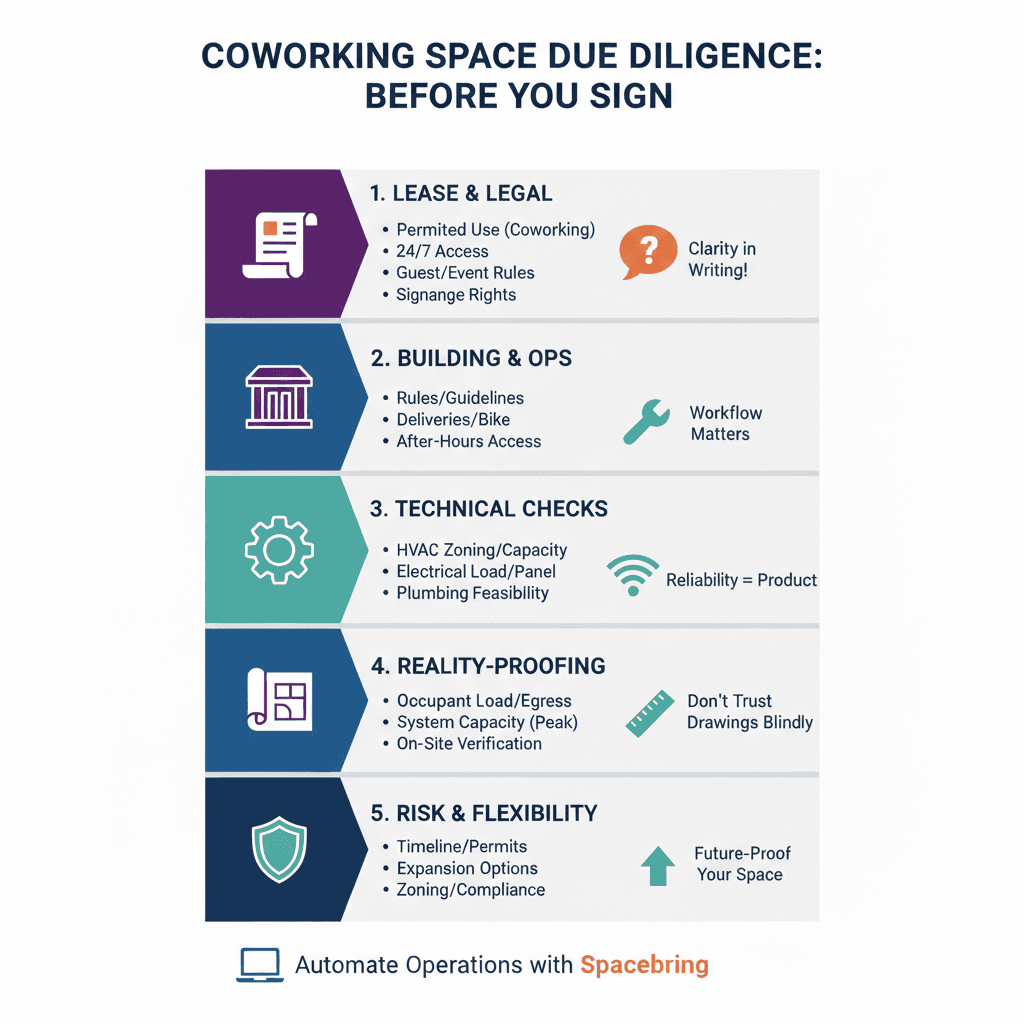
10. A simple “before you sign” checklist
Here’s a practical checklist you can copy into your internal process:
Lease & legal
- Permitted use supports coworking
- Hours and access align with your operating model
- Membership model isn’t restricted by “no subleasing” language
- Guests and events aren’t prohibited
- Signage options and approval process are clear
Building and operations
- Building rules and TI guidelines received
- Delivery and package process confirmed
- Trash/recycling process confirmed
- Parking and bike access reviewed
- After-hours access confirmed
Technical
- HVAC zoning and comfort expectations reviewed
- Electrical capacity confirmed for your planned layout
- Internet/fiber options confirmed (bonus if redundancy is possible)
- Plumbing feasibility confirmed (if adding kitchens/amenities)
- Drawings reviewed and key conditions verified on-site
Risk and Future Flexibility
- Buildout responsibilities are clearly documented
- Timeline constraints understood (permits, approvals, construction windows)
- Expansion or reconfiguration flexibility considered
Now that you’ve vetted your space, learn how to automate the operations with Spacebring.
The best coworking spaces aren’t just well-designed. They’re well-vetted before the lease is signed.
If you do these checks early, you’ll reduce surprises, protect your timeline, and avoid spending money on fixes that could have been prevented. Most importantly, you’ll lease a space that supports how coworking actually runs—high occupancy, high expectations, and constant change.